10000x Gold 2 Slot Review 2026 – RTP, Stack Xpand and Max Win

10000x Gold 2 at a Glance
10000x Gold 2 is a five reel, four row slot from the British studio 4ThePlayer. The game reached casinos on 26 February 2026 and reaches players through the Yggdrasil platform. It offers 1,024 ways to win, a headline return of 94 percent and a ceiling of 20,000 times the bet. Stakes start at 0.20 and stop at 20.00, with the studio setting 1.00 as the default spin.
4ThePlayer describes the volatility as extreme rather than merely high. That word choice matters. It warns you that the 26.14 percent hit rate produces mostly small returns, while the money that justifies the theme hides behind a single mechanic.
What is 10000x Gold 2 in one line
It is a multiplier engine wearing a gold and poker chip costume. Four X symbols on one reel merge into a single giant symbol carrying a multiplier, and multipliers on neighbouring reels multiply together rather than adding up.
The names you will see for this game
Three spellings circulate. The studio writes it as 10,000 X Gold 2, the largest slot database files it as 10000 Gold 2, and most operators list it as 10000x Gold 2. All three point to the same February 2026 release.
The Name Promises 10,000x and the Game Pays 20,000x
Here is the first oddity worth knowing. The game carries 10,000x in its title, yet the published ceiling is 20,000 times the bet. Every source agrees on that figure, including the studio, the distribution platform and the independent databases.
The original entry in the series makes the gap stranger still. That earlier title also carried 10,000x in its name while capping payouts at 7,500 times the bet. So the number in the family name has never matched either game.
Why the mismatch is worth flagging
Treat the title as branding, not as a specification. If you want to know what a slot can actually pay, read the game rules rather than the logo. In this case the real number happens to be generous, but the habit protects you elsewhere.
10000x Gold 2 Key Facts and Specifications
The table below pulls together the studio game sheet, the distribution platform data and the largest independent database. Where two sources report different values, both appear.
| Item | Detail |
|---|---|
| Provider | 4ThePlayer, distributed on the Yggdrasil platform |
| Release date | 26 February 2026 |
| Game type | Video slot, ways to win format |
| Grid | 5 reels, 4 rows |
| Ways to win | 1,024 |
| RTP | 94% headline, with a second certified build at 90.5% |
| Volatility | High in the databases, extreme in the studio wording |
| Hit frequency | 26.14% |
| Maximum win | 20,000x the bet |
| Minimum bet | 0.20 |
| Maximum bet | 20.00 |
| Default bet | 1.00 |
| Free spins trigger | 3 or more scatters |
| Buy feature | Free spins at 50x, a Double Xpand spin at 100x |
| Wild | Reels 2 to 5, substitutes everything except the scatter, no payout of its own |
| Accumulating prizes | Five tiers named Mini, Midi, Super, Mega and Ultra |
| Technology | JavaScript and HTML5 |
| Package size | 95.9 MB |
| Last recorded update | 15 May 2026 |
Two Certified RTP Builds, 94 Percent and 90.5 Percent
This is the most important section of the review. 10000x Gold 2 does not ship with one return figure. The studio certifies two builds, one at 94 percent and one at 90.5 percent, and the operator decides which version its players receive.
Independent trackers flag the game with an explicit RTP ranges warning for exactly this reason. The 94 percent you read in a review is therefore the best case rather than a guarantee.
What the 94 percent build costs you
A 94 percent return leaves a house edge of 6 percent. Most modern slots sit near 96 percent, which works out to a 4 percent edge. Put plainly, the better build here still costs you half again as much per spin as a typical release.
Consider a 1.00 stake over 1,000 spins. At 94 percent you expect to give back roughly 60.00. At 96 percent that expectation falls to about 40.00. The difference is real money, and it accumulates quietly.
What the 90.5 percent build does
The lower build turns a 6 percent edge into a 9.5 percent edge. That is not a rounding difference. Your expected cost per spin rises by roughly 58 percent compared with the 94 percent version of the same game.
Across those same 1,000 spins at 1.00, the expected loss climbs from about 60.00 to about 95.00. The reels look identical, the features behave identically, and the maths quietly takes half again as much.
How to check which build you are playing
Open the game information panel before you spin. The rules screen states the return for the build your casino has loaded. If the panel shows 90.5 percent, the honest move is to close the game and play somewhere else.
How the 1,024 Ways Grid Works
There are no paylines here. Instead the game pays whenever matching symbols appear on adjacent reels, counting from the leftmost reel inward. Any position on a reel counts, so the shape of the win does not matter.
Where the number 1,024 comes from
The arithmetic is clean. Four rows on each of five reels gives four to the power of five, and four to the power of five is exactly 1,024. The advertised figure is therefore a straight description of the grid rather than a marketing flourish.
One consequence follows immediately. Because every position counts, a single spin can produce many overlapping wins, and that is why the individual symbol payouts had to be set very low.
Stack Xpand Is the Engine of the Whole Game
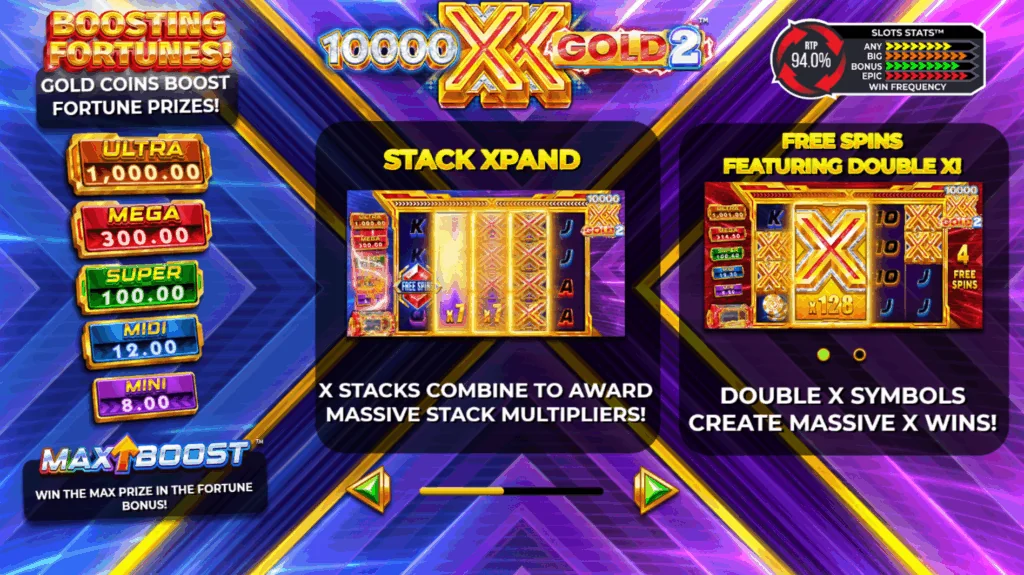
Stack Xpand triggers when four X symbols fill a single reel. Those four symbols merge into one oversized X that carries a random multiplier. In the base game that multiplier lands somewhere between five and ten times.
Free spins raise the range. There the reels can deliver Double X symbols, which count as two symbols each, and a completed stack carries a multiplier between ten and twenty times.
Multipliers multiply, they do not add
This rule is where the ceiling comes from. When stacks appear on neighbouring reels, their multipliers combine by multiplication. A stack at ten times beside a stack at five times produces fifty times, not fifteen.
Compounding of that kind escalates fast. Two average stacks already outrun anything the base symbols could pay on their own, which tells you where the design wants your attention.
| Situation | Trigger | Multiplier |
|---|---|---|
| Base game stack | Four X symbols fill one reel | x5 to x10 |
| Free spins stack | Four symbols, with Double X counting as two | x10 to x20 |
| Expanding wild in free spins | A wild fills its reel | x6 to x12 |
| Two or more adjacent stacks | Stacks on neighbouring reels | Values multiply together |
| Observed on screen | Reel captures of live play | x49 and x50 both recorded |
Boosting Fortunes and the Five Prizes That Start at Zero
A column of five prize meters sits beside the reels. The tiers carry the names Mini, Midi, Super, Mega and Ultra. Each one holds a cash value that grows as you play.
How the prizes fill
Gold Coin symbols can land on top of any standard symbol. Every coin adds between 0.05 and 0.50 times your bet to one of the five meters. Wilds do the same job during free spins, so the meters climb faster inside the bonus.
Once enough coins have landed, the Fortune Bonus can trigger. You then pick items on a grid until three matching tokens appear, and the tier those tokens represent pays out. Afterwards that prize resets to zero and starts filling again.
Why calling these fixed jackpots is misleading
One database tags the game with a fixed jackpots feature. The reel captures tell a different story. Every meter reads 0.00 on a fresh session, then climbs coin by coin, which is the behaviour of an accumulating pot rather than a fixed prize.
The distinction matters for planning. A fixed jackpot pays the same whenever it lands, so timing is irrelevant. An accumulating pot pays more the longer it has been fed, which means a freshly reset meter is worth less than a full one.
Free Spins and What Changes Inside Them
Three or more scatters open the bonus, and additional scatters add extra spins on top. The round plays at the stake that triggered it, so you cannot lower your bet to stretch the feature out.
Three upgrades arrive at once. Double X symbols enter the reel set and count as two symbols each, completed stacks jump to the ten to twenty times band, and wilds expand across their whole reel while carrying a six to twelve times multiplier.
Expanding wilds also feed the meter above their reel, so the Fortune prizes climb during the bonus as well. Further scatters inside the round grant retriggers, which is how the longer sessions happen.
The Paytable Looks Broken Until You Do the Arithmetic
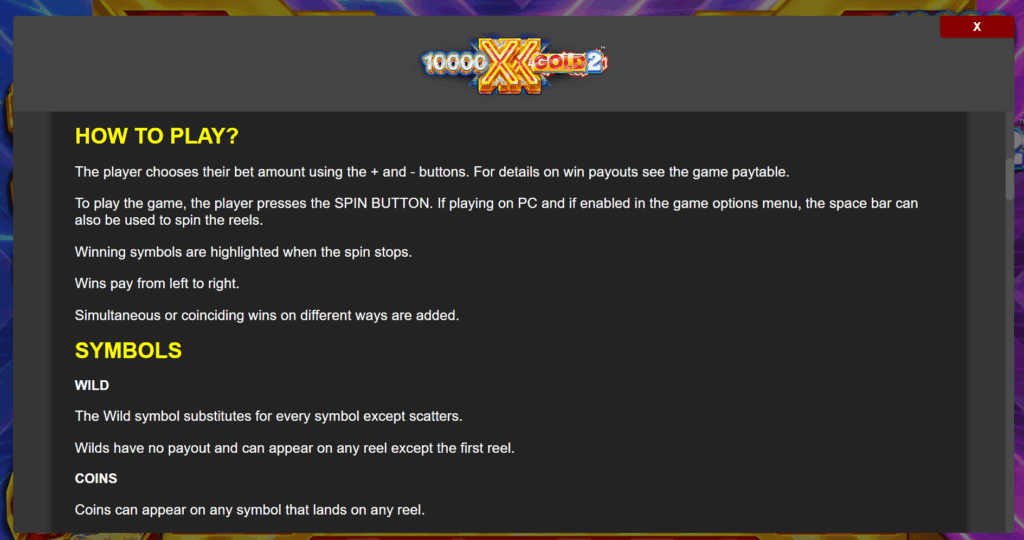
Read the symbol values cold and they seem absurd. Five matching high symbols pay between 0.20 and 0.25 times the bet. Five matching card symbols pay 0.15 times. Numbers that small look like a misprint.
They are not. With 1,024 ways paying at once and multipliers that compound, the designers had to shrink the base values or the game would pay far too much. Every meaningful win here is a small base amount multiplied by something large.
| Symbol group | Members | Five of a kind |
|---|---|---|
| High value | Golden X, poker chips, dice, golden dollar sign, gold bars, golden bell | 0.20x to 0.25x the bet |
| Low value | A, K, Q, J and 10 | 0.15x the bet |
| Wild | Star wild on reels 2 to 5 | No payout, substitutes all but the scatter |
| Scatter | Free Spins diamond | 3 or more open the bonus, extras add spins |
| Coin | Gold Coin over any standard symbol | Adds 0.05x to 0.50x to a Fortune meter |
A worked example straight off the reels
One capture shows a merged X carrying a fifty times multiplier, with the win counter reading 10.00 at the default 1.00 stake. Check the maths: a 0.20 times base win multiplied by fifty gives exactly ten times the bet.
That single frame validates the whole paytable. The tiny symbol values are genuine, and the multiplier does all the heavy lifting.
Where the 20,000x ceiling actually comes from
Push the mechanic to its limit and the cap makes sense. Five base game stacks at ten times each multiply out to 100,000 times, and 100,000 multiplied by a 0.25 times top symbol gives 25,000 times the bet.
That sits just above the published 20,000x cap, so the ceiling genuinely binds. Inside free spins the theoretical figure runs far higher still, which confirms the cap rather than the maths sets the limit. Treat this calculation as illustrative arithmetic from the published values, not as a studio claim.
The Buy Feature and What It Really Costs
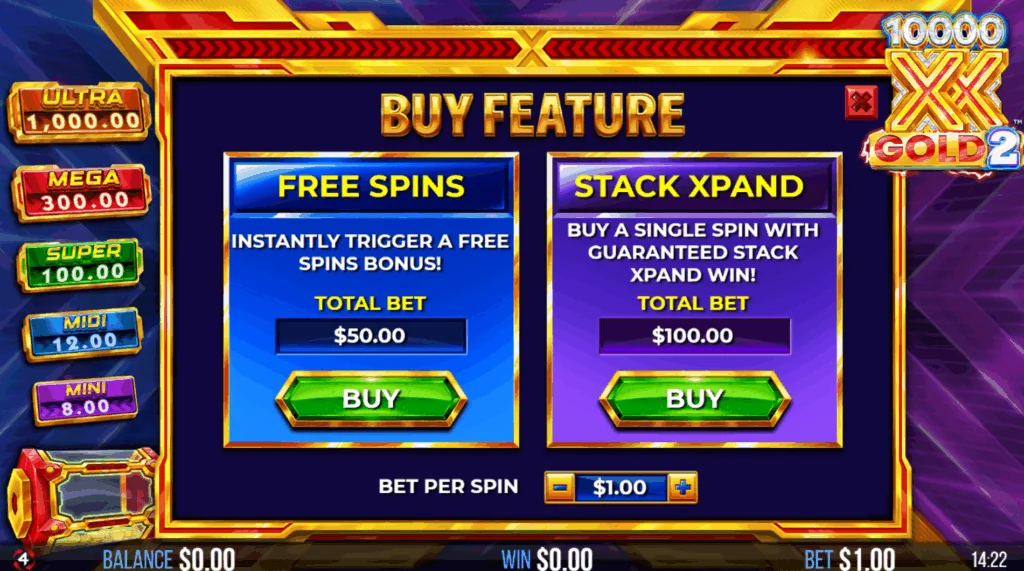
Two purchases sit in the menu. Fifty times your bet buys the free spins round outright. One hundred times buys a single Double Xpand spin with guaranteed features attached.
4ThePlayer states that purchased features run at the same 94 percent return as normal play. That transparency deserves credit, because plenty of studios stay quiet on the point.
The arithmetic behind a purchase
Apply the stated return to the price and the picture clarifies. A fifty times purchase carries an expected return of forty seven times, so each buy costs you about three times your bet on average. The hundred times spin expects ninety four times back, an average cost of six times.
Buying features therefore does not improve your odds. It concentrates the same edge into fewer, larger transactions, which shortens the time you spend playing and widens the swings.
Volatility, Hit Rate and the Shape of a Session
A 26.14 percent hit frequency means roughly one spin in four returns something. For a game the studio labels extreme, that is a friendly number, and it keeps the reels from feeling dead.
The catch hides in the size of those returns. If about a quarter of spins pay and the whole game gives back 94 percent, the average paid win works out near 3.6 times the bet. Rare enormous hits drag that average upward, so the typical win you actually see is far smaller.
What this feels like in practice
Expect long stretches of small returns that do not cover their own cost, punctuated by the occasional stack that pays properly. Bankroll accordingly, and treat the 20,000x figure as a lottery ticket rather than a target.
What the Reel Captures Confirm
Published captures of the game running let me verify several claims independently rather than trusting the databases alone.
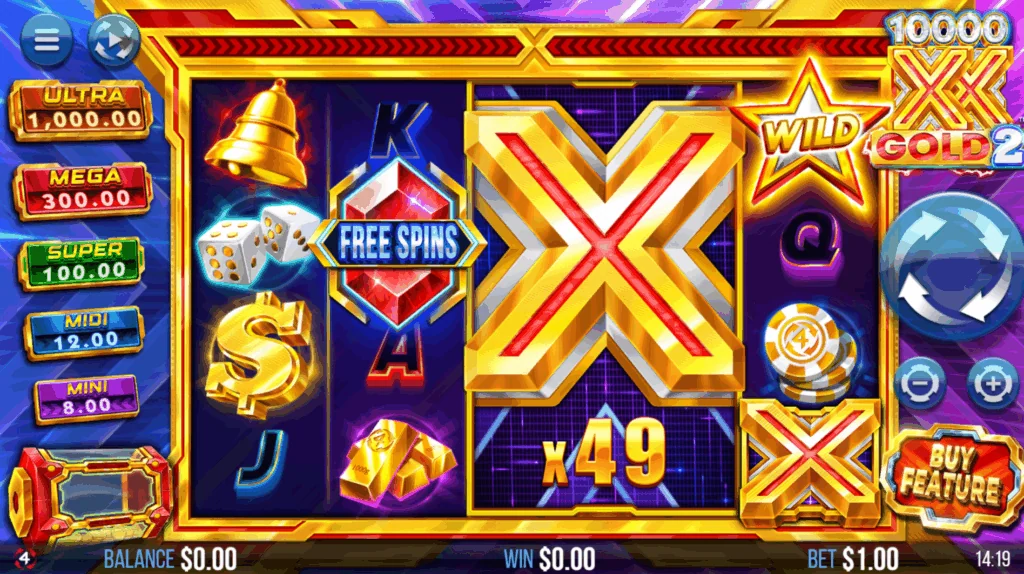
The grid reads five columns by four rows, matching the stated layout. The prize column shows five tiers ending in the letters that spell Mini, Midi, Super, Mega and Ultra, and each one reads 0.00 in a fresh session. Symbols on screen match the published list, including the golden bell, dice, dollar sign, gold bars and the card ranks.
Two multiplier readings settle the compounding question. One frame shows forty nine times and another shows fifty times. Neither value fits inside a single stack range of five to ten, and forty nine is seven multiplied by seven. Multiplication across stacks is therefore confirmed on screen rather than merely described in the rules.
The captures also show the scatter rendered as a Free Spins diamond, a star wild, and balances denominated in pounds. Nothing on screen contradicted the published specification.
Where the Sources Disagree
Four disagreements are worth recording, because reviews that hide them are less useful than reviews that name them.
First, volatility. Databases label the game high, while the studio calls it extreme. Second, the prize structure. One database says fixed jackpots, yet the meters plainly accumulate from zero.
Third, the return figure. Reputable sources list 94 percent alongside 90.5 percent, while several affiliate pages quote 96 percent or 96.5 percent. Those higher numbers match no certified build and should be ignored.
Fourth, availability. A scan of twenty leading casinos in one major market found the game at none of them, even though the studio has fifteen partner casinos listed for its other titles. Distribution looks thin for now.
Who Should Play 10000x Gold 2
Consider it if
You enjoy multiplier hunting and you accept that the base game is a waiting room. You also want a published ceiling worth chasing, and you have checked that your casino runs the 94 percent build.
Skip it if
You care about return above all else, because 94 percent is below par and 90.5 percent is poor. Skip it too if you want art worth looking at, since reviewers agree the visual work falls short of the premium theme it advertises.
For context on how this sits against its neighbours, our Towering Pays Valhalla review covers another release that ships with more than one certified RTP, 3 Majestic Drums is a second multi-RTP release, and 3 Pigs of Olympus 2: Rise of the DemiHog is one more game with an RTP range.