
Dice Game Demo by Spribe: Honest Review, RTP & Strategy

Game Overview and Basic Information
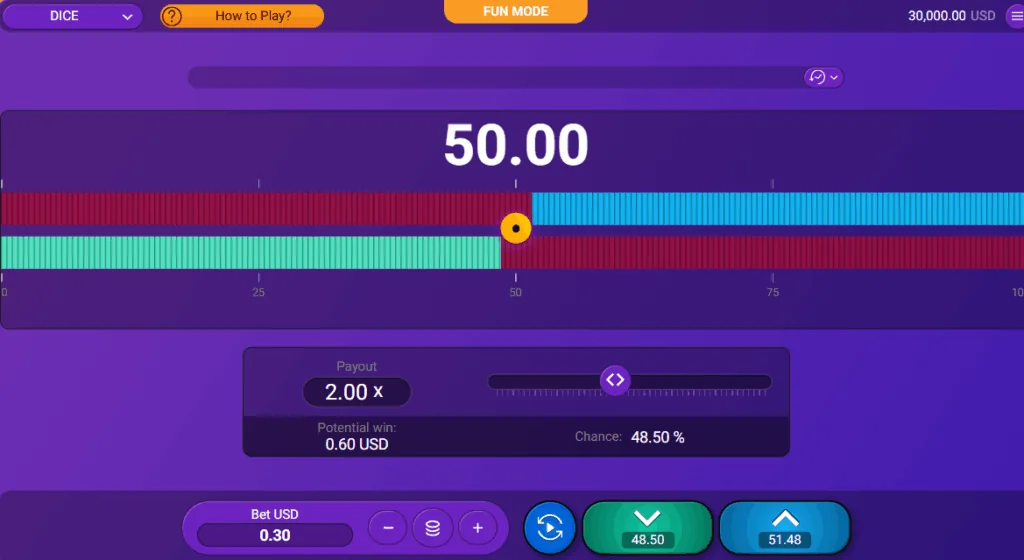
What is Dice? It is a provably fair dice game from Spribe, and it belongs to the instant-win category rather than the reel category. This is not a slot and it is not really a dice game in the traditional sense either. One number between 0.000 and 99.999 is generated per round, and you decide in advance whether it will land above or below a threshold you choose.
The Dice game is built around one control: a slider that sets the win condition. Move it one way and you win most rounds for a tiny premium; move it the other and you win rarely for a large one. There is no grid and there are no reels, so the table below describes the number range instead. Spribe states that outcomes range from 0.000 to 99.999.
Spribe lists the RTP at 97.00%, does not publish a volatility rating, and bet limits are set by the operator.
There are no reels and no scatter chains: the payout grows as the win chance shrinks, and Spribe does not state a fixed maximum multiplier on its game page.
Easy, Fast, Comfortable
The slider dominates the screen with the Roll Over and Roll Under buttons beneath it, and the current win chance and payout multiplier update live as you drag. There is nothing else to read.
A free Dice demo is available, and this is one of the real advantages of the format over a live table. The outcome comes from a provably fair generator rather than physical equipment. So Dice free play runs in the browser on practice credits with no registration and no download. It uses exactly the same maths and the same 97.00% return as the real-money build.
Bet limits depend on the operator, so check them in the game. Autoplay repeats the same threshold for a set number of rounds with optional stop conditions. This makes it easy to run a strategy and equally easy to run through a balance quickly.
Rounds resolve instantly with no animation to wait through, so this is one of the fastest games in the category and pace is limited only by how quickly you click.
How to Play Dice
Rules and Bet Types
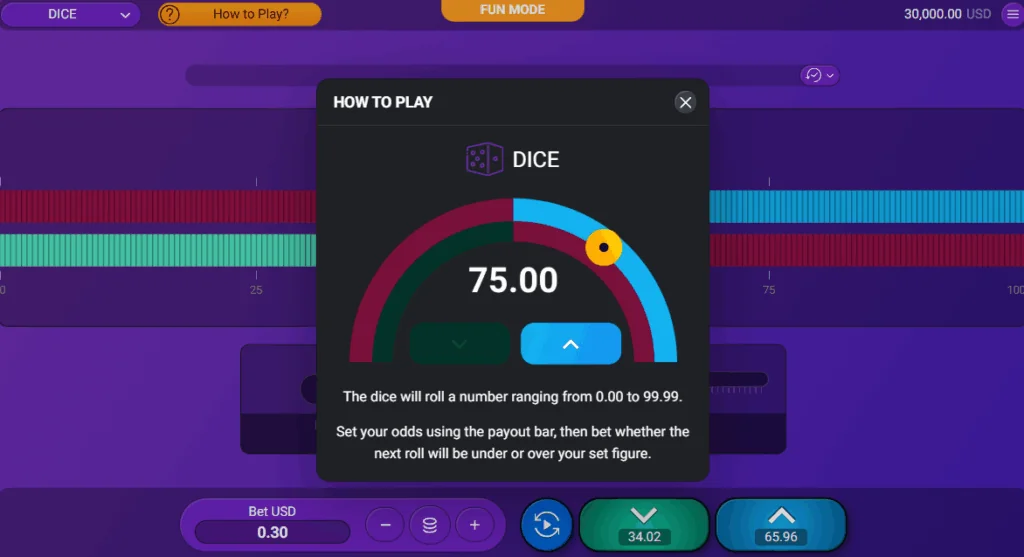
Set a threshold with the slider, choose Roll Over or Roll Under, then roll. If the generated number satisfies your condition you are paid the multiplier that was displayed when you committed.
Nothing is hidden: the win chance and the exact payout are both shown before the roll, and they are mathematically linked so that every setting returns the same theoretical 97.00%. There are no streaks, memory or hot numbers.
Setting Your Own Risk Profile
Choosing 80 with Roll Under gives an 80% win chance and a payout near 1.2x. Choosing 2 with Roll Under gives a 2% win chance and a payout in the high double figures.
It also means the game cannot be beaten by adjusting the slider, because the house margin is applied identically at every setting.
There is no cash-out decision at all, the round is settled the instant you roll, so unlike a crash game there is nothing to get wrong after committing.
Game Design
Theme and Visuals
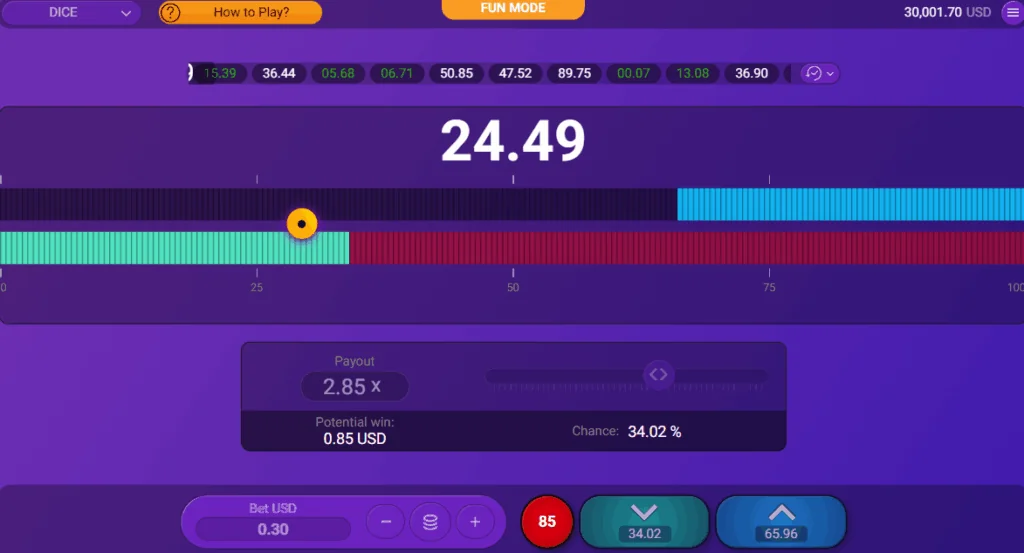
There is no theme in any meaningful sense: the presentation is a slider, two buttons and a number readout, styled as a crypto-native betting interface rather than a casino game.
The visual language is minimal and dark, closer to a trading screen than to a slot. That is a deliberate choice for the audience this game targets, but it offers nothing to look at.
The Dice symbols are functional rather than decorative, there are no symbols, the generated number and the threshold you set are the only things on screen that carry meaning.
Sound and Gameplay Experience
Audio is a single click for the roll and a short tone for a win, with no music, so long sessions do not become fatiguing.
The absence of celebratory audio also removes the reinforcement loop that louder games rely on, which is arguably a point in its favour.
Payouts, RTP and Volatility
Payout Structure and Multipliers
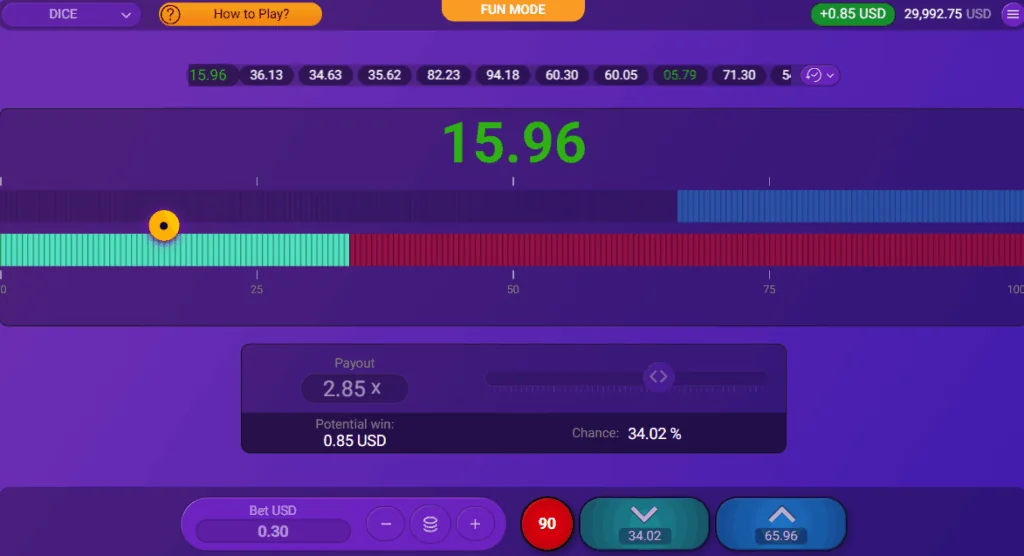
There is no payout table in the conventional sense. The multiplier is calculated from your chosen win probability, with the house margin applied, and it is displayed before every roll.
The practical range runs from just above 1x at the safest settings to very high multipliers at the most extreme. Every point in between is available rather than being limited to preset tiers.
The Dice feature list is short by design: an adjustable threshold, Roll Over and Roll Under modes, autoplay with stop conditions, and provably fair verification. There are no bonus rounds of any kind.
RTP and House Edge
The Dice RTP is 97.00%, which implies a house edge of 3.00%. Spribe states 97.00% on its own site, and the figure applies at every slider setting.
A hundred rounds can finish well above or well below it, and the undeclared volatility profile makes that spread wider rather than narrower.
Check the Dice RTP inside the operator’s own game info panel before playing for real money. Some studios license more than one return configuration, and the version an operator deploys is the one that applies.
Max Win and Volatility
Spribe does not publish a fixed maximum win for Dice; the payout depends on the win chance you choose. At the comfortable end of the slider the payout sits near 1.2x, which is the same game with the same 97.00% return arranged into a completely different shape.
Dice volatility is undeclared, and variance is entirely in your hands here, which is why no fixed volatility rating is published for the game. The practical reading is that the bankroll needs to survive a run of losing rounds long enough for the format’s maths to show up at all.
Dice Strategy
No slider position beats another on expectation, so the useful question is what you want a session to look like. Safe settings give long sessions with shallow swings; extreme settings give short sessions with a small chance of a large result.
Martingale-style progressions are especially tempting on this game because the safe settings win so often. They do not change the margin, and the operator’s bet ceiling means a losing run can hit the table limit before the progression recovers.
Fairness and Randomness
Dice runs on Spribe’s provably fair system. The result of each roll comes from a hashed seed pair that you can verify after the round rather than taking the outcome on trust.
For a game whose entire appeal is the honesty of a single number, that verification matters more than it would elsewhere.
None of this changes the odds in the player’s favour; it only means the odds are verifiable. The provably fair layer makes the published 97.00% return auditable rather than something taken on trust.
Mobile Device Compatibility
The slider is the easiest possible control to use on a touchscreen, and the whole interface fits a portrait phone screen with room to spare.
The only mobile drawback is precision: dragging to an exact threshold is fiddly on a small screen, though the value can also be typed directly.
Advantages and Disadvantages
Advantages
97.00% return at every slider setting.
Win chance shown before each roll. Nothing about the odds is hidden or discovered after the fact.
Risk level fully player-controlled. Combined with Roll Over or Roll Under, that keeps the cost of a session predictable instead of spiky.
Provably fair verification per roll. The same is true of instant rounds with no animation.
Limitations
No theme, symbols or bonus content. The interface is a slider and two buttons, and that is the entire game.
Top payouts need tiny win chances. The advertised ceiling is unreachable at any sensible risk level.
Fast rounds encourage overspending. Instant settlement means a bankroll can move very quickly.
Operator bet limits cap progressions. It is also fair to note nothing to learn after one session.
Conclusion
Dice is a provably fair dice game that does one thing and does it cleanly. The 97.00% return published by Spribe is competitive for the category, and the adjustable win chance gives every round a clear risk level.
More Spribe games on BetFM are covered in our Plinko and Aviator reviews.
Dice is a simple, transparent game and makes no attempt to be anything else. The 97.00% return is published by Spribe, and the win chance and payout are shown before every roll. Provably fair verification means you never have to take a result on trust. The cost of that honesty is that there is nothing to discover. There is no bonus content, no theme and no reason to keep playing once the novelty of the slider wears off.
The honest summary: this is not a substitute for a feature-rich slot, and the undeclared volatility means losing runs are part of the design.
For a second opinion on this style of game, compare Dice with Plinko and Goal, two Spribe releases we have reviewed in the same format.