Eye Of Spartacus Slot Demo — Honest Review, RTP & Volatility
Game Overview and Basic Information
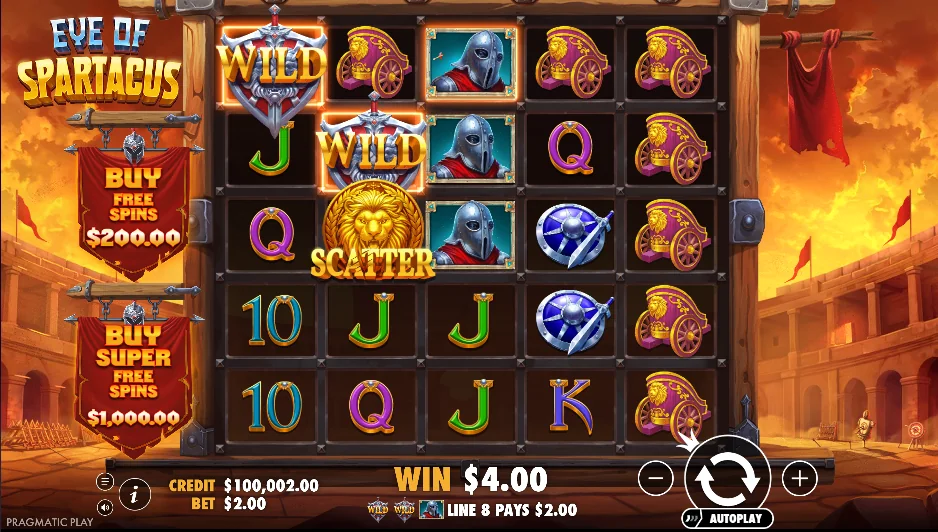
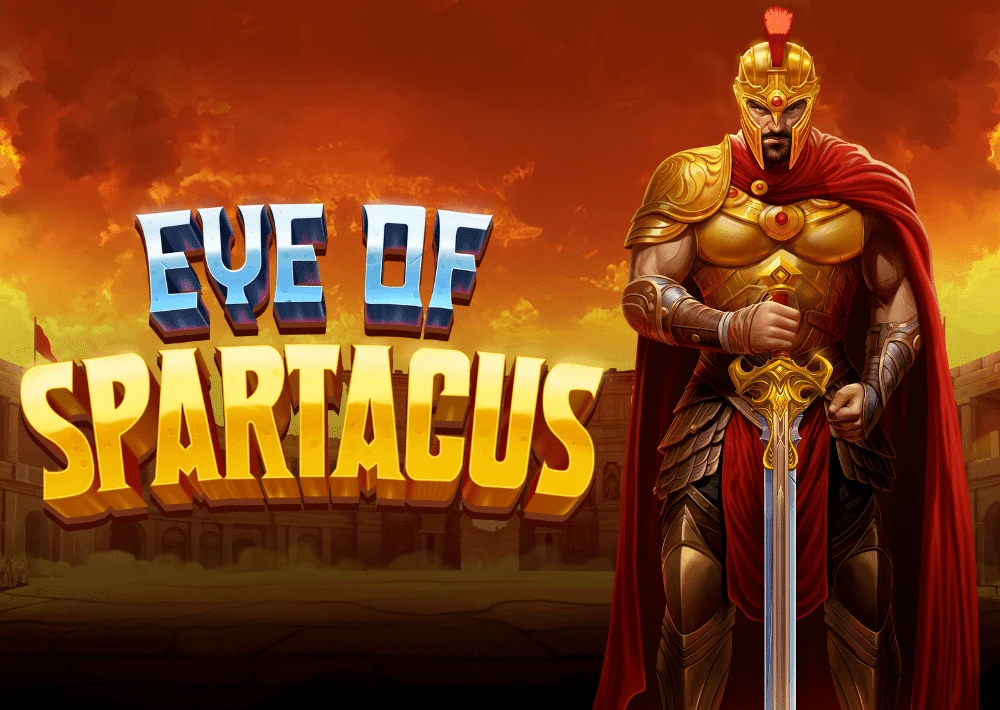
Eye Of Spartacus is a gladiatorial-themed video slot built around the mythology and combat culture of ancient Rome. The game positions itself within a specific niche – not the broad “Roman empire” aesthetic that dozens of titles share, but a focused lens on the gladiator as a figure of calculated violence and earned survival. That distinction shapes every mechanical decision in the game.
The slot runs on a standard 5-reel, 3-row grid with a fixed number of paylines. Bets scale across a range accessible to casual players and mid-stakes regulars alike, without the extreme floor-to-ceiling spread that some high-volatility titles use to push players toward risk. The math model is the more relevant starting point: Eye Of Spartacus carries an RTP in the range of 95-96%, which sits comfortably within the competitive bracket for modern video slots – not exceptional, but not a warning sign either.
Volatility is classified as medium-to-high. This means win frequency is deliberately suppressed in favor of weight – sessions can run dry for extended stretches before the mechanics trigger meaningful returns. The max win potential reflects this calibration, reaching multipliers that justify the variance without entering the inflated territory of 50,000x titles that trade realism for marketing copy.
The game was developed with HTML5 architecture, which governs its compatibility and rendering consistency across platforms. Its core loop combines base-game symbol interactions with a layered bonus structure – each component serving a distinct function rather than stacking redundantly.
Easy, Fast, Comfortable
The control layout in Eye Of Spartacus follows a logic that experienced slot players will navigate without friction, and newcomers won’t need to excavate through nested menus to find basic functions. Spin, autoplay, bet adjustment, and paytable access are surfaced at the primary level – nothing is buried three clicks deep.
Autoplay configuration is more granular than average. Loss limits, single-win caps, and session stop conditions are configurable independently, which matters for players who use autoplay as a bankroll management tool rather than a passive mode. This level of control isn’t universal across the category.
Load times are efficient. The game doesn’t run a heavy pre-load sequence, and initial asset delivery is fast enough that the gap between clicking launch and the first spin is negligible. Demo mode – which allows full gameplay without account registration or deposit – loads through the same pipeline with identical performance characteristics.
Free play access is available directly through the demo version, making it a practical entry point for anyone evaluating the volatility profile before committing real funds. The demo preserves all feature mechanics, including bonus round triggers, so the assessment is accurate rather than truncated.
Game Design
Theme and Graphics
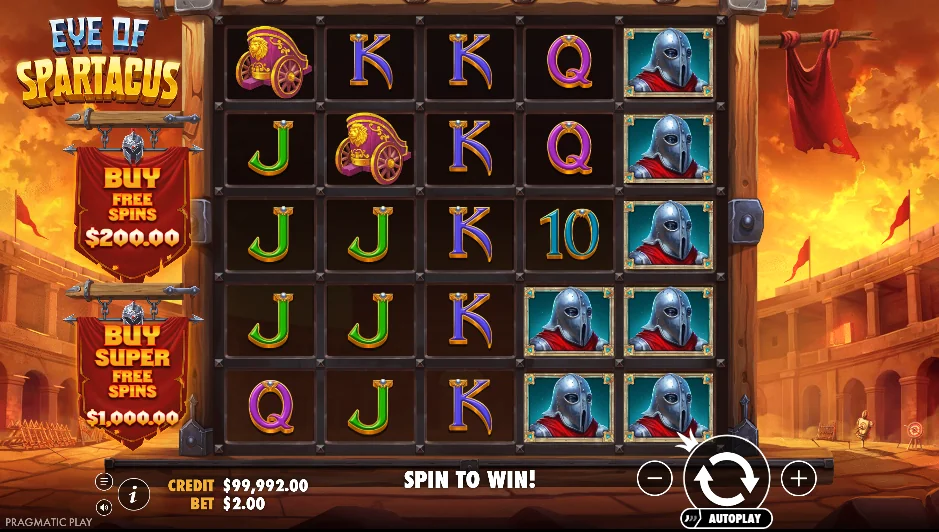
The visual language of Eye Of Spartacus draws from a specific register of Roman gladiatorial iconography – arena stone, iron weaponry, firelight – without dissolving into the generic sandstone-and-laurel palette that characterizes the weakest entries in this theme. The art direction makes deliberate choices: high-contrast shadow work, a muted but saturated color grading, and symbol designs that carry visual weight rather than acting as flat iconographic placeholders.
The background is rendered in layered depth – the arena bleachers occupy a middle distance while atmospheric elements push the spatial impression further. It’s not cinematic in the way a big-budget studio production might achieve, but it’s cohesive. The design doesn’t fight itself, which is more than can be said for many themed slots where UI chrome and thematic assets clash tonally.
Symbol artwork is consistent with the overall visual register – each icon feels like it belongs to the same design system. High-value symbols carry more rendering complexity than low-value card-rank fillers, creating a visual hierarchy that reinforces the pay structure intuitively.
Sounds and Gameplay Experience
The audio design operates in two distinct modes: ambient and active. During base play, a low orchestral texture runs underneath – strings and percussion at a register that maintains tension without becoming fatiguing over extended sessions. When significant events trigger, the audio shifts register sharply, using percussive hits and brass swells to mark the moment without the cartoonish exaggeration that undercuts immersion in cheaper productions.
Reel mechanics have tactile audio feedback – the stop sequence carries weight, which subtly reinforces engagement during the spin cycle. This is a small detail that separates audio-conscious production from titles that treat sound as a checkbox. The overall gameplay rhythm has a pacing that doesn’t feel artificially accelerated or padded – spin resolution lands at a tempo that keeps sessions fluid.
Bonuses and Symbols

Symbols in the Game
The symbol set divides into two functional tiers. The lower tier consists of styled card-rank symbols – adapted visually to fit the Roman aesthetic rather than appearing as generic playing card imports. These fill the reel frequency required for base-game payout balance without carrying significant individual value.
The upper tier consists of thematic symbols directly tied to the gladiatorial subject matter: helmets, shields, swords, and arena-specific iconography that references the Spartacus narrative. These symbols carry the bulk of the paytable value and interact with the game’s bonus mechanics in ways the lower-tier symbols do not.
The wild symbol functions as a standard substitution unit – replacing all symbols except scatters – but its behavior shifts in certain triggered states, where it gains additional properties beyond simple substitution. The scatter symbol’s role is specifically confined to triggering the free spins sequence; it carries no independent payout value outside that function.
Bonus Rounds and Free Spins
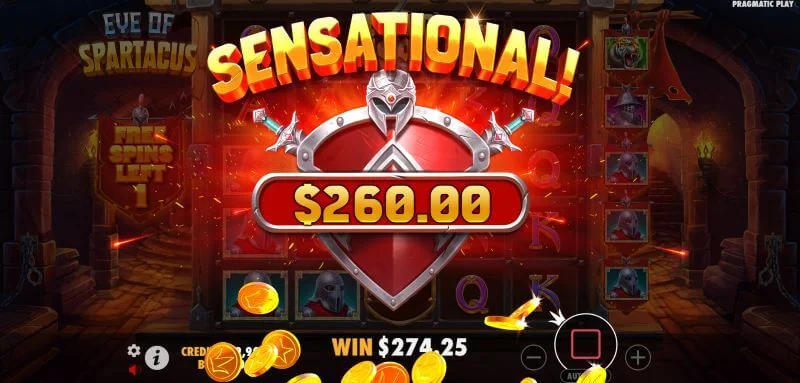
The primary bonus structure centers on a free spins round triggered by scatter symbol accumulation across the reels. The trigger threshold follows standard conventions, but what happens inside the bonus round diverges from baseline free spins mechanics. Wild behavior is modified during the active bonus – wilds that land during the free spins sequence carry a multiplier component, which compounds across the round rather than resetting per spin.
This compounding structure is where Eye Of Spartacus concentrates its max win potential. The multiplier ceiling within the bonus round is the single largest variable in the game’s outcome distribution. Sessions that trigger the bonus but don’t accumulate multiplier progression will produce modest results; sessions where multiplier stacking runs deep produce the payouts that define the game’s upper range.
Retrigger mechanics exist within the bonus round – additional scatter appearances during free spins extend the round rather than launching a nested sequence. This keeps the bonus structure linear rather than recursive, which suits the game’s pacing.
Paytable and Winning Combinations
Payouts scale steeply between the lower and upper symbol tiers. Three-of-a-kind combinations on lower-tier symbols return fractions of the bet – functionally, these exist to maintain hit frequency in the base game rather than generate meaningful value. The payout curve accelerates sharply at the upper symbol tier, particularly for five-of-a-kind combinations on the two highest-value symbols.
The wild substitution mechanics mean that effective five-of-a-kind combinations occur more frequently than raw symbol probability suggests – wilds filling two or three positions in a high-value combination represent a significant share of notable base-game wins. Payline structure means combinations must run left-to-right from the leftmost reel; no both-ways pay mechanic operates here.
Jackpot
Eye Of Spartacus does not operate a progressive jackpot. The maximum win is a fixed multiplier ceiling rather than a pool that accumulates across player activity. This is a deliberate math model choice – the absence of a progressive element means the game’s RTP is stable and not dependent on jackpot contribution calculations that can distort the actual return for players who never hit the top prize.
The fixed max win figure is achievable through the bonus round’s multiplier stacking mechanic during an optimal free spins sequence. It represents a genuinely attainable ceiling rather than a theoretical figure constructed from infinitesimally probable symbol alignments across a multi-stage jackpot system.
Mobile Device Compatibility
The HTML5 build ensures Eye Of Spartacus renders without a dedicated app installation – browser-based access on mobile delivers the complete feature set. Scaling adapts to both portrait and landscape orientations, though landscape preserves more of the visual composition and is the preferable orientation for extended play.
Touch input is integrated properly – reel spin, bet adjustment, and autoplay configuration all respond to tap and swipe inputs without precision demands that would make mobile play frustrating. The UI elements resize in a way that keeps interactive targets accessible on smaller screens without crowding the visual field.
Performance on mid-range mobile hardware is stable. The game doesn’t carry animation complexity that degrades frame rate on devices outside the premium tier, and battery consumption during normal session lengths is within expected parameters for HTML5 slot titles of this production level.
Advantages and Disadvantages
Advantages
The multiplier compounding mechanic within the free spins round gives the bonus sequence genuine strategic depth – the outcome isn’t purely a function of symbol frequency but of how the multiplier progression develops across the round. This creates sessions with distinct internal momentum rather than flat statistical uniformity.
The RTP sits at a competitive level without the distortion that progressive jackpot contributions create in other titles. What the stated return figure represents here is consistent with actual session experience across a sufficient sample.
Demo mode is fully featured – the decision to include all mechanics in free play, rather than a stripped version, means players can develop a realistic volatility profile before any financial exposure. This is a practical advantage for bankroll planning.
The audio and visual design maintain internal consistency, which reduces cognitive friction during extended play. The theme is specific enough to have identity without being so niche that it alienates players who aren’t specifically seeking Roman-themed content.
Limitations
Medium-to-high volatility with a compounding multiplier structure means the gap between an average bonus round and an exceptional one is wide. Players who trigger the free spins repeatedly without hitting meaningful multiplier progression will experience sessions that feel disconnected from the game’s stated potential – this is a mathematical reality of the model, not a perception problem.
The absence of a secondary bonus mechanic means the game’s entire variance weight sits on one trigger event. There’s no pick-em feature, no alternate path to significant wins, no base-game mechanic that can independently generate high-multiplier outcomes. For players who prefer bonus variety, the single-track structure is a genuine limitation.
Lower-tier symbol payouts are minimal enough that base-game sessions without bonus triggers produce slow bankroll erosion rather than genuine back-and-forth. The game isn’t designed for flat base-game profitability – it’s structured entirely around bonus round performance, which means session outcomes are heavily skewed by trigger frequency.
Conclusion
Eye Of Spartacus is a slot built around a single concentrated bet – that the compounding multiplier within its free spins round will deliver enough ceiling to justify the patience required to reach it. The math model supports this structure: the RTP is honest, the volatility is accurately represented by the mechanics, and the max win is achievable through a defined path rather than theoretical mathematics.
The design execution is above average without being exceptional. It maintains thematic coherence, functional usability, and audio production that earns its place in the experience rather than running as background noise. The demo version provides genuine access to all of this before any commitment is required.
Where the game is limited, those limitations are structural rather than accidental – a single bonus path, steep base-game variance, and a multiplier ceiling that requires specific conditions to reach. Players who understand the volatility profile and engage accordingly will find the game delivers on its design intent. Players who approach it expecting balanced base-game returns will likely find the session rhythm at odds with their expectations.