Fire In The Hole Xbomb Slot Demo — Honest Review, RTP & Volatility

Game Overview and Basic Information

Nolimit City released Fire In The Hole Xbomb in 2022, and it immediately carved out a distinct space in the high-volatility slot category. The setting is an abandoned mine shaft loaded with dynamite, tunnels, and the kind of tension that suits the mechanic at its core – the xBomb wild. The grid runs on a 5×3 layout at base, but that structure is deceptive. The game is built around vertical expansion: reels grow downward as mining symbols dig through rows, which fundamentally changes how wins accumulate across a session.
The Return to Player is fixed at 96.03%, placing it within competitive range for modern video slots. However, the RTP figure alone tells very little about how this game behaves. Fire In The Hole Xbomb operates at extreme volatility – Nolimit City categorizes it as a max-volatility title, which means the vast majority of spins return nothing while specific bonus triggers concentrate almost all of the mathematical value. Base game hits are sparse by design.
The theoretical maximum win is 50,000x the bet. Reaching it requires a specific chain of xBomb detonations during the bonus round combined with full reel extension and high-value symbol clustering. That ceiling is not a marketing estimate – it is a mathematical boundary built into the game model. Under standard conditions, most sessions will not approach it, but the architecture makes it structurally possible.
The slot uses a cluster-pays mechanics variant fused with the mine-dig feature. There are no traditional paylines. Wins form when matching symbols connect horizontally or vertically across adjacent positions. This eliminates fixed-line thinking entirely and requires a different read on symbol distribution than reel-based slots demand.
Easy, Fast, Comfortable
Nolimit City’s interface philosophy prioritizes control density without clutter. The spin button, bet selector, and autoplay toggle sit in a flat bottom bar with no overlapping menus. Adjusting the stake does not require navigating sub-screens – a single tap or click cycles through available bet levels. For a game with this level of mechanical complexity, the UI manages to stay unobtrusive.
The demo version is accessible without account registration on platforms that host Nolimit City content. Loading time is short, and the game initializes quickly even on mid-range hardware. Free play mode replicates all mechanics identically, including xBomb behavior, mine-dig sequences, and bonus round triggers. Nothing is artificially disabled or slowed in demo mode, which makes it a genuinely useful tool for understanding the rhythm before committing real funds.
Spin speed is adjustable through the turbo setting, which cuts animation duration significantly. For high-volatility sessions where a player cycles through many base-game spins waiting for a bonus trigger, this becomes a practical consideration rather than a cosmetic option. The game also includes a detailed paytable screen reachable mid-session, with symbol values displayed clearly alongside bonus rule summaries.
Accessibility across browsers is consistent. The game runs on HTML5 without requiring plugins, and the layout scales without distortion across screen sizes. There is no separate desktop or mobile build – the same codebase adapts dynamically.
Game Design
Theme and Graphics
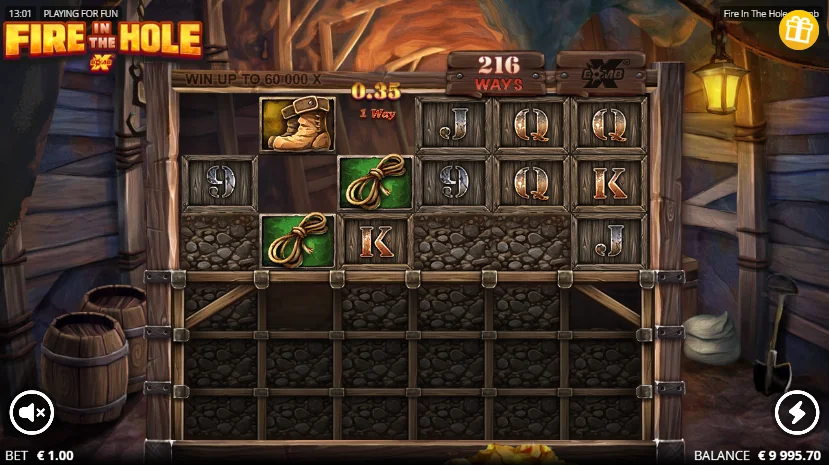
The visual language of Fire In The Hole Xbomb is built on industrial decay. The reels sit inside a mine shaft reinforced with rotting timber beams, and the background layers include pickaxes, cracked rock faces, and flickering lantern light. The color palette leans on desaturated browns, deep greys, and explosive orange accents – a combination that creates visual weight without overwhelming contrast.
Symbol artwork is sharp and purposefully unpolished. Low-value symbols use stylized card-rank designs embedded in mine-cart motifs rather than generic A-K-Q typography. High-value symbols depict miners, TNT crates, and canaries – each rendered with enough detail to distinguish them quickly during fast-spin sequences. The xBomb wild has its own visual identity: a glowing explosive with a lit fuse that pulses slightly before detonating.
The mine-dig animation – where the reel extends downward row by row – uses a drilling visual that feels mechanically earned rather than decorative. Each extension is accompanied by a brief visual cue that reinforces the spatial logic of the feature. The art direction communicates the game’s mechanics without relying on tutorial popups.
Sounds and Gameplay Experience
The audio design operates in two distinct modes. Base game spinning runs on a low-tension ambient track: distant metalwork sounds, faint cave echoes, and a rhythmic mechanical hum. It does not attempt to manufacture excitement during dead spins. When an xBomb appears or the mine-dig sequence initiates, the sound design shifts register – a percussion-forward layer enters, and the detonation effects carry physical impact through the mix.
The contrast between these two audio states is deliberate and functional. It trains attention without relying on constant stimulation. Players quickly learn to associate specific sound cues with mechanics, which accelerates reading of the bonus round without referencing the paytable each time.
Over extended sessions, the ambient base track avoids becoming fatiguing because it stays sparse. The sound team made restraint the core decision, which suits the volatility profile of the game. Long stretches between significant events do not feel empty – they feel like pressure building.
Bonuses and Symbols
Symbols in the Game
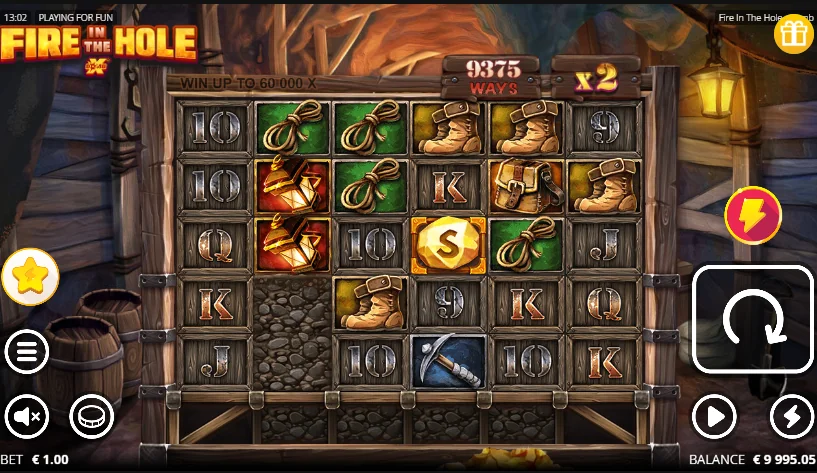
The symbol set contains eight standard paying symbols divided across two tiers. The low tier consists of four mine-themed card-rank equivalents that pay modest multiples for clusters of five or more. The high tier includes the miner character, the canary, the TNT crate, and the dynamite plunger – each with progressively higher cluster payouts scaling up to 25x for the top symbol on maximum cluster size.
The xBomb wild functions differently from every other symbol on the grid. It substitutes for all paying symbols and carries a multiplier that starts at 1x and increments by 1 each time it participates in a win or triggers a mine-dig sequence. Multiple xBombs on the grid stack their multipliers multiplicatively during the same event chain, which is the core mathematical driver of the game’s upper-end potential.
Scatter symbols – represented by the mine entrance gate – appear only on specific reels and trigger the bonus round when three land simultaneously. No partial scatter pays exist. The scatter’s sole function is bonus entry; it carries no independent payout value.
Bonus Rounds and Free Spins
Landing three scatters awards the Tunnel Bonus, which begins with a minimum of eight free spins. The mine-dig mechanic activates on every spin during this round: any reel containing a winning cluster or an xBomb wild extends downward by one row, adding positions to that specific reel. A reel can extend up to a maximum of eight rows, creating an asymmetric grid that can reach configurations as tall as 8×5 under sustained dig sequences.
xBomb wilds retain their accumulated multiplier value across spins within the bonus round rather than resetting each spin. This persistence is what enables compounding multiplier chains. A single xBomb that survives multiple win sequences can reach double-digit multipliers, and if two or more are present simultaneously, the combined effect scales rapidly.
Additional free spins can be won during the bonus through continued scatter landings, though the probability is low. Nolimit City also builds in a buy-bonus option on supported markets, allowing direct entry into the Tunnel Bonus at a fixed cost – typically around 100x the base bet – bypassing base game scatter hunting entirely.
Paytable and Winning Combinations
Cluster pays require a minimum of five connected symbols. Below that threshold, no payout registers regardless of symbol value. The minimum cluster for any symbol tier returns less than 1x the bet, meaning small clusters function as partial recovery rather than profit events. Meaningful returns begin at clusters of eight or more for mid-tier symbols and at five or more for the top-tier dynamite plunger.
xBomb multiplier application happens after the base cluster value is calculated. A cluster worth 5x multiplied by a 4x xBomb returns 20x – the multiplier does not add to the base value, it scales it. This distinction matters when estimating expected return from partial bonus sequences.
The paytable resets between sessions. Multipliers accumulated during a bonus round do not carry over to the next trigger. Each bonus entry begins at 1x across all xBombs present.
Jackpot
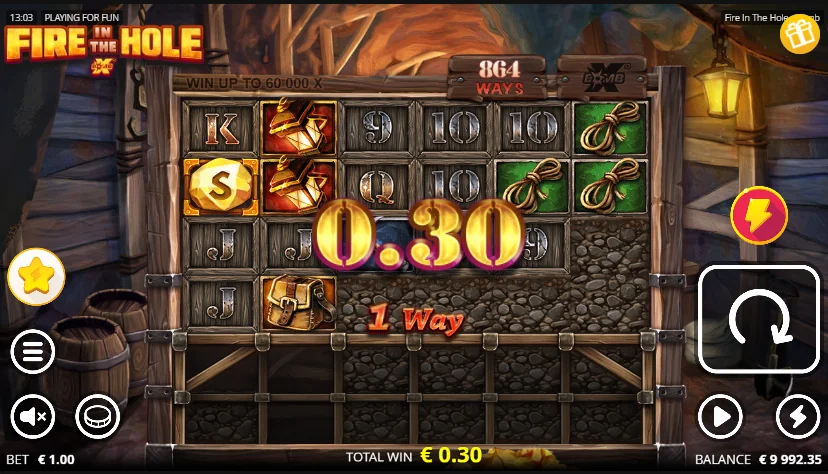
Fire In The Hole Xbomb does not include a progressive jackpot. The 50,000x maximum win is a fixed mathematical ceiling built into the base game model – it is the product of a fully extended grid, maximum symbol clustering, and peak xBomb multiplier stacking during the bonus round. There is no separate jackpot pool, no network prize, and no random jackpot trigger. The game’s upper win potential is entirely mechanics-driven.
This architecture means the maximum win, while rare, is achievable through the standard bonus round without requiring a separate lucky event layer. The tradeoff is that there is no jackpot safety net for sessions that fail to produce meaningful bonus outcomes.
Mobile Device Compatibility
The game performs without frame-rate degradation on current-generation mobile hardware. Testing on mid-range Android devices shows consistent rendering during mine-dig sequences, where multiple simultaneous animations run – reel extension, symbol drop, xBomb detonation – without visible slowdown. The HTML5 build handles these stacked events efficiently.
Touch controls map cleanly to the game’s interface. The bet adjustment slider operates well on smaller screens, and the spin button is sized appropriately for thumb interaction. Portrait mode is supported but landscape orientation provides better visual access to wide grid states during the bonus round, particularly when multiple reels have extended to maximum depth.
Battery consumption during extended mobile sessions is moderate. The ambient animations in the background layer – particle effects, lighting flickers – are relatively lightweight. Auto-spin functionality works without issues on mobile, and the turbo option further reduces per-spin processing load, which has a measurable effect on session duration before thermal throttling on lower-end devices.
Advantages and Disadvantages
Advantages
The xBomb multiplier persistence within a single bonus round creates genuine mathematical depth. Most slots reset multipliers after each spin, which caps volatility. Here, a long enough bonus sequence with active xBombs compounds in ways that produce outcomes meaningfully above the slot’s average win distribution. This is not marketing language – it is a structural property of the mechanic.
The mine-dig grid expansion ties visual feedback directly to bonus math. Watching a reel grow physically taller as the multiplier potential increases creates a clear read on session state without requiring constant paytable reference. The design communicates value accumulation visually.
Demo access is unrestricted and mechanically complete. Players can develop an accurate understanding of trigger frequency, bonus behavior, and grid dynamics before any real-money exposure. Given the extreme volatility, this is practically significant rather than a standard industry offering.
The buy-bonus feature – where available – sets a transparent entry price for the bonus round. At approximately 100x the stake, it removes base-game variance from the equation for players who want direct access to the mechanic rather than scatter hunting across hundreds of dead base spins.
Limitations
Base game hit frequency is genuinely low. Sessions of 200 or more spins without a meaningful return are consistent with the game’s volatility profile, not outliers. Players who require regular reinforcement from smaller wins will find the base game structure unrewarding regardless of bankroll size.
The bonus round outcome variance is extreme even relative to other high-volatility titles. A triggered bonus can produce 5x total or 5,000x total from similar starting conditions depending on xBomb positioning and cluster formation. This unpredictability is the game’s defining character, but it also means bonus triggers do not reliably translate to session recovery.
The buy-bonus option is blocked in several regulated markets, including the UK. Players in those jurisdictions must grind base game spins for natural scatter triggers, which changes the bankroll requirement significantly given the trigger frequency.
The maximum win ceiling of 50,000x, while high, is harder to approach than comparable figures in some competing titles because it requires simultaneous alignment of multiple independent conditions during the bonus round. The mathematical path to the ceiling is legitimate but narrow.
Conclusion
Fire In The Hole Xbomb is a mechanically coherent slot built around a single compounding idea: xBomb multipliers that grow within a spatially expanding bonus grid. Every design element – the mine theme, the dig animation, the audio shift on trigger – connects to that central mechanic rather than existing as decoration. The 96.03% RTP and extreme volatility position it clearly for players who accept long base-game variance in exchange for outsized bonus potential.
The demo version is the correct starting point. It replicates the full mechanic without restriction and gives an honest read on how infrequently the bonus triggers and how widely outcomes distribute when it does. No amount of written description substitutes for direct observation of the mine-dig sequence over several hundred spins.
This is not a session-filler slot. It is a high-commitment title with a specific risk architecture. Players who align with that profile will find it technically accomplished and mathematically interesting. Those expecting frequent small returns from a 96% RTP figure will find the reality of the volatility distribution more difficult than the number suggests.