Good luck 40 Slot Demo – Honest Review, RTP & Volatility
Game Overview and Basic Information
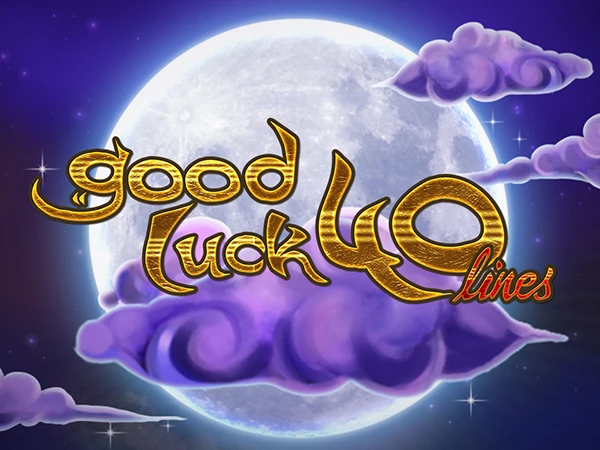
Good Luck 40 is a fruit-themed video slot developed by EGT (Euro Games Technology), built on a 5-reel, 40-payline structure that targets players who prefer straightforward mechanics over complex feature ladders. The number in the title is not decorative – it directly references the fixed payline count, which remains active across every spin regardless of bet configuration.
The return-to-player rate sits at 95.79%, placing Good Luck 40 slightly below the industry midpoint of 96% but within an acceptable range for land-based-origin titles that have migrated online. Volatility is medium, which means the math model balances moderate win frequency against moderate payout sizing – neither punishing patience nor rewarding reckless session lengths.
Bet range spans from 0.40 to 800 per spin in most casino environments, with coin denomination flexibility allowing both casual and higher-stakes approaches. The game does not include a progressive jackpot by default, but EGT’s proprietary Jackpot Cards system can be layered on top in participating casinos, introducing four jackpot tiers triggered randomly.
Maximum win potential without the jackpot system reaches approximately 1,000x the stake – achievable through the top-paying symbol landing across a full five-reel combination. This positions Good Luck 40 as a medium-ceiling game: not a volatility chase, but capable of delivering meaningful single-spin returns.
Easy, Fast, Comfortable
The interface loads without friction. Button placement follows a conventional bottom-panel layout – spin, autoplay, bet adjustment, and paytable access are immediately visible without hunting through nested menus. For players switching between different titles in a session, this zero-learning-curve setup reduces decision fatigue.
Autoplay offers a fixed-round selector, typically ranging from 10 to 500 spins, with loss limit and single-win cap options available depending on the operator’s configuration. The absence of complex bonus-trigger interruptions means autoplay sessions run cleanly, which is specifically relevant for players using free play mode to study spin distribution patterns.
Spin speed is responsive. There is no artificial delay between outcome resolution and the next spin trigger, which matters practically during extended sessions. The paytable is accessible mid-session without disrupting the game state, and bet changes apply immediately on the following spin rather than requiring confirmation steps.
Accessibility across browsers is consistent – the game runs on standard HTML5 architecture, meaning no plugin installations or compatibility patches are needed. Operators offering the Good Luck 40 demo version maintain the same interface as the real-money variant, so transitioning between modes introduces no behavioral differences.
Game Design
Theme and Graphics
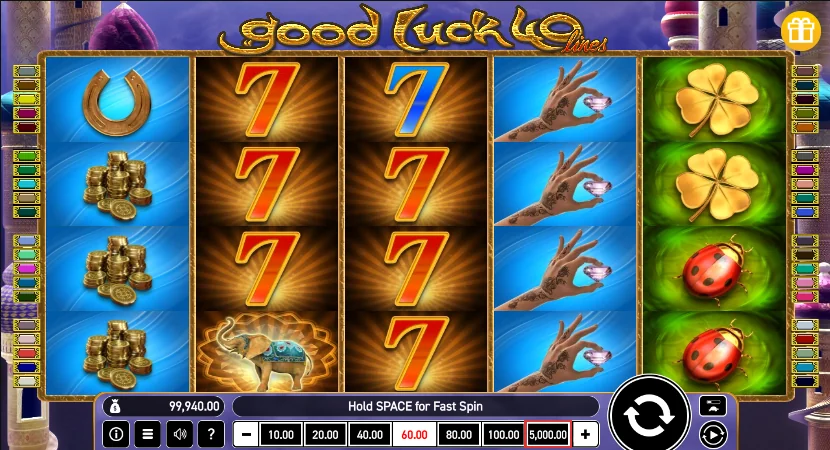
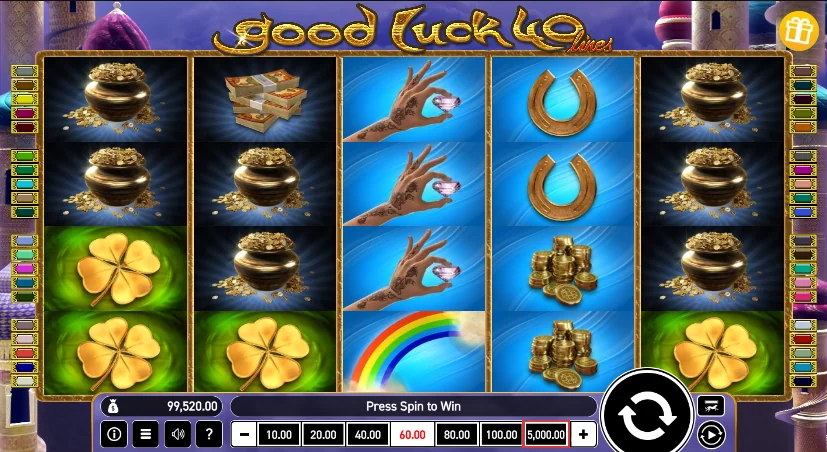
Good Luck 40 operates within the classic fruit machine visual language – cherries, lemons, watermelons, grapes, plums, oranges, and bells populate the reels against a dark background that uses gold and red accents to reference Eastern lucky charm aesthetics. The title itself signals this intent: “good luck” as a concept pulls from both Western gambling superstition and Chinese fortune symbolism, though the execution leans more toward the European fruit slot tradition than genuine cultural design.
Symbol rendering is clean and vector-sharp, scaling without degradation across screen sizes. The reel frame uses a metallic finish that avoids the plasticky appearance common in lower-budget EGT titles. Background animations are minimal – a subtle shimmer effect rather than active environmental motion – which keeps visual attention on the reels rather than peripheral decoration.
Color saturation is deliberately high. Each fruit symbol uses a distinct hue with enough contrast separation that misreading adjacent symbols on active paylines is unlikely even at smaller viewport sizes. The star symbol, which functions as the wild, uses a gold-and-white design that visually separates itself from the standard fruit set without appearing jarring within the overall palette.
Sounds and Gameplay Experience
The audio layer in Good Luck 40 follows a logic of restraint interrupted by reward signaling. Base-spin sound effects are minimal – reel spin, mechanical stop clicks – which prevents auditory fatigue during longer sessions. Win events scale sound intensity relative to the payout size, creating an implicit feedback system that distinguishes between a minor three-of-a-kind hit and a full five-symbol line win without requiring the player to read the credit display.
Background music loops on a short cycle with a mildly celebratory tone that sits below threshold levels where it becomes actively distracting. Mute functionality is available via a single toggle, and the game remembers the setting across spins within the same session. The overall sound design is functional rather than immersive – it supports the gameplay loop without attempting to create an emotional environment, which is consistent with EGT’s land-based arcade heritage.
Bonuses and Symbols
Symbols in the Game
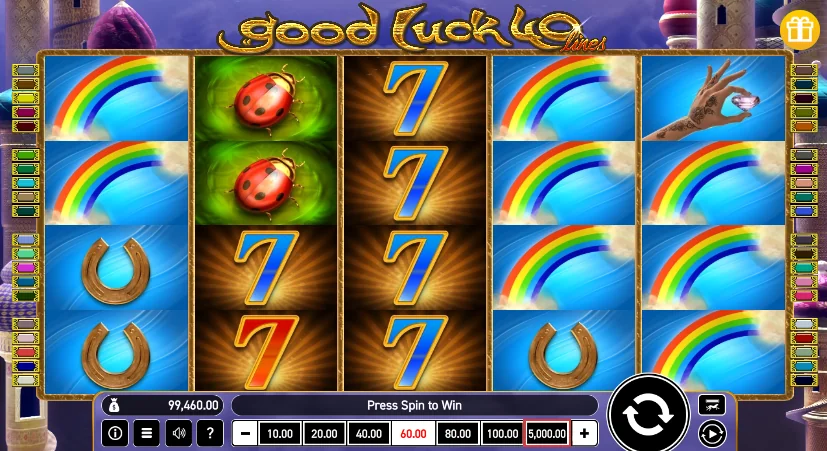
The symbol hierarchy in Good Luck 40 runs from low-value fruit icons at the base through to the seven – a classic high-value marker in fruit slot conventions. Cherries are the lowest-paying symbol and notably the only one that pays on two-of-a-kind combinations, which marginally increases hit frequency on shorter lines. Lemons, oranges, and plums cluster in the mid-tier, followed by watermelons and grapes, with bells and the seven occupying the premium positions.
The star serves as the wild symbol, substituting for all standard symbols to complete paylines. It does not expand, stack, or carry a multiplier – its function is purely substitutive, which aligns with the game’s mechanical simplicity. There is no scatter symbol in the base configuration, meaning the bonus trigger pathway runs exclusively through the wild’s combinatorial effect rather than a dedicated bonus symbol.
Bonus Rounds and Free Spins
Good Luck 40 does not include a traditional free spins round. This is a deliberate mechanical choice rather than an omission – EGT designed this title as a high-frequency base-game experience, where the 40 active paylines generate enough combinatorial coverage to sustain engagement without a separate bonus state.
Where a bonus dimension exists, it arrives through the Jackpot Cards feature present in EGT-enabled casinos. This system activates randomly at the conclusion of any paid spin and presents a card-matching mini-game across four suits – clubs, diamonds, hearts, and spades – each corresponding to a jackpot tier. Matching three cards of the same suit within the revealed set awards the associated jackpot. The trigger probability and tier weighting are operator-configured, meaning this feature’s presence and behavior depend entirely on the casino environment rather than the base game.
Paytable and Winning Combinations
Payouts in Good Luck 40 are calculated on a total-bet multiplier basis rather than coin-per-line arithmetic. A five-cherry combination pays 100x the total stake. Five sevens – the top symbol – pays 1,000x. Mid-tier symbols (watermelon, grapes) pay between 150x and 300x for full five-reel coverage. The bell pays 400x at five of a kind.
Line wins require consecutive symbol matching starting from the leftmost reel. Non-adjacent matches do not qualify regardless of symbol identity. When multiple paylines trigger simultaneously on a single spin, all qualifying combinations are paid independently and summed. The cherry’s two-of-a-kind payout – roughly 2x to 5x stake depending on configuration – functions as a loss-buffer mechanic, recovering small amounts during dry sequences.
Jackpot
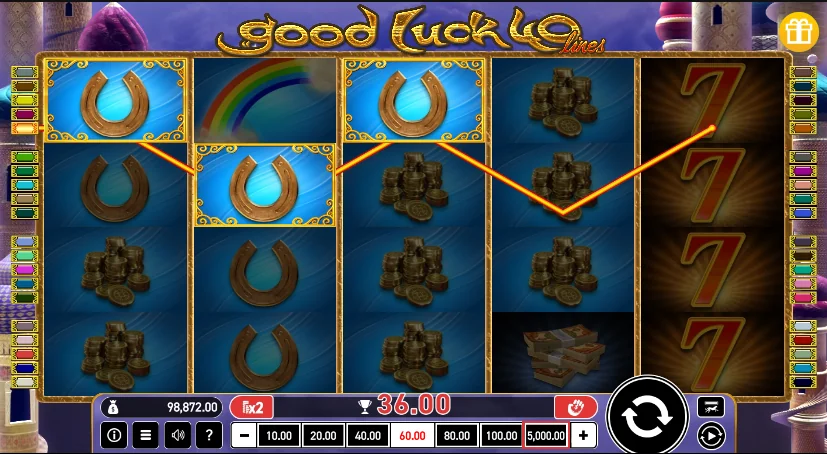
Within the base game’s own math model, there is no fixed jackpot. The 1,000x maximum represents the ceiling of standard symbol-based wins. The EGT Jackpot Cards system, when active, introduces four progressive tiers – Club, Diamond, Heart, and Spade – with the Spade jackpot representing the largest accumulation. These jackpots are funded by a contribution from each qualifying spin across all connected games in the network, meaning their values fluctuate based on player activity across the entire EGT ecosystem rather than within Good Luck 40 specifically.
Players accessing Good Luck 40 through the demo or free play version will not encounter the Jackpot Cards feature, as it requires real-money stake contribution to activate. This distinction is important for anyone using demo play specifically to evaluate jackpot trigger behavior – it cannot be assessed outside live casino conditions.
Mobile Device Compatibility
Good Luck 40 renders on mobile through the same HTML5 base that powers its desktop version, with touch input replacing mouse interaction for all controls. The 5×3 reel grid scales proportionally across portrait and landscape orientations without clipping the interface or requiring scroll interaction to access the control panel.
Performance on mid-range Android devices and current iOS hardware is stable – load times are short, and frame rate during reel spin animation does not degrade on standard 4G connections. The simplified visual architecture (minimal background animation, flat symbol design) contributes to this efficiency; the game does not demand graphics processing headroom that would cause thermal throttling on older devices.
Touch targets on the spin and bet controls are adequately sized for thumb operation, though the paytable navigation on smaller screens requires more deliberate taps due to compressed table layout. The autoplay configuration panel retains full functionality on mobile, including loss limit settings, without requiring a desktop session to configure extended play parameters.
Advantages and Disadvantages
Advantages
The 40-payline fixed structure eliminates the bet management variable present in adjustable-line games – every spin covers the full combinatorial grid, which means no wins are missed due to inactive lines. For players who prefer to focus on stake sizing rather than line configuration, this removes a decision layer entirely.
Medium volatility combined with the cherry’s two-of-a-kind payout creates a gentler bankroll curve than high-volatility fruit slots. Sessions do not produce the extended win-free sequences that characterize higher-variance games, making the title more suitable for fixed-budget play where session length matters as much as maximum return.
The Jackpot Cards overlay, where available, adds a win ceiling significantly above the base game’s 1,000x limit without altering the base math model. Players gain access to jackpot potential without absorbing the volatility cost that typically accompanies jackpot-integrated slots.
Interface consistency across demo and real-money modes means behavioral familiarity transfers directly. There is no adjustment period when switching from free play to live conditions.
Limitations
An RTP of 95.79% trails the current market standard for online-native slots, many of which operate at 96% or above. Over statistically significant play volumes, this difference compounds – players are returning slightly less per unit wagered than on comparable titles with higher RTP configurations.
The absence of free spins or any base-game bonus round limits variance upside for players who specifically seek high-multiplier events within a session. Good Luck 40’s ceiling in the base game is determined entirely by symbol combination math, with no mechanism that artificially amplifies a win beyond the top symbol payout.
The Jackpot Cards feature, while attractive, is operator-dependent and absent from many online casino deployments. A player selecting this game specifically for jackpot access may find it unavailable at their chosen platform without this information being clearly communicated at the selection stage.
Thematically, Good Luck 40 offers no differentiation from dozens of EGT fruit titles sharing the same symbol set, reel structure, and visual approach. For players prioritizing thematic novelty or narrative design, this title provides no meaningful distinction from its sibling games.
Conclusion
Good Luck 40 is a competent, mechanically transparent slot that functions exactly as its structure implies – 40 lines, medium volatility, steady hit frequency, and a top-end win of 1,000x that requires no bonus state to reach. Its value is clearest for players who want predictable session behavior and are not chasing feature-driven variance spikes.
The RTP sits close enough to 96% to be acceptable, but not so high that it becomes a distinguishing argument for choosing this title over alternatives. The Jackpot Cards ceiling changes the calculus significantly in casinos where it is active, but its operator-dependent nature means players should verify availability before treating it as a given.
Demo access allows genuine evaluation of spin rhythm and payline activity patterns, though jackpot behavior and real-money volatility distribution require live conditions to experience fully. For anyone weighing Good Luck 40 against similar fruit slots, the decision will most likely rest on whether the EGT jackpot ecosystem is accessible at their platform – without it, the game competes on base-game mechanics alone, where it is solid but unremarkable.