Gravity bonanza Slot Demo – Honest Review, RTP & Volatility
Game Overview and Basic Information
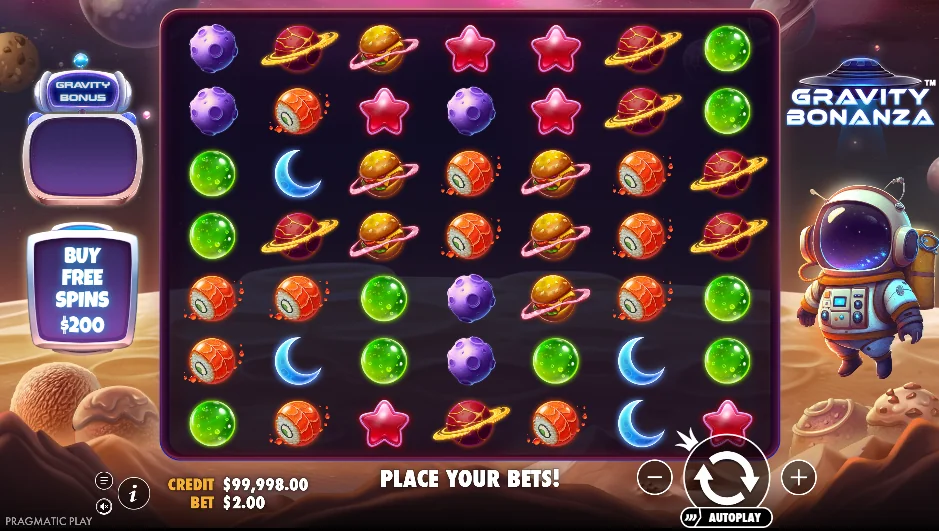
Gravity Bonanza is a cluster-pays slot developed by Pragmatic Play, built around a gravitational cascade mechanic where winning symbols are pulled downward rather than simply disappearing. The grid measures 7×7, departing from the standard reel-based format most players encounter in everyday slot catalogues. This structural choice directly shapes how combinations form and how chain reactions accumulate across a single paid spin.
The gravity bonanza RTP sits at 96.09%, which positions the game marginally above the mid-tier average for cluster slots. That figure applies to the base version; certain casino operators may deploy adjusted RTP configurations, so checking the paytable within your specific platform is worth doing before committing real funds. Variance is classified as high – wins arrive infrequently but carry disproportionate weight when they do. This is not a grind-friendly game for players who prefer steady, low-amplitude returns.
The gravity bonanza max win reaches 10,000x the stake. Achieving that ceiling requires a specific alignment of multiplier mechanics during the bonus phase – it is mathematically possible but statistically concentrated in the extreme tail of the probability distribution. Hit frequency in the base game hovers around 1 in 4.3 spins, which is lower than many cascading alternatives and reinforces the high-volatility classification.
Stakes range from €0.20 to €100 per spin, covering a broad spectrum from casual demo exploration to high-roller sessions. The gravity bonanza game is certified by independent auditing bodies and operates on a provably fair RNG framework, meaning each spin outcome is generated independently of previous results.
Easy, Fast, Comfortable
The interface strips away unnecessary complexity. The spin button, bet adjuster, and autoplay toggle occupy the bottom bar without cluttering the grid. Navigating between stake levels requires two taps – no nested menus, no confirmation screens slowing down the process. For players moving directly from the gravity bonanza demo into real-money mode, the transition feels frictionless because both versions share identical UI architecture.
Loading time across desktop browsers averages under three seconds on a standard broadband connection. The game does not front-load heavy assets between spins, which keeps the session rhythm consistent. Autoplay supports up to 1,000 automatic rounds and includes configurable loss limits and single-win thresholds – practical controls that matter for sessions using high-volatility settings where bankroll swings can be sudden.
The paytable is accessible mid-spin, meaning players can reference symbol values without interrupting an active autoplay sequence. This sounds minor but becomes relevant when a cascade chain is building and a player wants to cross-reference a multiplier value in real time. The game rules section uses plain language rather than dense legal phrasing, making the gravity bonanza rules genuinely readable rather than performatively disclosed.
Accessibility features include a turbo spin mode that reduces animation duration by roughly 40%, useful for players who find the standard cascade animation cycle too slow during extended sessions. There is no dedicated sound toggle separate from the master volume slider, which is a small but noticeable omission.
Game Design
Theme and Graphics
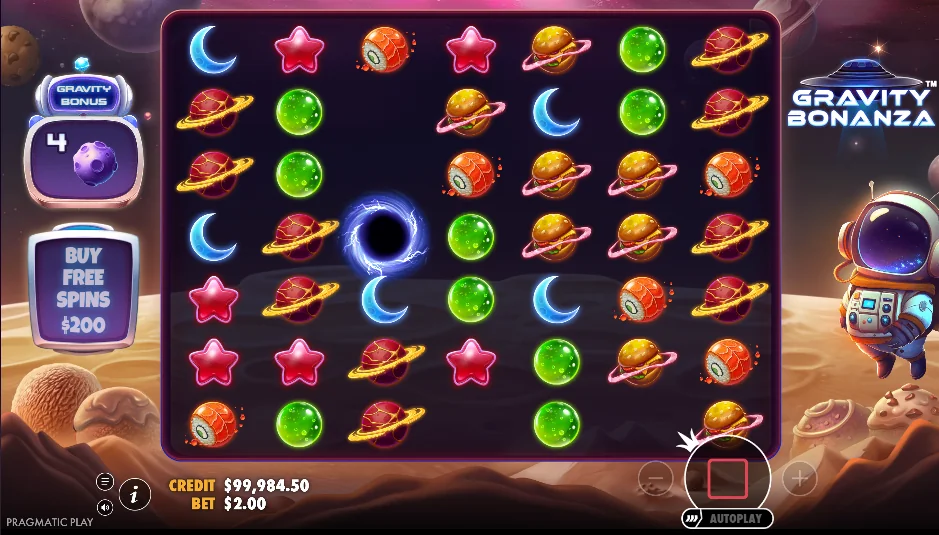
Gravity Bonanza leans into a cosmic laboratory aesthetic – think deep-space physics experiments rather than generic outer-space wallpaper. The background layers a particle accelerator structure against a dark gradient atmosphere, with ambient light shifts that respond to the cascade depth. The visual language is deliberate: the gravitational pull mechanic has a direct design counterpart in the way symbols visually drop and settle after each removal.
Symbol design follows a tiered visual hierarchy. High-value symbols use geometric crystal structures in distinct color profiles, making them identifiable at a glance even during rapid cascade sequences. Low-value symbols use simpler mineral shapes with less chromatic saturation, which prevents visual noise when the grid fills with a mixed distribution. The overall color palette avoids the oversaturated neon common in cluster slots – contrast ratios are high enough that distinguishing symbol types does not require deliberate focus.
Animations scale with win size. A standard cluster removal plays a brief implosion effect; a large multiplier trigger activates a longer, more elaborate sequence without delaying the next spin beyond the standard cycle time. The distinction between a functional animation and a reward-signaling one is handled cleanly.
Sounds and Gameplay Experience
The audio design functions as a feedback layer rather than background decoration. Each cascade level shifts the ambient tone upward in pitch, creating an auditory cue that mirrors the escalating tension of a chain reaction. By the third or fourth consecutive cascade, the sound environment has noticeably transformed – subtle enough to avoid being gimmicky, distinct enough to register without watching the screen.
The base game soundtrack maintains a low-frequency electronic pulse that does not fatigue during long sessions. Contrast this with bonus phase audio, which introduces a higher-register melodic element that separates the feature round perceptually from the standard game cycle. Players who disable sound lose a meaningful portion of the gameplay feedback system, since several cascade progression cues are primarily audio-driven.
Win celebrations are proportionally scaled. A minimum-threshold cluster plays a short chime; a near-maximum-win cascade triggers a sustained audio event. The gravity bonanza gameplay experience benefits from this proportionality – it avoids the disconnection that occurs in slots where every spin generates identical audio intensity regardless of outcome magnitude.
Bonuses and Symbols
Symbols in the Game
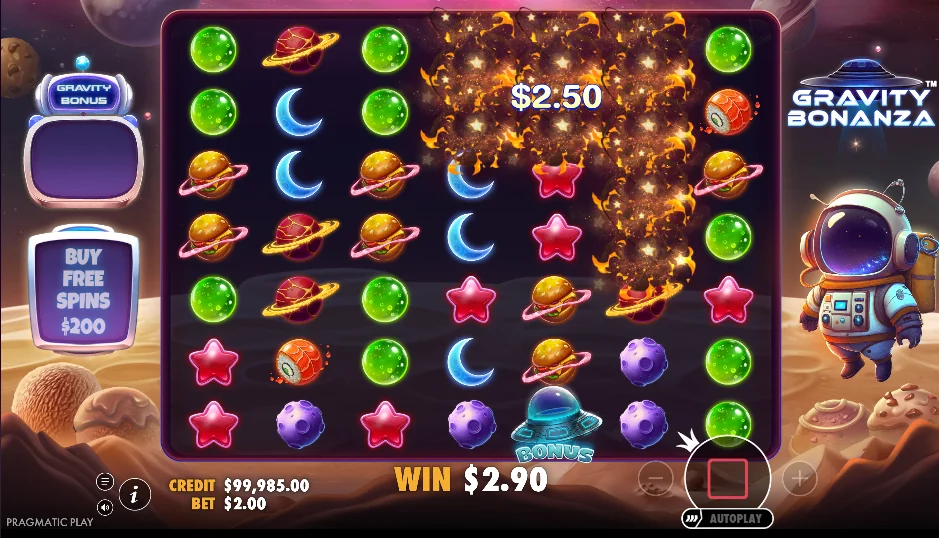
The gravity bonanza symbols divide into four functional categories. Standard paying symbols cover six tiers: three low-pay mineral variants and three high-pay crystal variants. The highest-paying crystal symbol returns 50x for a cluster of 15 or more – the cluster size threshold matters here, as the payout curve is non-linear and clusters between 5 and 9 symbols pay significantly less proportionally.
Wild symbols substitute for all standard paying symbols and can appear anywhere on the 7×7 grid except the scatter positions. They do not carry independent payout values – their function is purely substitutional within cluster formation. Multiplier wilds represent a separate symbol class: they carry a fixed multiplier value (ranging from 2x to 10x) that applies to the total win of any cluster they contribute to, not just the portion they complete.
Scatter symbols appear exclusively during the base game and require a minimum of four simultaneous appearances to trigger the bonus round. They do not form clusters and hold no independent cash value – their role is purely as a threshold trigger. Bomb symbols, introduced in certain cascade sequences, eliminate adjacent symbols to expand active cluster zones.
Bonus Rounds and Free Spins
The free spins feature activates upon landing four or more scatters simultaneously. Four scatters award 10 free spins; five award 15; six or more award 20. Retriggers are possible during the feature by landing additional scatters, with each set adding spins at the same rate as the initial trigger.
During the gravity bonanza features phase, multiplier progression works differently than in the base game. Each cascade within a free spin increments a persistent multiplier that does not reset between spins – only between feature activations. This means a deep cascade chain on spin 3 of a free spins sequence carries its multiplier value forward to spin 4. The compounding effect of this mechanic is where the 10,000x max win becomes mathematically accessible, though reaching the upper multiplier values requires sustained cascade activity across multiple consecutive free spins.
The bonus buy option, where jurisdictionally permitted, allows direct entry into the free spins round at a fixed cost of 100x the stake. This bypasses scatter variance but does not alter the internal mechanics of the feature round itself – RTP remains consistent between bought and organically triggered bonus rounds.
Paytable and Winning Combinations
Cluster formation requires a minimum of 5 adjacent symbols of the same type, connected horizontally or vertically. Diagonal adjacency does not count. The payout scale is exponential rather than linear: moving from a 5-symbol cluster to a 10-symbol cluster does not simply double the return – it can increase it by a factor of 4 to 6 depending on the symbol tier.
Multiple clusters of the same symbol type on a single spin pay independently if they are not connected. Two separate clusters of the same high-value crystal symbol each trigger their own payout calculation. This distinction becomes tactically relevant when evaluating near-miss configurations where a single additional symbol would merge two clusters into a single larger one with a disproportionately higher return.
Multiplier wilds stack when more than one appears in a contributing cluster – their values multiply together rather than add. Two 5x multiplier wilds within the same cluster produce a 25x multiplier on the total cluster win, not a 10x. This stacking behavior is documented in the paytable but easy to underestimate when reading raw symbol values in isolation.
Jackpot
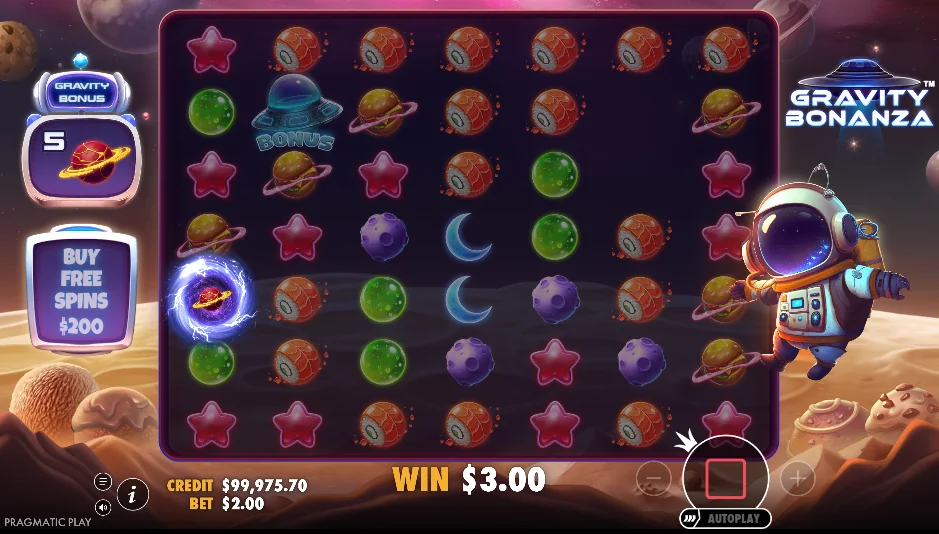
Gravity Bonanza does not feature a progressive jackpot. The 10,000x maximum win is a fixed ceiling determined by the combination of multiplier accumulation and cluster payout during the free spins phase. There is no networked prize pool, no jackpot meter, and no separate jackpot trigger mechanic. Players seeking progressive jackpot structures will not find that element here – the game’s ceiling is defined and finite, which some players prefer for predictability of maximum exposure.
Mobile Device Compatibility
The gravity bonanza game runs on HTML5 and does not require any separate application download. Performance on iOS and Android devices is consistent with the desktop version, with no observable frame rate degradation during cascade sequences on devices released within the last four years. Older mid-range Android hardware may show minor animation stuttering during extended free spins with high cascade counts, though core gameplay remains unaffected.
The 7×7 grid scales correctly to portrait orientation on screens as small as 5.4 inches without truncating symbol detail. Portrait mode compresses the bottom control bar but keeps all primary functions – bet size, spin, and autoplay – accessible without scrolling. Landscape orientation on tablets provides the closest visual experience to desktop, with additional padding around the grid that improves peripheral visibility during cascade animations.
Touch input responsiveness is calibrated for cluster games – the spin trigger registers without requiring precise tap placement within a small button boundary. Session continuity across background/foreground switching is maintained; the game resumes at the same spin state rather than forcing a reload, which matters during autoplay sequences.
Advantages and Disadvantages
Advantages
The non-resetting multiplier during free spins is a mechanically significant distinction. Most cascade slots reset multipliers between bonus spins, capping the achievable win per spin rather than per feature round. Gravity Bonanza’s carry-forward design creates genuine escalation potential across the entire free spins sequence rather than isolated per-spin peaks.
Multiplier wild stacking produces outsized returns in configurations that would generate modest payouts in equivalent slot formats. This creates moments of disproportionate outcome that feel earned by grid configuration rather than arbitrary RNG selection.
The 96.09% RTP is verifiable at the paytable level rather than buried in terms, and the game’s audit certification is current. For players who prioritize transparency in fairness documentation, this matters practically rather than symbolically.
The gravity bonanza free play demo replicates all bonus features including the full free spins mechanic, which is not universal – some developers gate bonus features behind real-money play. Testing the feature round in demo mode before stake commitment is genuinely possible here.
Limitations
High volatility combined with a 5-symbol minimum cluster threshold creates extended dry periods in the base game. The 1-in-4.3 hit frequency means sessions without bonus triggers can consume significant bankroll without generating compensatory base game returns. This is not a design flaw – it is an intentional variance profile – but it imposes a realistic minimum bankroll requirement that contradicts low-stake casual use.
The bonus buy price of 100x stake is above the market median. Comparable cluster slots from competing developers offer direct feature access at 70-80x stake, making the buy-in here relatively expensive for players who prefer bypassing scatter variance.
Sound design, despite its quality, lacks per-element control. Players who want cascade sound effects without background music – a common preference during long sessions – cannot configure this without muting all audio.
The 10,000x maximum win, while substantial, sits below the ceiling of several direct competitors in the high-volatility cluster category. Players specifically targeting maximum exposure potential will find higher caps elsewhere.
Conclusion
Gravity Bonanza succeeds as a mechanically coherent high-volatility cluster slot. The non-resetting multiplier system during free spins is its defining structural choice, and it justifies the game’s high-variance profile by creating a feature round where successive cascades build on each other across the entire sequence rather than resetting between spins. The 96.09% RTP is competitive, the 7×7 cluster format is executed cleanly, and the demo mode provides full access to the feature mechanics before any real-money commitment.
The gravity bonanza strategy that produces the most rational bankroll behavior is straightforward: treat base game play as a cost of entry toward the bonus round, maintain enough reserves to sustain the base game hit frequency, and recognize that the game’s return distribution is heavily skewed toward feature-phase outcomes. Low-bankroll sessions on maximum stake are structurally mismatched with this volatility profile. Scaled stakes relative to session bankroll produce more representative exposure to the game’s actual payout mechanics.
The gravity bonanza review conclusion is this: for players who understand what high-variance cluster mechanics demand and can calibrate session expectations accordingly, this is a technically sound, well-designed title worth extended engagement. For players expecting base game consistency or frequent modest returns, the variance profile will feel punishing regardless of RTP efficiency.