MegaBlock Demo – Honest Review, RTP & Strategy
Game Overview and Basic Information
MegaBlock is a tower building game rather than a slot, even though most lobbies will file it next to one. InOut Games released it on 10 February 2026 with a construction theme, and the whole loop is dropping blocks onto a stack and deciding when to stop before the tower falls over.
The published MegaBlock RTP is 95.5%, which is on the low side of what the studio usually offers. Volatility is listed as variable because it depends entirely on the difficulty mode you pick, so there is no single figure to quote. The number shown in your own MegaBlock casino information panel is the one that counts.
Stakes run from 0.10 to 200 in the base currency, and the MegaBlock max win is capped at 20,000 dollars. That cap applies per result rather than per session, and it matches the ceiling InOut Games uses across most of its catalogue. Anyone funding an account in naira should also remember that the operator handles the conversion, so the local equivalent of the cap moves with the exchange rate.
One small thing to flag before anything else. The studio spells the title both MegaBock and MegaBlock on the same page, sometimes in the same paragraph. The specification table calls it MegaBlock, so that is the spelling used here, but you may see either version in a casino lobby.
Easy, Fast, Comfortable
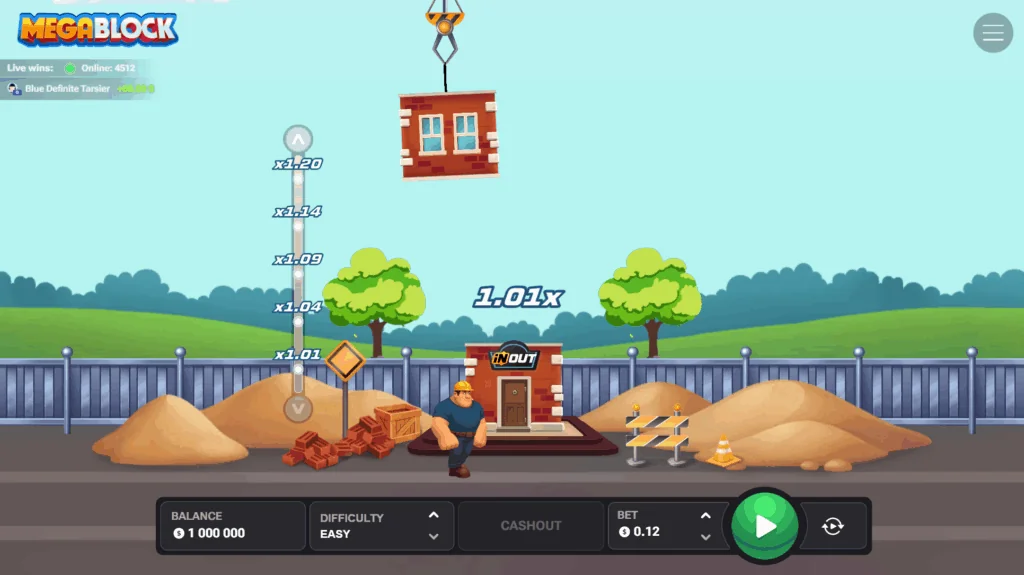
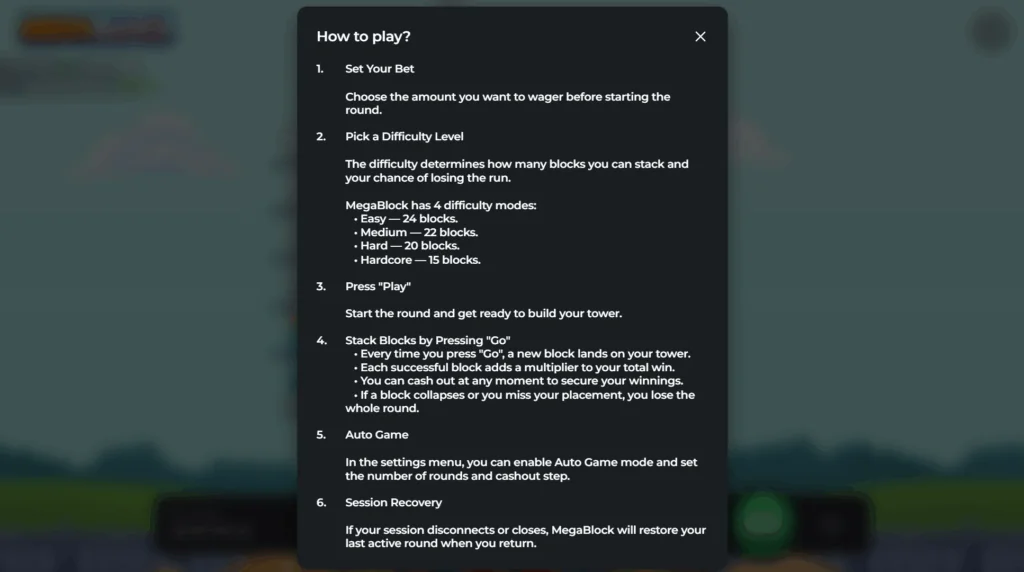
The MegaBlock rules fit into four steps. Set your bet, choose a difficulty, press play, then press go to drop each block. Every block that lands cleanly pushes the multiplier up. Cash out whenever you like, and if a block misses or the tower collapses the round is over and the stake is gone.
Nothing about the MegaBlock game interface needs learning. There is a bet field, a difficulty selector, a play button and a go button, and that is the whole panel. It is deliberately built for someone opening a browser tab for five minutes rather than settling in for a long evening. Everything sits within thumb reach on a phone, which is clearly where the studio expects most rounds to be played.
Difficulty is the real decision. Easy allows up to 24 blocks, Medium up to 22, Hard up to 20 and Hardcore only 15. Fewer available blocks means the multiplier climbs faster but the round ends sooner, so the mode you pick sets the risk before you drop anything at all.
Most MegaBlock play ends up being about self control rather than skill. The multiplier is visible, the next block is one tap away, and the temptation to add one more is constant. That tension is the entire product, and it works better than it sounds on paper.
Game Design
Theme and Graphics
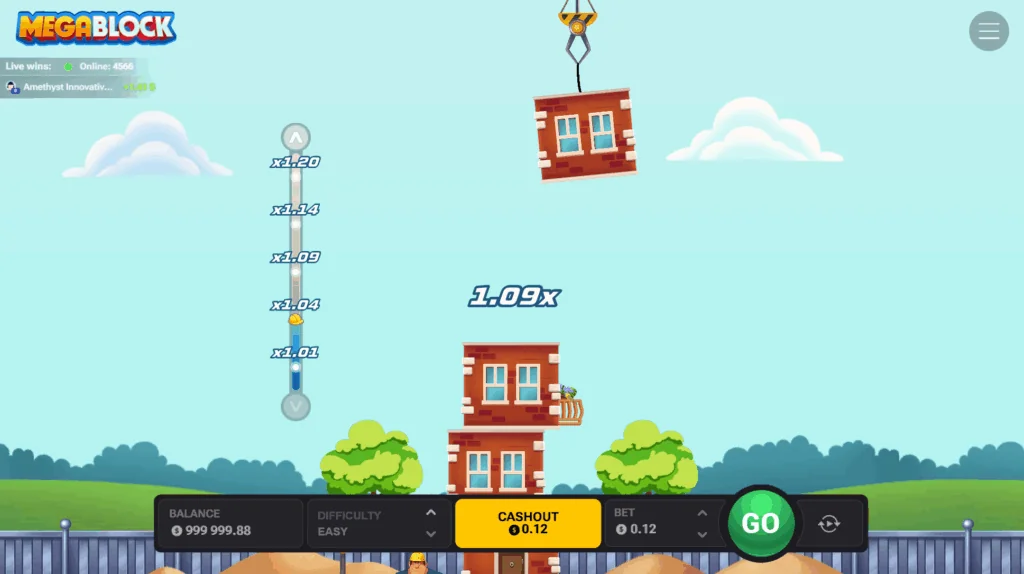
The look is industrial and simple. Blocks stack on a base, the tower grows upward, and the camera pans as it climbs. There is no story, no characters and no cutscene. For a game about stacking rectangles that is arguably the correct decision rather than a shortcut.
Colour contrast is decent, which matters if you play outside. The multiplier reads clearly against the background and the block edges are well defined, so judging placement on a mid range Tecno or Infinix screen in Lagos afternoon light is not a problem.
Compared with a proper MegaBlock slot machine style grid, the screen carries very little information. Your bet, the current multiplier, the block count and the two buttons. Some players will find that refreshing after a busy video slot, others will find it bare.
Sounds and Gameplay Experience
Audio is minimal. A thud when a block lands, a crash when the tower goes, and a short tone on cash out. There is no soundtrack to speak of, so playing on mute costs you nothing at all, which suits anyone spinning in a shared room or on a danfo.
The feel is mechanical in a good way. Each drop has a small delay before the result registers, and that pause is where the nerve gets tested. It also means a laggy connection is genuinely annoying, because timing feedback is the only feedback the game gives you.
Autoplay changes the experience completely. Handing the drops to the software with a preset cash out level turns an active timing game into a passive one, which some players use for discipline and others find pointless. Both reactions are fair, and the setting is easy to switch off.
Bonuses and Symbols
Symbols in the Game
There are no symbols in the traditional sense. No wilds, no scatters, no card ranks and no paylines. The block itself is the only game piece, and its position on the stack is what determines whether the round continues or ends right there. In place of a paytable you get a running counter and a multiplier, and that pair of numbers carries all the information a round needs.
What replaces a symbol set is the block counter. Each successful placement is a step, and each step carries a higher multiplier than the last. The published block limits per mode are the closest thing to a paytable that MegaBlock offers to a player planning a session.
That absence is worth understanding before you open it. Anyone expecting a MegaBlock slot machine experience with reels and bonus icons will be surprised. This is an instant game with a stacking mechanic, filed under slots purely because that is where casinos put everything.
Bonus Rounds and Free Spins
There is no MegaBlock bonus round. No pick screens, no wheels and no second stage. The multiplier ladder is the only reward structure, and the studio is straightforward about that rather than dressing it up with invented feature names. If you want a second stage to break up the rhythm, this is not the title that will give it to you.
MegaBlock free spins do not exist either. What you get instead is autoplay, which runs paid sequences of 10, 20, 30, 50, 75, 100, 150 or 200 rounds. Those are paid rounds, not free ones, and the distinction matters for anyone reading a lobby description quickly.
There is no MegaBlock bonus buy. Since there is no feature to open, there is nothing to purchase, so the whole mechanic simply does not apply here. Players arriving from PG Soft or Pragmatic titles should adjust their expectations accordingly.
Paytable and Winning Combinations
The payout calculation is stake multiplied by the multiplier you banked. Nothing else feeds into it. That makes the maths unusually easy to follow, and it means you can see exactly what a cash out is worth before you commit to another block. There is also no partial cash out, so the decision is always all or nothing, unlike some other releases in the same catalogue.
The studio does not publish the multiplier attached to each block position, which is the most significant gap in the documentation. It states the block limits per mode and says the top multiplier is reached in Hardcore, but the actual ladder values are left to the in game display.
Cash out steps give you a way to work with that. Autoplay can be told to stop at a multiplier of 1, 3, 5, 8, 12, 16, 20 or 24, which effectively lets you set a target payout in advance. It is a genuinely useful tool for anyone who struggles to stop manually.
Jackpot
There is no jackpot in MegaBlock, progressive or otherwise. The 20,000 dollar figure is a hard payout ceiling, not a prize pool, and no portion of the return is being diverted to fund one. What you see in the multiplier is what the game can pay.
That ceiling only bites at the top of the stake ladder. At 0.10 a round it is irrelevant. MegaBlock money play near the 200 maximum is where the cap becomes a real constraint, and it is worth doing that arithmetic before you move up the bet levels.
Mobile Device Compatibility
Mobile is the intended home for this game. The studio calls the approach mobile first, and the interface backs that up, because two large buttons and a bet field is about as touch friendly as a casino product gets on a six inch screen. Rotating the phone is unnecessary because the layout is built vertically, which suits one handed play on a crowded bus.
There is a MegaBlock app for both iOS and Android. InOut Games says it carries identical mechanics and payout structure to the desktop version, with touch optimised controls, faster loading through reduced graphics and account management built in for deposits and withdrawals.
A MegaBlock download is still optional. The browser build runs in HTML5 and behaves the same way, so anyone short of storage on a crowded handset can skip the install entirely. The app mainly buys you stability rather than any extra features.
Connection quality matters here more than in a reel game. Because the whole mechanic is timing based, a lag spike on a weak Airtel or 9mobile signal can cost you a block placement. Loading over wifi where possible is a sensible habit for a game like this.
MegaBlock Strategy: What You Can Control
No betting pattern changes the result of a round in MegaBlock. Every outcome comes from a random number generator, and the 95.5% RTP is a long-run average, not a promise for one session. What you can control is how long your balance lasts.
The difficulty selector is the main lever. Lower levels give more frequent, smaller results, while higher levels put more of each stake at risk for a bigger multiplier, so choose the level before you choose the stake.
Try the demo first, set a loss limit and a win target before the first real round, and stop when either one is reached.
Advantages and Disadvantages
Advantages
The difficulty system is the strongest feature. Four modes with published block limits give you real control over the shape of a session, and the range between 24 blocks on Easy and 15 on Hardcore is wide enough to feel like two different games.
The autoplay tooling is better than most. Being able to combine a spin count with an automatic cash out multiplier is a proper bankroll tool rather than a convenience feature, and very few instant games in this bracket offer that combination. Setting a stop level before the first drop removes the hardest decision from the round entirely.
Transparency on fairness is solid. The provably fair system uses a server seed, a client seed and a per round nonce combined through a hashing algorithm, and the studio explains the process on its own page rather than just claiming the label and moving on.
Access is easy and cheap. A MegaBlock demo runs in the browser without a deposit, the minimum real stake is 0.10, and the free version behaves identically, so learning the timing costs nothing beyond a small amount of data.
Limitations
A 95.5% RTP is the weakest part of the package. Other InOut titles publish 96% and above, so this one asks you to accept a slightly worse theoretical return for the tower gimmick. That is a fair trade only if the mechanic actually appeals to you. A slightly better return would have made the low stake floor far more attractive over a long session.
The multiplier ladder is undocumented. Without published values per block position it is impossible to compare modes properly before playing, and several MegaBlock reviews make the same point. You end up learning the numbers by watching the demo rather than reading a paytable.
Naming is a mess. The same official page uses MegaBock and MegaBlock interchangeably, and the URL uses one while the specification table uses the other. It is a small thing, but it makes finding reliable information about the game harder than it should be.
Content depth is thin. One mechanic, no bonus, no free spins and no jackpot means the variety comes only from switching difficulty. If you want something to explore across many sessions, opening MegaBlock online will not hold you for long.
Conclusion
MegaBlock is a clean, honest tower stacking game with unusually good autoplay controls and a well explained fairness system. If the idea of dropping blocks for a rising multiplier appeals, it does that job with very little fuss and a low entry stake. The provably fair seeds are a genuine plus for anyone who likes checking results rather than taking them on trust.
The reasons to hesitate are a 95.5% return, an undocumented multiplier ladder and a total lack of features beyond the core loop. Anyone who wants a bonus round, free spins or a jackpot should look at a different title from the same studio.
Try the free demo first, work out which difficulty suits your patience, then set a cash out step before you start playing for real. Stick to operators licensed to serve Nigerian players, check what your state regulator requires such as the Lagos State Lotteries and Gaming Authority, and decide your loss limit in advance.
Gambling is for adults aged 18 and over. Set a loss limit before you play, take breaks, and stop if it stops being fun.