Ocean King Jackpot Demo Review by TaDa Gaming: RTP, Jackpots and Max Win
Game Overview and Basic Information
Ocean King Jackpot is a fish shooter, not a reel game. A cannon sits at the bottom of a shared arena, fish swim across it, and every kill pays the multiplier attached to that fish. The game was built and published by TaDa Gaming, whose game card files it as Fish and Arcade with zero paylines. Some lobbies credit a different provider, which is a distribution tag and not an authorship credit.
The official game card lists the release as December 2023, with no exact day. The arena seats up to four players at four turret positions, each with their own balance on screen. This changes the session rhythm: a fish you’ve softened up can die to somebody else’s shot. The loop never gets more complicated than aim, fire, collect.
The studio publishes a maximum return of 97%: 94.5% from fish payouts, 1.2% from fixed jackpots, 0.3% from progressive pools and 1% from free Dark Whirlpool rounds. The North American game card lists a maximum of 96.5% on a 94% base, so the figure that applies depends on your market. That split is more useful than the headline: nearly all of the return comes back through routine kills, while the progressive line is worth three tenths of a percentage point.
The largest multiplier on the chart belongs to the Vampire King, which pays up to 3,000x the shell that finishes it, the max win per shot; the full list of special targets is in the paytable section below.
Demo Play and Session Pacing
A demo round is the cheapest way to find out whether the shot economy suits you. Demo credits behave exactly like funded ones, so ten minutes is enough to see how the cost of your shots compares with what the big targets pay. Kills are random, so no target takes a fixed number of shells.
On BetFM the main play button opens the registration form, so free play there begins after an account exists. Where a genuine no-signup demo is offered, the mathematics is identical and only the payout is missing.
Availability depends on the operator, not the studio. The official card classes the game as Fish and Arcade, and lobbies shelve it there rather than in the slots grid, so it can look absent.
Pacing deserves attention because holding the fire button empties a balance quickly. The cannon keeps firing continuously while the button is down, and an auto mode can keep it firing without you. Setting a shot value and a time limit before the first shell is worth more than any aiming tip.
Game Design
Theme and Graphics
The theme is an underwater rock concert with a Halloween streak. Stage lighting, amplifiers and a cast of skeletal and vampiric characters fill the background, in place of the coral and shipwrecks that fishing games usually reach for. Both headline targets, Vampire King and Rock Skeleton, come out of that costume box.
Readability is a strength. Outlines are thick and palettes stay separated, so targets remain legible once the arena fills up. In a game where firing at the wrong shape costs money, that is a practical concern rather than a cosmetic one.
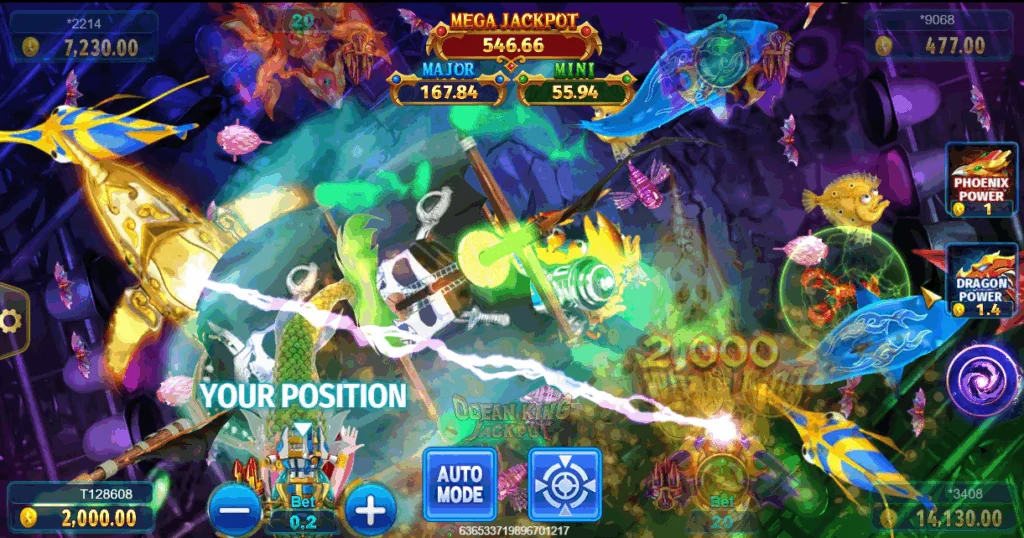
Layout is conventional and it works. Shot selector and cannon sit along the bottom, balance and the three jackpot meters run across the top, and the fish occupy the middle.
Controls and Gameplay Experience
Hold the button for continuous fire or tap for single shots. The arena also offers auto mode and lock-on aim, so you can automate shooting or control it shell by shell. No spin cycle has to play out, so the pace of a session is set by the hand on the screen and nothing else.
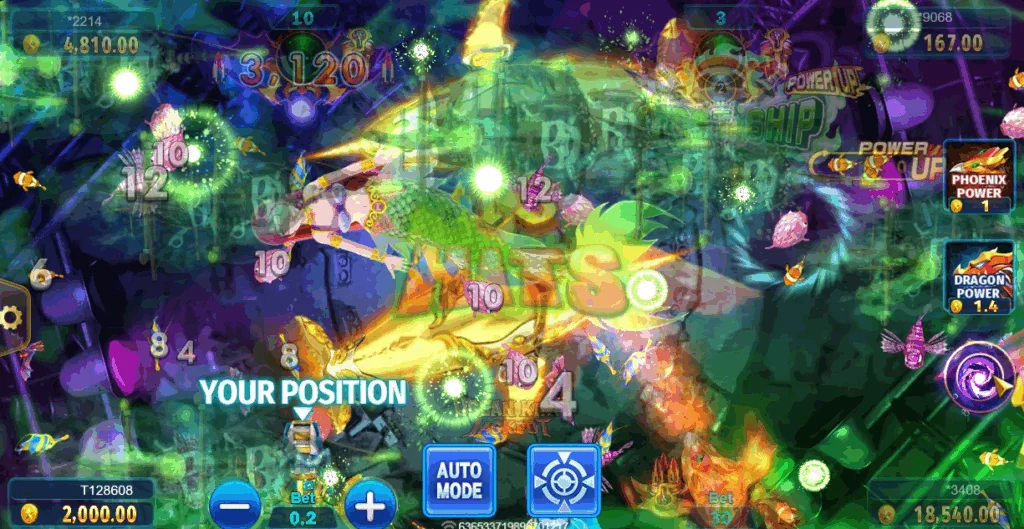
Weapon choice is the second lever. Pick the standard Rocket Cannon, or spend five times the bet on Phoenix Power to raise the kill rate. Dragon Power costs seven times the bet. A Flame Bomb is available as well. The Lightning Chain and the Vortex Fish are released by special targets, while the free Dark Whirlpool charges from an energy bar as you fire and then hits every fish in the arena. The buttons show these prices in coins and update with the bet: at a 0.2 bet they read 1 and 1.4, at 0.4 they read 2 and 2.8.
With up to three other players in the arena, kills are competitive. The section on shared arenas below explains what that means for long boss fights.
Bonuses, Jackpots and Targets
Targets Instead of Symbols
The game has no symbol set. Fish are the paytable, each with its own hit points and multiplier band. The chart runs from small fry to bosses, with more than fourteen target types in total.
Above the common fish sit the specials. Thunder Dragon pays 50x–220x with a secret multiplier of 1x–9x. Rock Skeleton runs 90x–2,400x, and Vampire King (top of the chart) pays 100x–3,000x. Mermaid, Ancient Crocodile and the Ghost Ship each pay 100x–1,200x. The official paytable also prints the routine tiers: 2x–20x for small fish, 10x–30x for the giant clownfish, giant butterfly fish and giant fugu, 20x–60x for the blue shark, 30x–100x for the killer whale and a flat 100x for the golden whale. Bomb and drill crabs pay 120x–180x, hammer and laser crabs 150x–225x. Most of the 94.5% base return is paid back through these kills.
Item targets and special weapons are where the arithmetic shifts. The Phoenix and Dragon cannons sit in the weapon selector, while the Vortex Fish and the Lightning Chain come from special targets, and the Lightning Chain adds 20x to 200x. Vampire Revenge multiplies a win by five, and the free Dark Whirlpool fills from an energy bar. Deciding when to pay for extra power is most of the skill this game has to offer.
Bonus Rounds and the Wheel Crab
The game does have a bonus screen. Killing the Wheel Crab opens a roulette wheel paying between 20x and 800x the bet. It is a discrete round with its own animation, not a passive multiplier bolted onto the base game.
Free spins do not exist because nothing spins. The studio’s return breakdown does credit 1% to the free Dark Whirlpool rounds, but this is not a reel feature. Don’t expect retriggering spins.
There is no feature purchase. Raising cannon power is the nearest equivalent, and it buys damage instead of a guaranteed round: the cost per shell rises immediately while the outcome stays random.
Paytable and Shot Economy
Treat the paytable as a shot economy. A 30x fish only shows a profit if it dies within 30 shells. A cheap cannon kills slowly; an expensive one kills quickly and empties the balance just as fast.
The provider does not publish a bet range and describes it only as deliberately wide, so the limits are operator settings. In the BetFM demo the bet runs from 0.1 to 100 per shot. Other casinos may set different limits, so confirm the range for your account in the lobby.
Cannon power is the lever that matters. A higher-powered shell costs a multiple of the bet, so switching power mid-fight changes both the cost of a kill and how fast the balance moves. That is where value most often leaks out of a session.
Three Jackpot Pools
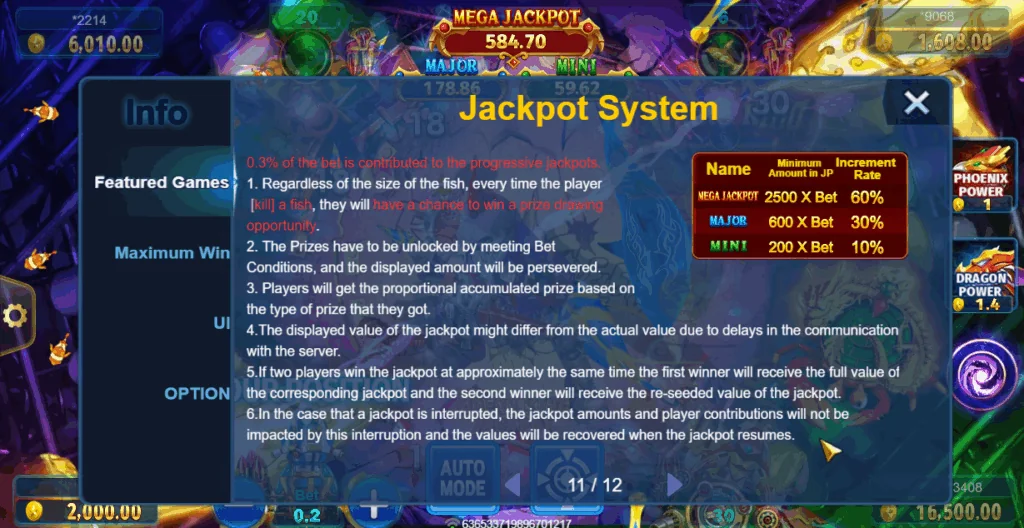
There are three pools, not one. The in-game Info screen lists their minimums as 2,500x the bet for MEGA, 600x for MAJOR and 200x for MINI, and all three grow while the network plays. The published breakdown books 0.3% to the progressive line, which is also the share of every bet that feeds the pools. The increment splits 60% to MEGA, 30% to MAJOR and 10% to MINI.
The trigger is random: any kill can award a pool. No rare target has to be reached first. The Info screen adds that a prize is released only once the bet conditions are met.
It also explains the recurring 2,500x figure. That is the minimum size of the MEGA pool at the moment it becomes payable, and the pool can be larger. Reading it as a ceiling understates the game, and reading it as a target misunderstands how it is awarded.
Mobile Device Compatibility
The studio publishes no standalone app, and none is needed. The HTML5 build runs in any modern mobile browser; when an operator wraps its lobby in an app, the game loads inside that shell.
Installer files offered by third party sites should be ignored. The only application worth trusting is one served from the operator’s own domain.
Performance figures such as memory use, frame rate or load time are not published for this game. What is clear from the demo build is the technology: HTML5 and JavaScript, compiled with the Cocos Creator engine and WebAssembly modules.
Connection stability matters more than the handset. Arena state is live and shared with the other players, so a signal that dips can interrupt a burst of fire.
Advantages and Disadvantages
Advantages
Control is the honest selling point. Aiming, picking a weapon and deciding when to stop firing are real decisions, though the long-term return is capped at the published maximum, 97% or 96.5% on the North American card, however well you make them.
The published RTP is itself an advantage, and an unusual one in this genre. The figure comes with a component breakdown, which is more disclosure than most fishing titles offer.
Volatility is rated low to medium, which the studio links to frequent wins, so the arena tends to pay in small amounts regularly instead of only in rare bursts.
Feedback is transparent. A shell costs a known amount, a kill pays a printed multiplier, and the balance moves for reasons visible on screen. Reel games hide the same arithmetic behind animation.
Limitations
Jackpot hit frequency is not published. The 0.3% progressive share and the three jackpot minimums are; how often a pool actually lands is not, so you cannot plan around the pools.
Speed of loss is the practical risk. Hold to fire has no natural brake, and a Dragon Power shell costs seven times the bet every time it is fired, which is why deposit and session limits matter here.
Shared arenas cut both ways. Several players firing at the same boss means a target you have been working on can be finished by someone else, and there is no way to reserve it.
Documentation stops short of what a session needs. The RTP split and the paytable tiers are published, but the bet range, hit frequency and pool history appear nowhere, which leaves the in-game screens as the only reference for those.
Conclusion
Ocean King Jackpot makes sense read as an arcade shooter with a gambling layer, a published maximum return of up to 97% (96.5% on the North American card) and three network pools that land at random. It is not a slot, and reviews that describe reels, scatters or free spins are describing something else.
Before funding an account the useful checks are short: confirm the operator’s licence in the footer, confirm the shot range and the currency in the lobby, and set a loss limit.
Run the demo first. If raising cannon power to recover a loss starts to feel reasonable, the session is over, whatever the jackpot meter says.
Gambling is for adults aged 18 and over. Set a loss limit before you play, take breaks, and stop if it stops being fun.
Frequently Asked Questions
What is the Ocean King Jackpot RTP?
Can I try Ocean King Jackpot free?
What is the Ocean King Jackpot max win?
Does the game have free spins or a bonus buy?
How are the jackpots awarded?
Do I need to download an app?
What is the minimum stake?
Where can I play it legally?
Where to Play Ocean King Jackpot
The casinos below carry Ocean King Jackpot. Before you play for real money, open the game rules and check which RTP version the casino runs.