
Pappu Demo – Honest Review, RTP & Strategy


Game Overview and Basic Information
What is Pappu? It is a scratch-card game from Jili Games, built on a traditional Indian pastime rather than on reels. Each round lays out twelve covered pictures, one of them is revealed as the winning pattern, and you are paid if it matches a pattern you backed.
The Pappu game has been in circulation since 2019, the publication year JILI prints on its own game sheet. The studio files it under Fish and Arcade rather than under slots, and the paylines field on the official page reads zero — there is no reel mechanic anywhere in it.
Anyone searching for a Pappu slot will therefore find something closer to a lottery ticket than to a spinning game. The Pappu max win is quoted here as 50x the stake, which is the highest multiplier documented for the title.
Pappu volatility is medium. Wins arrive often because you can cover several of the twelve patterns in the same round, but the amounts stay small unless the random multiplier features fire, so the balance tends to drift rather than swing.
Easy, Fast, Comfortable
There is almost nothing to learn. Choose which patterns to back, confirm the stake, reveal.
The Pappu demo runs in the browser on a practice balance, and for a game this simple that is genuinely all the preparation anyone needs. Two or three minutes is enough to see how the twelve patterns, the payout ladder and the multiplier prompts fit together.
Pappu free play is also the honest way to test what happens when you cover more patterns per round. Covering more of the board raises the hit rate and lowers the return per hit, and the practice version shows that trade-off without costing anything.
No download, no account, no waiting. It loads as a web page and closes as one.
How to Play Pappu
Rules and Bet Types
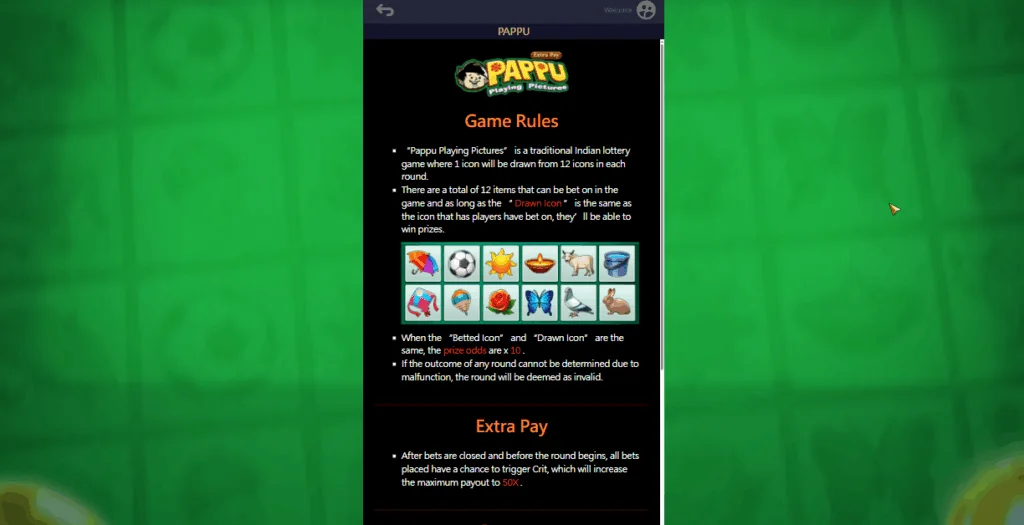
The Pappu rules fit into a sentence: twelve pictures are laid out face down, you place a stake on one or more of them, one picture is revealed as the winning pattern, and matching stakes are paid at the posted odds.
Bets are placed per pattern, so the cost of a round is the sum of the patterns you cover. The entry stake is €0.10 and the documented upper limit is €50 a round, which is a wide band for a game of this type.
Anyone asking how to play Pappu really has only one decision to make: how much of the board to cover. Backing a single pattern is the high-variance option; spreading across most of the twelve is closer to buying a small, frequent return.
Patterns, Extra Pay and the Crit Multiplier
Pappu symbols are the twelve pictures on the card. They are decorative rather than hierarchical — no picture is worth more than another, and the payout depends on the odds attached to the pattern you backed rather than on which image turns up.
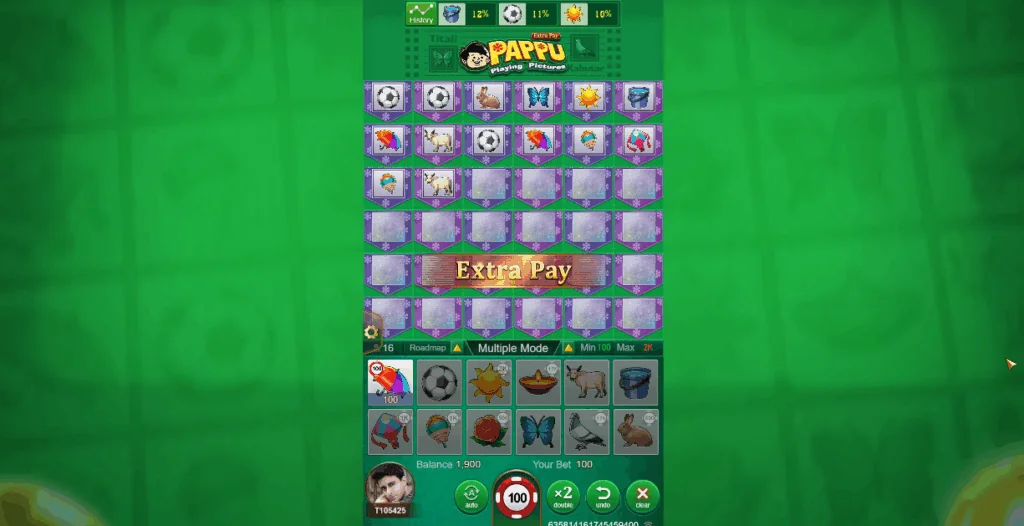
The Pappu features that actually change the maths are the two random multipliers. Extra Pay raises the prize multiplier on a round at random, and the Crit prompt can stack on top of it; together they are the only route to the upper end of the paytable.
Neither multiplier can be bought or triggered on purpose. Both are applied by the game before the reveal, which is why the format stays a pure chance product no matter how you distribute the stake.
Game Design
Theme and Visuals
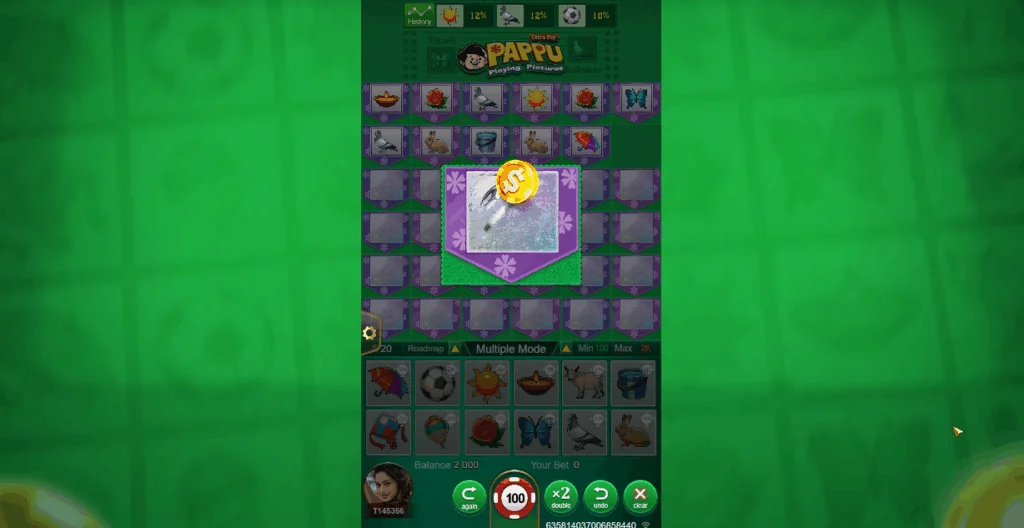
The presentation is deliberately plain: a card of twelve tiles, bright flat colours and Indian motifs on the tile faces.
It looks like the paper game it is modelled on, and that is the point — the audience for this title recognises the layout on sight.
Where the design earns its keep is in the numbers. The odds for every pattern are printed on the board rather than buried in a help screen, and the multiplier prompts appear in the same place every round, so nothing important is more than a glance away. For a game that resolves in two seconds, that clarity matters more than artwork does.
Sound and Gameplay Experience
Audio is a short reveal sting and a coin sound, with a louder cue reserved for the multiplier prompts.
Pappu gameplay is round-based and extremely fast, so the sound is the main signal that something out of the ordinary has happened.
There is no ambience to speak of and no music loop worth mentioning. Over a long session it becomes repetitive, and muting it costs you nothing except the multiplier cue.
Payouts, RTP and Volatility
Payout Structure and Multipliers
Payouts are odds against the stake placed on a single pattern, not against the total cost of the round. That distinction is easy to miss: covering ten patterns and hitting one does not return ten times the posted odds.
The base ladder tops out around ten times the pattern stake, and the two random multipliers are what lift it above that.
Because both multipliers are random and their frequency is undisclosed, the gap between a typical win and the best possible one is much wider than the base ladder suggests. That is worth knowing before treating the headline multiplier as a realistic target.
RTP and House Edge
The Pappu RTP is quoted here as 97.00%, the figure JILI publishes across its fish-and-arcade catalogue and one we verified on eight sibling titles. It is the most defensible number available for this game.
It is not a certified figure. JILI leaves the return field blank on its own Pappu page, SlotCatalog lists it as not available, and the third-party sites that do quote a number disagree with each other — 96%, 96.5% and 97.25% all appear, none of them citing a certificate.
On a 97.00% basis the house edge is 3.00%. Treat that as the studio’s house standard for the category rather than as a measured result for this title, and treat any specific figure you find elsewhere with the same caution.
Max Win and Volatility
The Pappu max win used here is 50x the stake, the highest multiplier documented for the game through the Crit and Extra Pay features. JILI leaves the max-win field on its own game sheet empty, so this is a documented ceiling rather than a certified one.
Volatility is medium and the ceiling explains why: 50x is modest by arcade standards, so the game cannot produce the rare enormous returns that make a high-variance title swing. What you get instead is a steady, small-stakes rhythm — which is the honest appeal of a scratch card.
Pappu Strategy
A realistic Pappu strategy is a budgeting exercise rather than a system. Every pattern carries fixed odds, the reveal is random, and no distribution of stakes changes the expected return.
What you can control is variance. One pattern per round produces rare, larger wins; eight or ten patterns produce frequent small ones at the same theoretical cost.
Set the cost of a round first and then decide how to split it, rather than the other way round. Covering the whole board feels safe but multiplies the round cost, and that is how a €0.10 minimum quietly becomes a €1 round.
Ignore any advice about patterns being due. Each reveal is independent and the multiplier prompts are drawn at random — there is no sequence to read.
Fairness and Randomness
Every reveal is produced by a certified random number generator, and the multiplier prompts are drawn by the same process.
JILI publishes testing certificates for its arcade portfolio on its own site, and this title sits inside that framework.
The practice version uses the identical build, so it is a genuine demo rather than a showreel. That is a real advantage the RNG formats hold over live-dealer products.
Mobile Device Compatibility
The game is HTML5 and vertical by default.
The twelve tiles are large enough to tap accurately on any modern phone.
Because a round resolves in about two seconds, the mobile build suits the format better than a desktop one does — it is designed for short bursts rather than long sittings.
No app is needed on any platform; the browser build is the full game.
Advantages and Disadvantages
Advantages
Very low barrier to entry, €0.10 minimum
Odds for every pattern printed on the board
Free practice mode uses the same RNG
Medium volatility keeps drawdowns shallow
Limitations
No certified RTP published for this title
50x ceiling is low for the category
Multiplier frequency is undisclosed
Repetitive audio and no depth to explore
Conclusion
Pappu is a faithful digital version of a paper game and it is refreshingly honest about what it is: twelve tiles, fixed odds, two random multipliers and nothing else.
The reservation is documentary rather than mechanical. JILI publishes neither a return figure nor a maximum win for this title and third-party listings contradict each other, so the numbers in this Pappu review are the studio’s category standard and the best-documented multiplier rather than certified values.
If you want a fast, low-stakes game with no learning curve, it does the job and the practice mode costs nothing. If you want to know exactly what you are paying for before you play, this is one of the titles where the paperwork simply is not there yet.