Pilot Chicken Demo by Spribe: Honest Review, RTP & Strategy
Game Overview and Basic Information
What is Pilot Chicken? It is a step-based instant-win game from Spribe, and it belongs to the instant-win category rather than the reel category. Instead of a smooth climbing curve it advances in discrete steps: a chicken crosses a busy airport apron one move at a time, and every completed step raises the multiplier.
The Pilot Chicken game is built around a single decision repeated every step: take the multiplier already banked, or risk it on one more move. There are no reels or paylines: progress is a line of steps across the apron, which is why the table below describes a runway.
This Pilot Chicken review works from the published figures. Spribe declares an RTP of 97%, and the risk profile is player-selected through three modes.
Anyone arriving here after searching for a Pilot Chicken slot will find something different from a spinning-reel title. There are no reels and no scatter chains. Spribe does not publish a max win on the official game page, so check the rules panel in the game.
Pilot Chicken Demo and Interface
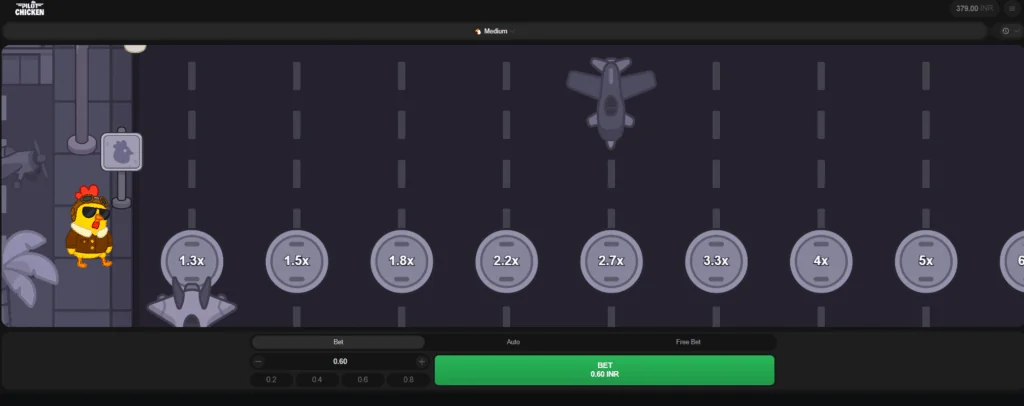
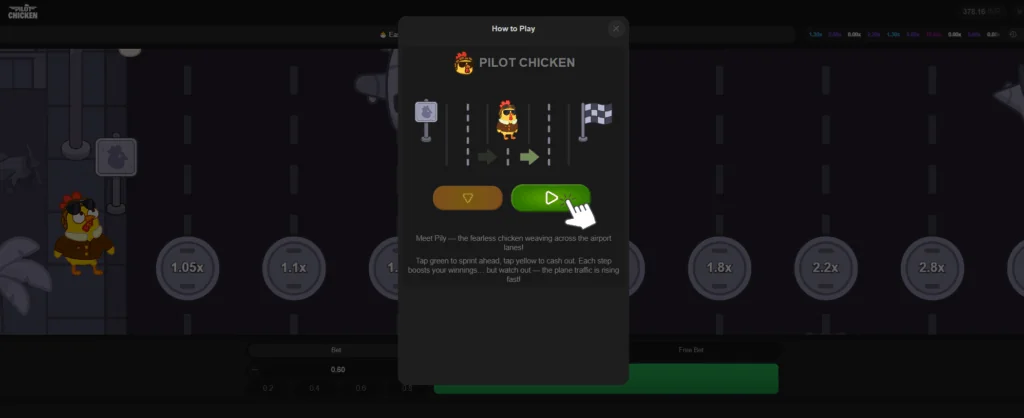
The interface is stripped down on purpose. A green button advances the chicken one step, a yellow button banks the current multiplier, and the difficulty selector sits above them. The running multiplier and the next step’s value are both on screen at once.
A Pilot Chicken demo is available, which is a real advantage of the format over a live table. The outcome comes from a provably fair random generator, so free play runs in the browser on practice credits. It uses the same maths and the same 97.00% return as the real-money build.
Each operator sets its own bet range. The difficulty selector is the main control. It changes both how fast the multiplier grows and how likely each step is to end the run, so the player sets the risk profile before the round.
The round advances only when the player presses the green button, so the tempo is entirely self-directed. There is no countdown and no forced ascent.
How to Play Pilot Chicken
Rules and Bet Types
The Pilot Chicken rules fit into a short paragraph. Choose a difficulty, place a stake, then press the green button to move the chicken forward one step at a time. Each successful step increases the multiplier; press the yellow button at any point to bank it. If a step fails, the round ends and the stake is lost.
Stakes are set by the operator. The difficulty setting determines the multiplier ladder and the survival chance per step, and there are no side bets or bonus purchases layered on top.
Nothing in the Pilot Chicken rules is hidden behind a menu. The bet, the potential return and the current multiplier are all on the main screen, so the format reads as simple even to a first-time player.
Difficulty Modes and Step Multipliers
Three selectable difficulty modes are the defining feature. A lower setting gives a high chance of surviving each step but adds only a little to the multiplier. A higher setting inverts both: it pays much more per step, and each step is much more likely to end the run.
The difficulty selector redistributes variance. Picking the hardest mode does not make the game more generous, only more extreme.
This is where Pilot Chicken gameplay differs most from a reel game. A slot spin resolves itself, but here every step is a fresh decision. Two players staking the same amount can bank very different multipliers on the same difficulty setting.
Game Design
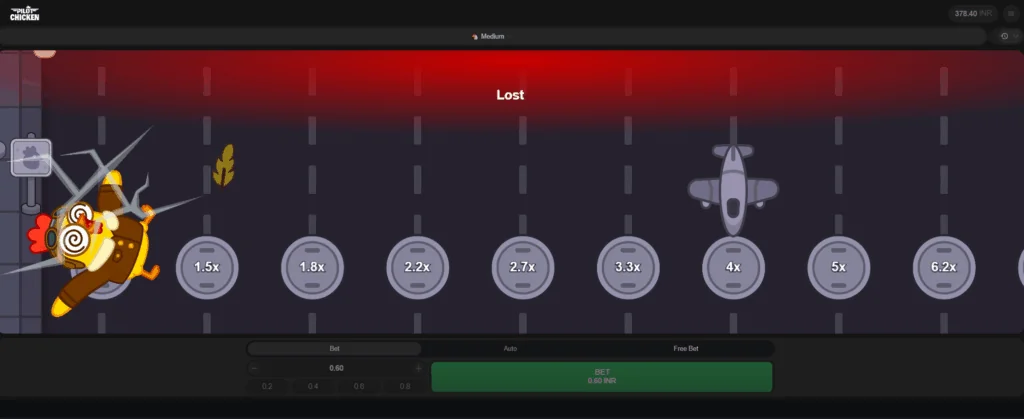
Theme and Visuals
The theme is a comic airport apron: a chicken picking its way between taxiing aircraft, service vehicles and moving obstacles, played entirely for laughs.
The art is bright, flat and cartoonish, with the step markers clearly delineated so the next decision point is never ambiguous. Readability is prioritised over spectacle, which matters in a game where every tap is a choice.
The Pilot Chicken symbols are functional: the chicken, the step markers, the obstacle vehicles and the running multiplier make up the whole set. Because the game has no paytable of picture icons, the on-screen numbers do the work that symbols do in a slot.
Sound and Gameplay Experience
Short comic effects punctuate each step, with a distinct cue for a successful move and a blunt one for a failed one, so the outcome registers before the animation finishes.
There is no continuous soundtrack, which suits a self-paced game; the audio marks events, and muting it loses nothing but flavour.
Round after round the Pilot Chicken gameplay loop stays identical, and that repetition is the point. The tension comes from the player’s own timing.
Payouts, RTP and Volatility
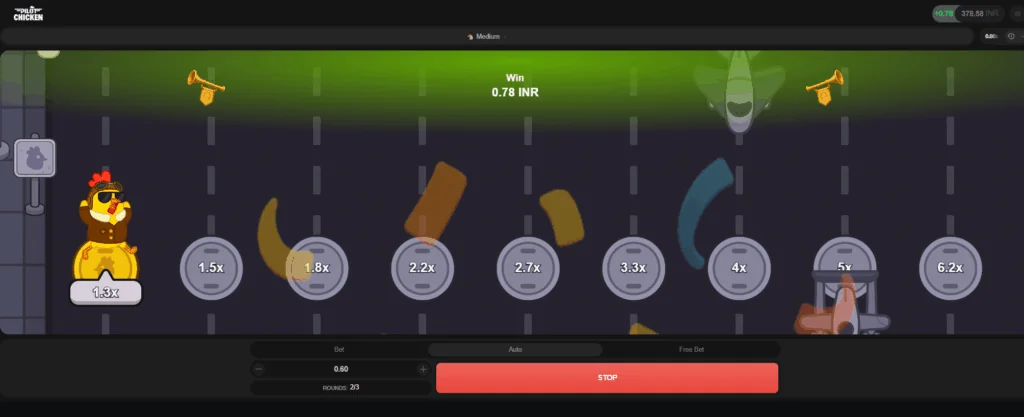
Payout Structure and Multipliers
There is no paytable of symbol combinations. The payout is the stake multiplied by the multiplier shown when the yellow button is pressed. That multiplier builds up step by step.
Each difficulty setting has its own multiplier ladder, so the same number of completed steps pays very differently on Easy than on the hardest mode. The next step’s value is always displayed before it is attempted.
The Pilot Chicken features list is short by design: three difficulty modes, a step-by-step multiplier ladder, manual banking at any point, and a fully self-paced round. There are no free spins, no bonus buy and no side bets.
RTP and House Edge
The Pilot Chicken RTP is 97.00%, which implies a house edge of 3.00%. That is a strong figure for the category and it holds constant across all three difficulty settings.
That figure is a long-run average measured over an enormous number of rounds, not a promise about a session. A hundred rounds can finish well above or well below it, and the player-selected volatility profile widens that spread.
Check the Pilot Chicken RTP inside the operator’s own game info panel before playing for real money, so you know the figure that applies.
Max Win and Volatility
The studio does not publish the Pilot Chicken max win on the official game page. A seven-figure multiplier only becomes mathematically reachable on the highest risk mode, where the chance of surviving each individual step is at its lowest. On the easier settings the practical ceiling is far lower.
In Pilot Chicken, the player chooses the volatility. The same game can behave like a low-variance grinder or an extremely spiky one, depending only on the difficulty setting. The practical reading is that the bankroll needs to survive a run of losing rounds long enough for the format’s maths to show up at all.
Pilot Chicken Strategy
There is no Pilot Chicken strategy that changes the house edge: the return is fixed in the maths and no betting pattern edits it. What a strategy can do is shape the distribution of results: how often a session ends in a small win, and how deep the losing streaks are allowed to run.
The only meaningful decision is a pre-committed step target: choose a difficulty, decide in advance how many steps to attempt, and bank there regardless of how the run feels. Because the return is identical across settings, the choice is purely about the shape of the variance a player wants.
Easy mode with a fixed three or four step target produces frequent small wins; the hardest mode with the same discipline produces mostly losses punctuated by occasional large ones. Neither is better value, but deciding the target before the round removes the step-by-step temptation that costs many players their banked multiplier.
The habit worth more than any pattern is a pre-set loss limit and a pre-set stop. Decide both before the first bet and enter them into the auto controls where possible, so the decision is not made mid-streak.
Fairness and Randomness
The studio titles use provably fair verification. The outcome of each round is committed cryptographically before play begins, and a player can confirm afterwards that the sequence of steps was not altered mid-run.
That matters more in a step-based game than in a single-shot one, because the player is making repeated decisions against the same pre-committed result. The verification tool is reachable from the game’s own interface.
None of this changes the odds in the player’s favour; it only means the odds are verifiable. The studio’s Provably Fair technology lets players verify each round themselves.
Mobile Device Compatibility
The game is built in HTML5 and runs in a mobile browser without an app, so the same URL works on a phone, a tablet and a desktop.
The two large buttons make this easy to play on a phone. The whole interaction is a thumb tapping one of two targets, with no small controls to hit.
Because the round is self-paced there is no reaction-time penalty on a slow connection, which makes this format considerably more forgiving on mobile data than a continuously ascending crash game.
Screen size is the real constraint: the controls scale down comfortably, but running several simultaneous bets is noticeably easier on a larger display.
Advantages and Disadvantages
Advantages
Three difficulty modes set the variance. Being able to choose between a high-survival grind and a long-shot chase inside one game is unusually honest design.
97.00% return holds across all modes. A constant return across risk settings means the difficulty selector controls variance only; no setting is a worse bet.
Fully self-paced with no round timer. Combined with 3 difficulty modes, that keeps the cost of a session predictable.
Provably fair per-round verification. Committing the outcome cryptographically before the first step is the strongest fairness guarantee available, and it matters especially where the player makes repeated decisions. The same is true of banking available at every single step.
Limitations
Seven-figure ceiling only on hardest mode. The max win is not published on the official game page.
Repetitive once a step target is fixed. Following a disciplined plan reduces the game to tapping the same two buttons in the same order, and there is no feature ladder to break that up.
No bonus features or side bets. Every payout comes from the step multiplier alone; there is nothing else to unlock, buy into or trigger.
Hardest mode ends runs very quickly. On the highest risk setting the majority of rounds end within the first few steps, which is mathematically correct but can feel abrupt. It is also fair to note a comic theme that will not suit everyone.
Conclusion
Pilot Chicken is a step-based instant-win game that does one thing and does it cleanly. The 97% return is competitive for the category, and the three modes give the round a reason to be watched.
The difficulty selector is the reason to choose it. The same 97.00% return can be played as a patient grind or as a long-shot chase, and the player makes that choice.
The honest summary: this is not a substitute for a feature-rich slot, and the player-selected volatility means losing runs are part of the design. Try the Pilot Chicken demo first, decide whether the timing decision feels enjoyable, and set the loss limit before switching to real money.
Gambling is for adults aged 18 and over. Set a loss limit before you play, take breaks, and stop if it stops being fun.
If you enjoy deciding when to stop, Red Baron offers a live crash round with the same choice, and Chicken Cross is a chicken crossing game played lane by lane.