
Sic Bo Game Demo by JILI: Honest Review, RTP & Strategy


Game Overview and Basic Information
What is Sic Bo? It is a three-dice table game from Jili Games, and it belongs to the instant-win category rather than the reel category. This is a table game rather than a slot, and there is nothing to spin. Three dice are rolled, and every bet on the board is settled against the combination they show.
The Sic Bo game is built around a board of independent bets rather than a single stake, so what you back matters far more than how much you stake. There is no reel grid, so the table below describes the board instead. Three dice produce a total between three and eighteen, and the board carries bets on totals, on big or small, on specific numbers and on triples.
Jili does not publish a volatility rating on its game card, and bet limits are set by the operator. The game rules in the official JILI demo list an RTP of 97.00%; check the game info at your casino.
There are no reels and no scatter chains, and the published Sic Bo max win is 4,000x the stake. The 4,000x ceiling comes from a triple combined with the Extra Pay boost rather than from a standing price on the board.
Easy, Fast, Comfortable
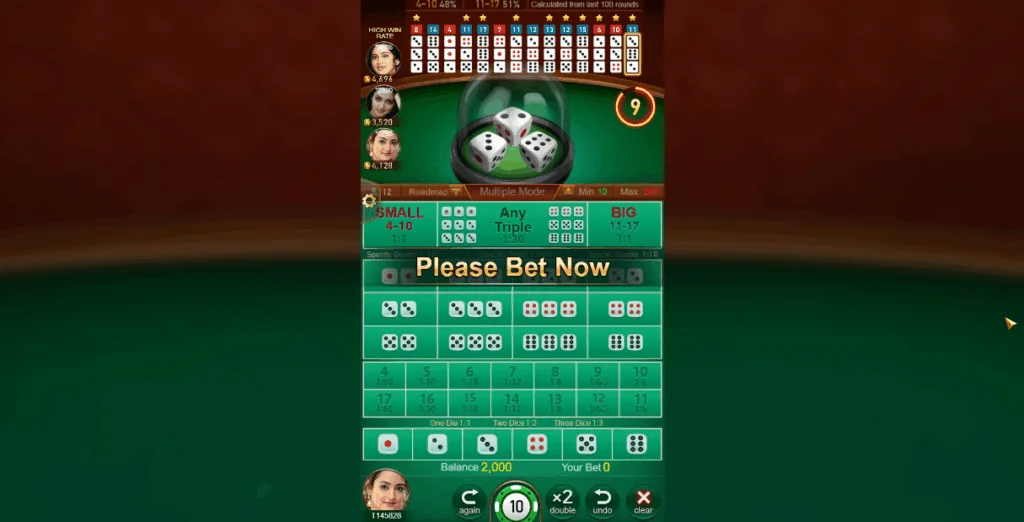
The board fills the lower half of the screen with the dice cup above it, chip denominations along the bottom and a repeat-bet control beside them. The Extra Pay markers appear directly on the affected bet spots.
A free Sic Bo demo is available, and this is one of the real advantages of the format over a live table. The outcome comes from a random number generator rather than physical equipment. So Sic Bo free play runs in the browser on practice credits with no registration and no download, using the same maths as the real-money build.
Bet limits depend on the operator, so check the minimum and maximum stake in the game. The repeat-bet control replays an entire board layout in one tap, which is convenient and also means a complex multi-bet round can be repeated faster than it can be reconsidered.
Rounds are short because there is no decision after the roll, so the game moves faster than a live dealer table would.
How to Play Sic Bo
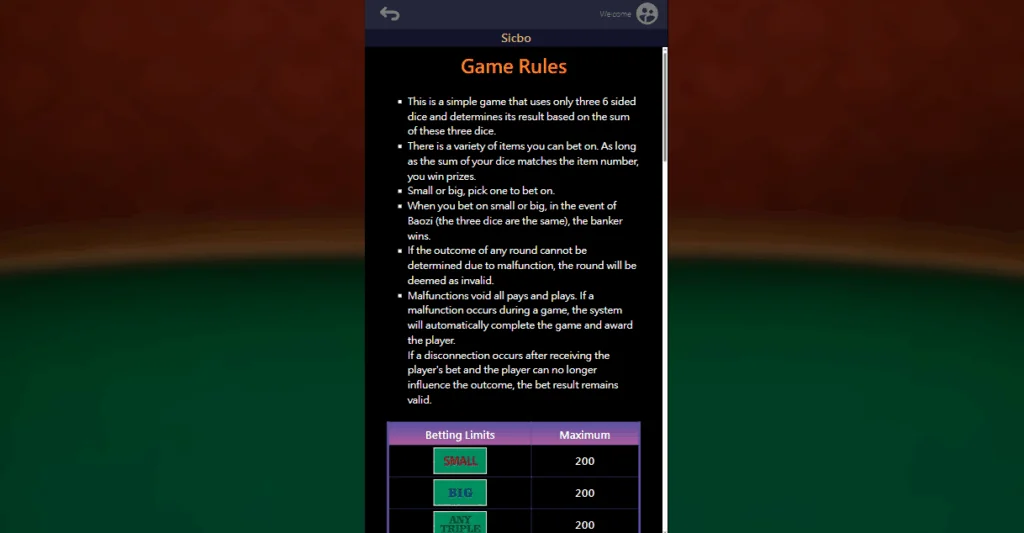
Rules and Bet Types
Place chips anywhere on the board, then roll. Three dice are thrown and every bet covering the result is paid at its posted price. Bets that miss are lost, and there is no second stage.
The standard menu is here: big and small on the total, individual numbers, specific totals from four to seventeen, and triples both specific and any. Prices climb steeply as the covered outcomes narrow.
Extra Pay and the Free Bonus Game
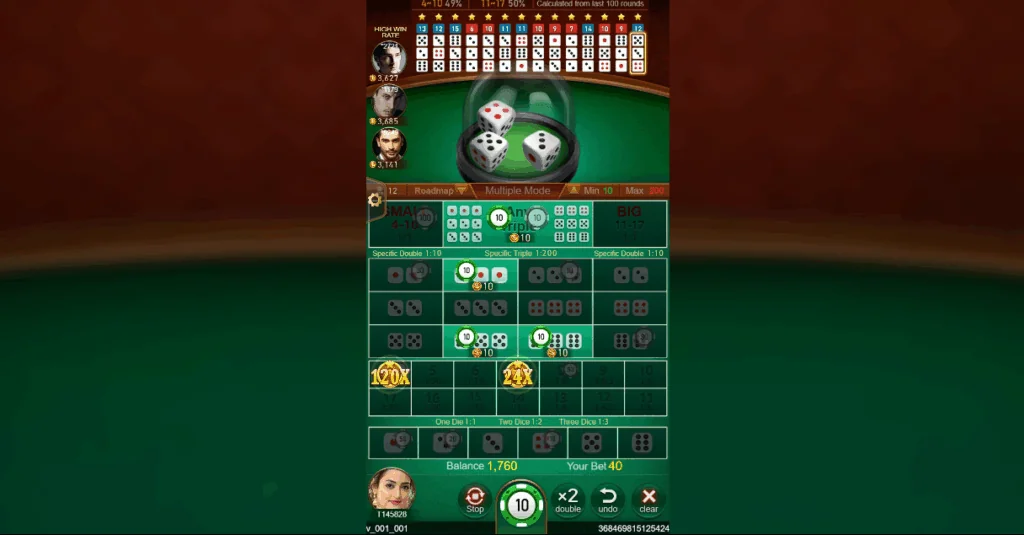
Before the roll, the game can mark selected bet spots with boosted prices. This is the Extra Pay layer, and it is what lifts the ceiling well beyond the standard sic bo paytable, the studio describes reaching four-figure multiples through it.
There is also a bonus game that costs nothing to enter and is awarded from the base game. It is a short additional round rather than a feature with its own structure, and it is the second route to the larger multiples.
There is no cash-out mechanic, each roll settles every bet immediately, so the only ongoing decision is which spots to cover next.
Game Design
Theme and Visuals
The theme is a traditional Asian dice table rendered in a bright, modern style, with the cup and dice presented plainly rather than dressed in a narrative.
The presentation is dense but legible: a full bet board with clear pricing on every spot, and the Extra Pay markers standing out against it. There is little decoration and no wasted space.
The Sic Bo symbols are functional rather than decorative. The three dice faces and the bet spots on the board are the symbols, and the Extra Pay markers are the ones that change a round’s value.
Sound and Gameplay Experience
Audio centres on the dice rattle and a short payout chime, with a distinct cue when Extra Pay lands on the board.
That Extra Pay cue is the one worth listening for, because it signals a change in pricing before you have committed chips.
Payouts, RTP and Volatility
Payout Structure and Multipliers
Big and small pay close to even money, individual numbers pay by how many dice show them, and specific totals climb steeply toward the edges of the range. Triples carry the highest standing prices, reaching 180 to 1.
Extra Pay overlays boosted prices on selected spots, which is how the game reaches its advertised ceiling. Without it, the board tops out at the standard triple price.
The Sic Bo features list is short by design, The features are Extra Pay boosted pricing, a free bonus game awarded from the base game, and one-tap repeat betting. There are no free spins or progressive elements.
RTP and House Edge
The game rules in the official JILI demo list an RTP of 97.00%; check the game info at your casino. Each bet on the board carries its own return, and the game rules list the details.
A hundred rounds can finish well above or well below it, and the triples make that spread wider rather than narrower.
Check the Sic Bo RTP inside the operator’s own game info panel before playing for real money. Some studios license more than one return configuration, and the version an operator deploys is the one that applies.
Max Win and Volatility
The Sic Bo max win is 4,000x the stake, according to Jili’s own game page.
Jili does not publish a volatility rating, and variance is set by which spots you cover. Big and small behave gently while triples are extremely spiky, so no single rating applies. The practical reading is that the bankroll needs to survive a run of losing rounds long enough for the format’s maths to show up at all.
Sic Bo Strategy
Big and small are the only bets that keep the return near the headline figure over a session. Specific totals and triples are priced fairly but land rarely, so treating them as occasional side stakes rather than the main plan is the sensible approach.
Covering many spots at once feels like insurance but is not: each bet is independent and each carries its own margin. So spreading chips widely just pays the house margin more times per round.
Fairness and Randomness
The game runs on a random number generator, and the dice result is generated independently each round.
There is no carry-over between rounds and no adjustment based on prior results. The outcome of each round comes from a random number generator.
None of this changes the odds in the player’s favour; it only means the odds are verifiable.
Mobile Device Compatibility
The board is compact enough to work in portrait, and the big and small spots in particular are large easy targets on a phone.
Precise betting on individual totals and triples is harder on a small screen, because those spots are the smallest on the board.
Advantages and Disadvantages
Advantages
Extra Pay boosts on the board. JILI lists Extra Pay and a Bonus Game on the official game card.
Extra Pay boosts prices before the roll. You see the boosted price before committing chips.
Free bonus game awarded from base play.
A free Bonus Game with prizes above 1,000x.
Limitations
The game rules in the official JILI demo list an RTP of 97.00%; check the game info at your casino. The JILI RTP API lists the same 97.00% figure.
No feature depth beyond Extra Pay. The bonus game is a short round rather than a structured feature.
Wide board invites over-betting. Every additional spot pays the house margin again.
Triples land very rarely. It is also fair to note one-tap repeat speeds up spending.
Conclusion
Sic Bo is a three-dice table game that does one thing and does it cleanly. The 4,000x ceiling and the free Bonus Game give the round a reason to be watched.
For a second opinion on this style of game, compare Sic Bo with Andar Bahar and 7up7down, two JILI releases we have reviewed in the same format.
Sic Bo from this studio is a competent RNG version of a classic with one real addition: Extra Pay gives it a ceiling that standard sic bo does not have. The board is complete, and the free bonus game is a fair inclusion. The problems are the absence of any real feature depth and a board that tempts players into spreading chips across bets that each carry their own margin.
The honest summary: this is not a substitute for a feature-rich slot, and the bet-dependent volatility means losing runs are part of the design.