Zombie Blasters Slot Review 2026 – RTP, Multiplier Wheel and Max Win
Zombie Blasters at a Glance
Zombie Blasters is a 6×5 cluster pays slot from PG Soft, released in June 2026, and the name oversells the action considerably. Nobody aims anything. What you actually get is a cluster grid with cascades, a supply of x2 multiplier symbols, and one genuinely clever device: an Alarm symbol that spins a wheel above the reels and then rewrites every multiplier on screen to whatever the wheel landed on.
The headline numbers are good. PG Soft publishes the return as 96.75% and the ceiling as 10,000x. Volatility runs high, and independent listings put the hit frequency at 24.81%, which is roughly one paid spin in four. For a high variance cluster game that is a comfortable rate, and it comes from the cascade structure rather than from generous symbol values.
There is one caveat that deserves top billing. In PG Soft’s own game data the return figure sits in a field labelled max RTP, not RTP. That wording is a strong signal that lower certified builds exist and that operators choose which one to run. The 96.75% is the best case, not a promise.
Zombie Blasters Key Facts and Specifications
The table below combines PG Soft’s published game data with the largest independent slot database and with a reel capture of the game running. Where they differ, both readings appear.
| Item | Detail |
|---|---|
| Provider | PG Soft (Pocket Games Soft) |
| Release date | 10 June 2026 per the database, 15 June 2026 per the studio record |
| Game type | Video slot, cluster pays |
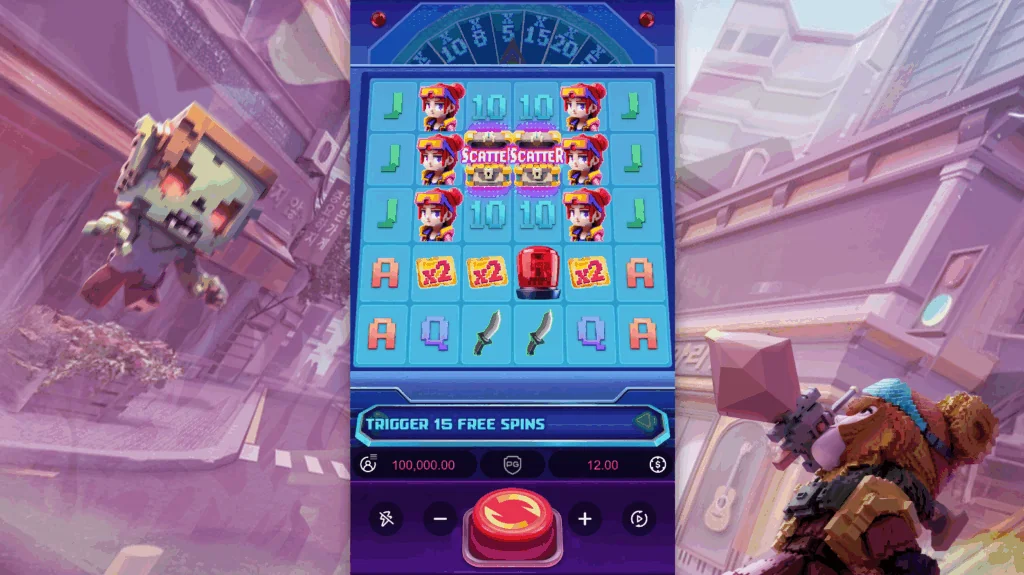
| Grid | 6 columns by 5 rows, 30 cells, confirmed on a reel capture |
| Ways to win | Cluster Pays, 8 or more matching symbols joined by their sides |
| RTP | 96.75%, published by the studio in a field labelled max RTP |
| Volatility | High |
| Hit frequency | 24.81% per independent listings, not published by the studio |
| Max win | 10,000x the bet |
| Min bet | 0.60 |
| Max bet | 180.00 |
| Multiplier symbols | x2, cumulative by addition |
| Multiplier Wheel | x5 to x50, triggered by the Alarm symbol |
| Free spins | 10, 15 or 20 depending on scatter count |
| Jackpots | None |
| Technology | HTML5 and JavaScript |
| Studio tagline | Alarm symbols will activate the wheel to boost your multipliers |
Two gaps stand out. Neither the studio nor the main database publishes a hit frequency, so the widely quoted 24.81% comes from secondary listings and should be treated as indicative. And the database records no file size at all, which for a June 2026 release simply means nobody has measured the build yet.
What PG Soft Publishes About Zombie Blasters
The studio’s own description is short and unusually specific about the mechanics, so it is worth taking at face value. PG Soft calls Zombie Blasters a five by six symbols combination video slot featuring a multiplier wheel that transforms all of the multiplier symbols on the reels. It adds that any Alarm symbol involved in a win will transform into a Multiplier symbol with a multiplier of up to x50, and that collecting four or more Scatter symbols triggers different amounts of free spins.
Note the wording on the grid. The studio writes five by six, the database records six by five, and a reel capture settles it: six columns across, five rows down, thirty cells in total. The studio is simply listing rows first. Nothing is in dispute except the order of the numbers.
The Arcade Framing Is Part of the Design
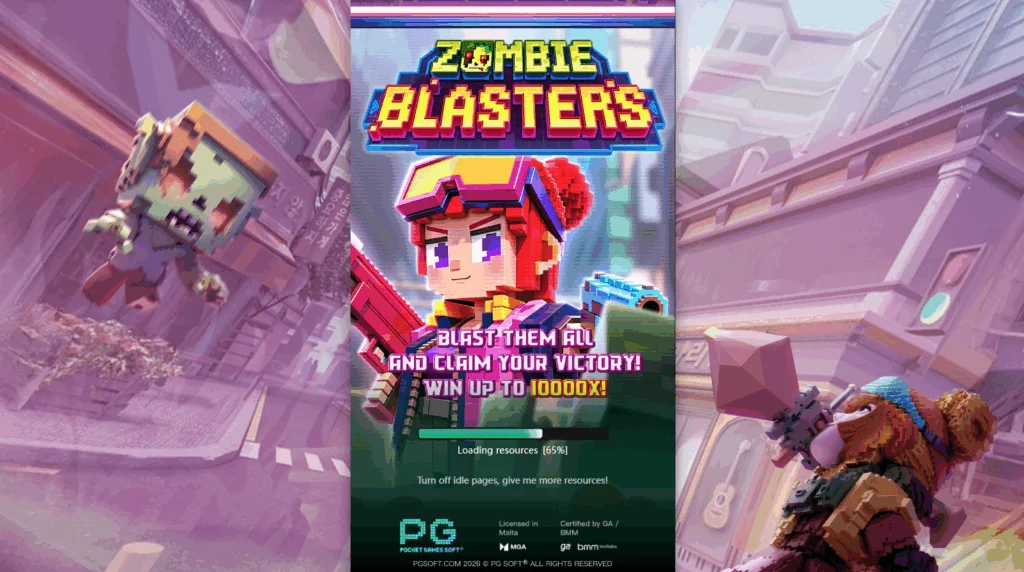
PG Soft frames the whole thing as an arcade cabinet. Its description sets the scene inside a busy arcade, with a machine that stands out for its bright red button and flashing alarm light, and a goggle wearing girl with twin red buns fighting through zombie filled ruins to defend the last safe zone. One press of the red button, the studio says, unleashes bullets and flying blades. That is not just flavour text: the reel capture shows a large red arcade button where the spin control normally sits, and the flashing alarm light is the Alarm symbol that drives the wheel.
The 6×5 Grid and How Cluster Pays Works
There are no paylines and no betways. A win starts when eight or more identical symbols touch each other along their sides, anywhere on the thirty cell grid. Diagonal contact does not count. The game then removes the paid group, drops new symbols into the gaps, and checks again.
Eight out of thirty is a demanding threshold for a cluster game, and it explains a lot about the volatility profile. You need better than a quarter of the grid occupied by one symbol before anything pays. The reel capture shows the practical effect: a grid full of royals and weapons where several symbols come close to a cluster without quite forming one.
Cascades Are the Engine, Not a Bonus
The cascade is not a feature you trigger; it is how every spin resolves. A paid cluster clears, replacements fall, and the chain continues until no winning cluster remains. Databases file this under both cascading and avalanche, which are two names for the same behaviour. Everything else in the game is built on top of the chain, and the multiplier rules only make sense once you understand that a single spin can resolve through several rounds of clearing.
The x2 Multiplier Symbol Explained
The x2 Multiplier symbol pays nothing on its own. It is a modifier, and it only matters when the spin already has a win to modify. It can land on any spin in the base game.
The arithmetic is addition, not multiplication, and that distinction matters. Once the cascade chain finishes, the game sums every x2 symbol involved in the final payout. One symbol doubles the spin win. Two make it x4. Three make it x6. Ten would make it x20. Because the values add rather than compound, a screen full of them grows the win steadily rather than explosively, and that keeps the base game from producing wild outliers on its own.
Why Longer Chains Help
Since the multipliers are counted at the end of the chain, a spin that cascades several times has more opportunities to bring x2 symbols into the final payout. That is the quiet synergy in the design. Cluster slots with cascades often waste modifiers on early links; here the accounting happens once, at the end, on the total.
The Zombie Blasters Multiplier Wheel
This is the mechanic worth playing for. The Alarm symbol activates the Multiplier Wheel when it is still on the reels at the end of a winning spin. The wheel reveals a value between x5 and x50. Then comes the part that makes it powerful: the Alarm symbol and every visible Multiplier symbol on the grid all convert into Multiplier symbols carrying the revealed value, and only then is the spin win paid with the upgraded total.
| Element | Behaviour |
|---|---|
| Trigger | Alarm symbol remaining on the reels at the end of a winning spin |
| Wheel range | x5 to x50 |
| Effect | The Alarm and all visible Multiplier symbols become Multiplier symbols at the revealed value |
| Payment order | The wheel resolves first, then the spin win is paid with the upgraded multiplier |
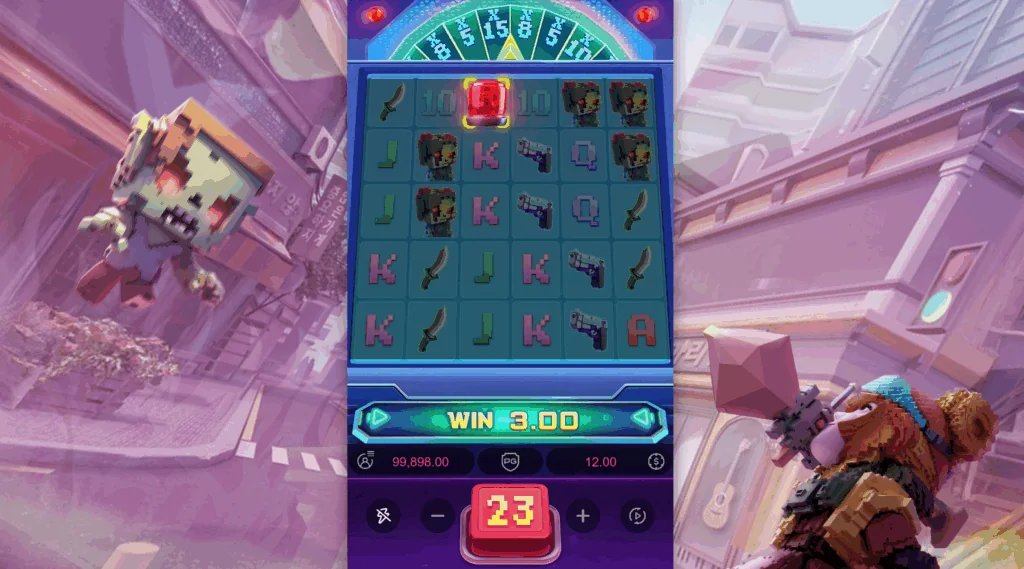
| Verified on screen | A wheel sits above the grid showing values including x5, x8, x10 and x50 |
The upgrade rule is the whole point. A grid holding four x2 symbols is worth x8 by addition. If the wheel lands on x50, those four symbols plus the Alarm all become x50 symbols, and the same grid is now worth x250. The number of multiplier symbols on screen when the alarm sounds matters far more than the wheel value alone.
The Wheel Is Visible Above the Reels
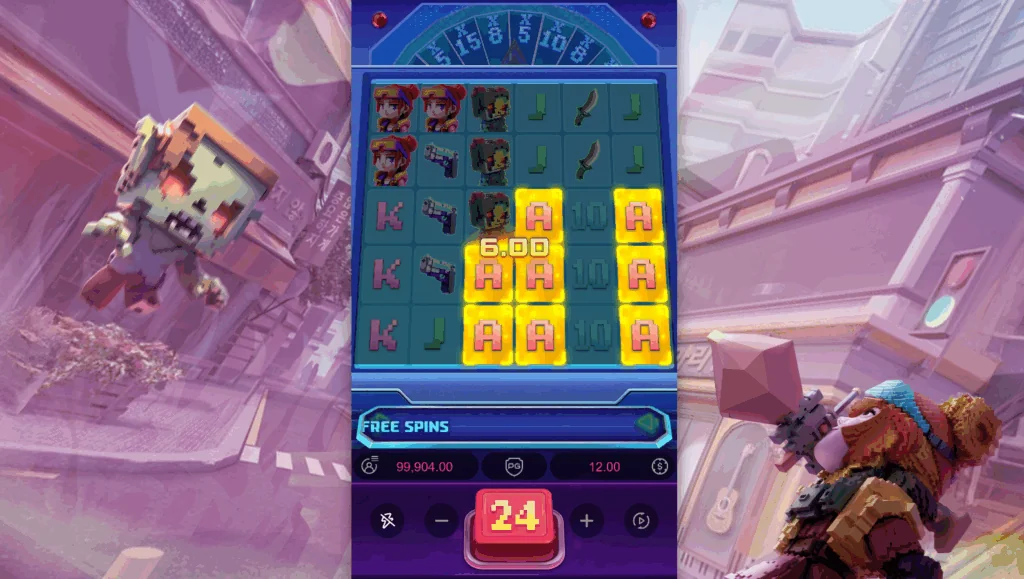
A published capture of the game confirms the layout described here. The wheel sits directly above the grid with its segments legible, including x5, x8, x10 and x50 among them, and a banner beneath the reels reads that the alarm symbol will activate the Multiplier Wheel. The mechanic is signposted in the interface rather than buried in a help screen, which is unusual and welcome.
Zombie Blasters Free Spins and the Multiplier Bank
Scatters open the bonus, and the studio confirms that four or more are needed. The award scales with the count.
| Scatters | Free spins |
|---|---|
| 4 | 10 |
| 5 | 15 |
| 6 or more | 20 |
Inside the round the rules change in one decisive way. Multipliers no longer reset after each spin. Instead they move to a bank displayed below the reels and stay there until the bonus ends, and any new Multiplier symbols that land are added to the banked value for that spin’s payout. Three or more scatters during the round add five extra spins, which matters most once the bank has already accumulated a few values.
Why the Bank Changes the Maths
In the base game a multiplier is worth something once. In free spins it is worth something on every remaining spin. That turns the bonus from a batch of extra spins into a compounding structure where the early spins are effectively investments in the later ones. It also explains why extra spins are valuable here in a way they are not in most slots: five more spins on a bank that already reads x40 is worth far more than five more spins at the start.
The Alarm Still Works Inside the Round
The wheel is not disabled during free spins, and since the wheel rewrites every visible Multiplier symbol to its value, an alarm landing late in a well stocked round is the single most valuable event in the game. That combination, a full bank plus a high wheel value, is the realistic route to the ceiling.
Zombie Blasters RTP and the Max RTP Problem
Every source publishes 96.75%, and that is a strong figure. The market average sits around 96.2%, so this game is above it, and a 3.25% house edge is competitive for a feature heavy cluster release.
The problem is the label. In PG Soft’s own game record the figure appears in a field named max RTP rather than RTP. Studios do not choose that word casually, and the main database independently tags the game with a generic 96% RTP marker rather than a fixed value. Read together, those two signals point the same way: more than one certified build almost certainly exists, and the operator decides which one you play. Nobody publishes the lower figures, which is exactly why you should open the game’s own information screen and read the number there before you commit real money.
What the Difference Is Worth
If a reduced build ran at, say, 94.75% instead, the house edge would rise from 3.25% to 5.25%. That is a 60% increase in expected cost per spin for an identical looking game. No feature in the list compensates for that, which is why the check matters more here than the headline number does.
Volatility, Hit Frequency and What Sessions Feel Like
Volatility is high, and every source agrees. The published hit frequency of 24.81% comes from secondary listings rather than from the studio or the main database, so treat it as indicative, but it is plausible for a cascading cluster game where any resolved chain counts as a hit.
One paid spin in four sounds generous until you remember what most of those hits are worth. An eight symbol cluster of a royal on a 6×5 grid is a small return, often less than the stake. The distribution is therefore lots of tiny recoveries that slow the bleed, with the actual variance concentrated entirely in the alarm and the bonus. Base game stretches without a multiplier hit can feel very dry, and the database’s own review says so.
Where the 10,000x Zombie Blasters Max Win Comes From
The studio publishes the ceiling as 10,000x and records it in the same data as the return, so the figure is first party rather than an estimate. Working backwards from the mechanics makes it look reachable rather than decorative.
Take the wheel at its maximum of x50. To reach 10,000x you then need a base payout of 200x before multipliers, or a smaller payout combined with a free spins bank stacked well above x50. Both routes exist. A long cascade chain on a high value symbol during free spins, with a bank already holding several wheel values and an alarm landing on top, is the shape of a maximum win here. It is not a single lucky spin.
The Cap in Money Terms
At the 0.60 minimum stake the ceiling is worth 6,000. At the 180.00 maximum it is 1,800,000. The multiplier does not change with the stake, so the bet size decides the entire scale of the outcome.
Betting Range and Bankroll Maths
Bets run from 0.60 to 180.00, a three hundred fold spread, and both the database and operator listings agree on the limits. The 0.60 floor is a consequence of the cluster structure rather than an arbitrary choice, and it makes long test sessions affordable.
For planning purposes the useful figures are the edge and the bonus rate. At 96.75% you expect to lose 3.25% of turnover, so a thousand spins at 1.00 carries an expected cost of about 32.50, with a realistic swing many times larger in either direction. Because the variance sits in the bonus, the sensible approach is to buy as many spins as your budget allows rather than to raise the stake and shorten the session.
Sizing Against a Rare Bonus
Nobody publishes how often four scatters land. What the structure tells you is that the free spins round is where the multiplier bank lives and therefore where almost all of the upside sits. A stake that lets you reach the bonus a handful of times is worth more than a stake that produces one large base game win and then runs out of spins.
Theme, Presentation and the Arcade Framing
The look is voxel indie rather than horror. The undead are built from chunky cubes, the weapons are oversized, and the ruined city backdrop keeps everything on the arcade side of the line. A reel capture shows the symbol set clearly: royal card values in pastel pixels, a blade, a pistol, a zombie head and the goggle wearing heroine PG Soft describes.
The interface follows PG Soft’s mobile first habit, and on a wide monitor that shows. The playable area is a narrow vertical panel with the wheel above and the red arcade button below, and the rest of the screen is filled with static backdrop art. On a phone it will look purpose built. On a desktop it looks like a phone game running in a frame.
One Claim I Could Not Verify
At least one review refers to feature purchases in this game. The main database’s feature list does not include a buy feature, and the studio description does not mention one either. Two out of three sources therefore say no. If a buy button matters to you, look for it in the lobby before you assume it is there.
Zombie Blasters Verdict: Who This Slot Suits
Zombie Blasters is a better game than its title suggests and a riskier proposition than its RTP suggests. The Multiplier Wheel is a genuinely good idea, because converting every multiplier on screen to a single high value creates a moment where a modest grid becomes a large payout. The free spins bank compounds that properly. Those two mechanics working together are worth the attention.
Against that sits the max RTP labelling, which turns the strongest number in the review into a conditional one, and a presentation that wastes most of a desktop screen. It suits a player who enjoys cluster mechanics, who will actually check the RTP in the game information screen, and who is playing for the bonus rather than the base game. It suits nobody who wants steady returns or a shooter.
What to Check in the Demo
Two things. First, the RTP shown in the information screen, because that is the number that applies to you. Second, how often the alarm actually lands, since the wheel is the mechanic carrying the whole design and everything else in the game is a way of waiting for it.
For context on how this sits against its neighbours, our Bakery Bonanza review covers another release on the same studio engine, Alibaba’s Cave of Fortune is a second title from that engine, and Captain’s Bounty is one more title from that engine.