Fire in the hole 3 Slot Demo – Honest Review, RTP & Volatility

Game Overview and Basic Information
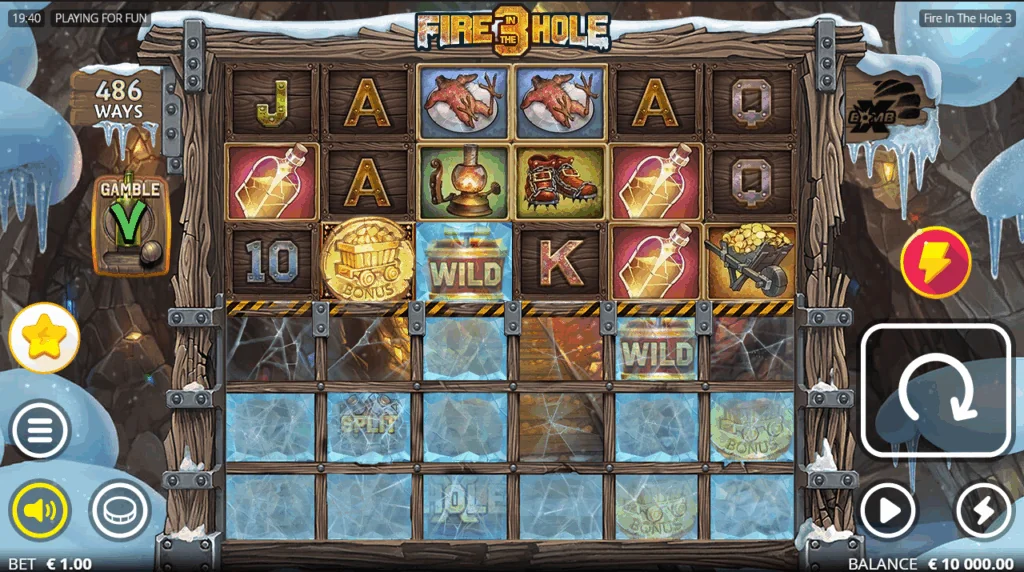
Nolimit City released Fire in the Hole 3 as the third chapter in a mining-themed series that progressively pushed volatility and mechanic complexity further with each installment. Where the first two entries established the underground aesthetic and introduced core xBomb mechanics, this version reconfigures the grid structure and multiplier logic to produce a genuinely different risk profile – not just a reskin.
The game operates on a 6-reel grid that expands dynamically through the xWays mechanic during specific trigger conditions. Base RTP is set at 96.05%, which sits comfortably above the industry median for high-variance titles in this category. That figure, however, only becomes meaningful when paired with the volatility classification: Fire in the Hole 3 volatility is rated extreme – not merely high. The distinction matters because session behavior is significantly different from standard high-volatility slots. Long dry stretches are built into the math model, not accidental.
Maximum win potential reaches 50,000x the bet. That ceiling is not theoretical padding – it connects directly to the stacked multiplier sequences achievable in the deepest bonus states. Minimum bet starts at €0.20, with a maximum of €100 per spin, giving the game a usable range across different bankroll sizes without demanding high stakes to access core features.
The hit frequency in base game hovers low by design. Nolimit City engineered this title specifically for players who accept extended losing sequences in exchange for the mathematical possibility of disproportionate returns in bonus phases. Understanding that trade-off before the first spin is the single most important piece of context for this game.
Easy, Fast, Comfortable
The interface strips away everything non-essential. Bet adjustment, autoplay controls, and the paytable are accessible within two interactions from the main screen – no nested menus, no obscured settings. The spin button response time is immediate across tested configurations, and the game doesn’t insert artificial delays between outcomes outside of animation sequences, which can be shortened via the turbo setting.
Autoplay supports up to 1,000 spins with configurable stop conditions: single win cap, total loss threshold, or both simultaneously. The loss limit implementation is particularly clean – it calculates against session balance rather than individual spin value, which gives players a more accurate stopping trigger.
Loading times in demo mode are fast even on mid-range devices. The free play version mirrors the full game without authentication barriers – no registration required to access it, which removes friction for players evaluating the mechanic before committing funds. Fire in the hole 3 free play runs identically to the real-money build in terms of feature triggering and animation, so the demo serves as a genuine simulation rather than a simplified preview.
The game history log tracks the last 100 rounds with expandable detail per spin, including feature triggers and individual reel outcomes. For a high-volatility title where session tracking carries real strategic value, this level of record-keeping is genuinely useful rather than decorative.
Game Design
Theme and Graphics
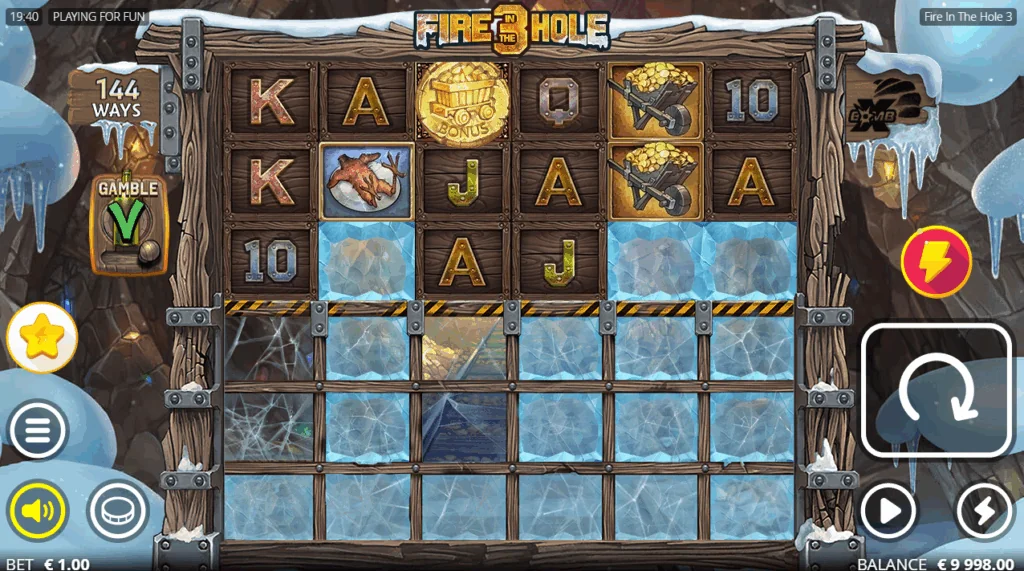
The visual language is built around a derelict mine shaft – crumbling timber supports, explosive charges embedded in rock faces, lantern light casting uneven illumination across the reels. Nolimit City’s art team applied a gritty, desaturated color palette with deliberate contrast spikes on high-value symbols, which creates a functional visual hierarchy without relying on garish color coding.
Reel backgrounds shift when bonus states activate, deepening into darker tunnel environments as multiplier values escalate. It’s not decorative – the visual shift acts as an ambient indicator of current game state, which reduces the need to track numerical overlays during fast-play sequences.
Symbol animations avoid the overproduction common in competitor titles at this budget level. Explosions trigger crisply without frame stuttering, and idle animations on high-value characters are subtle enough to avoid becoming visually fatiguing over long sessions. The overall aesthetic consistency across the series is maintained here, but with a noticeably higher polygon count on character models compared to the previous entries.
Sounds and Gameplay Experience
The audio design commits fully to the underground industrial setting. The base game soundtrack runs at low intensity – rhythmic but unobtrusive, built around percussion and ambient mechanical noise rather than melodic loops. This pacing choice is deliberate: it prevents audio fatigue during base game, then uses escalating sound design during feature sequences to create genuine tension differentiation.
Explosion audio when xBombs detonate is punchy and spatially positioned – each blast sounds directionally distinct from the last, which prevents the repeated trigger sound from becoming homogeneous. Win celebrations scale with win size through dynamic audio layering, avoiding the flat celebration tone that makes many high-volatility titles feel tonally mismatched when large wins occur.
Muting the game removes all audio including spinning sounds without affecting animation timing – useful in shared environments. Sound effects and music can also be adjusted independently, which is a small but appreciated UX consideration that many competing titles overlook entirely.
Bonuses and Symbols
Symbols in the Game
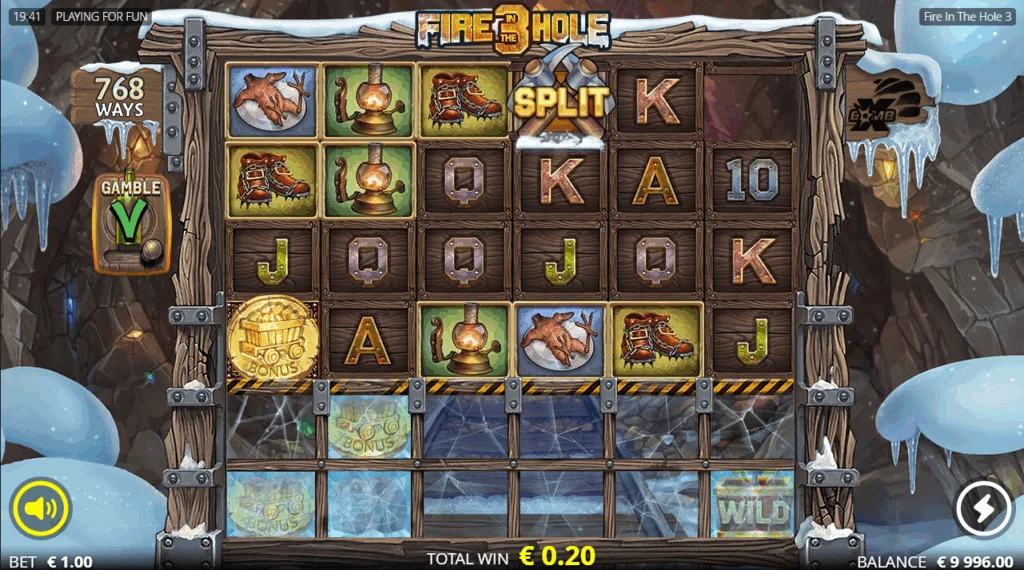
Fire in the Hole 3 symbols divide into two functional tiers. Low-value symbols are represented by mining equipment – helmet, pickaxe, lantern, and dynamite bundle – each carrying distinct payout values with no overlap in combination thresholds. High-value symbols feature character portraits of the miners themselves, each with a named identity tied to the game’s lore, which adds specificity to what could otherwise be generic premium icons.
The xBomb Wild functions as both a substitution symbol and a core mechanical trigger. It substitutes for all standard symbols and attaches a multiplier value on collection. Crucially, when multiple xBombs appear in a single sequence, their multiplier values compound rather than add – this compounding behavior is the mathematical engine behind the title’s enormous 70,000x max win potential.
Scatter symbols take the form of mine cart icons and appear exclusively on designated reels. Their positioning logic is constrained to specific column positions, which affects base game trigger probability in a way that’s worth understanding before adjusting bet sizing.
Bonus Rounds and Free Spins
The primary bonus entry point is the Free Spins round, triggered by landing three or more scatter symbols. Initial allocation is 8 free spins, with retrigger potential during the feature adding incremental spins rather than resetting the count. This accumulation mechanic extends feature duration meaningfully when consecutive retriggers occur.
During free spins, xBomb Wilds collected across the sequence build a persistent multiplier that carries forward rather than resetting between spins. This carry-forward behavior is the central distinction between base game xBomb interactions and feature-phase interactions – the same symbol functions differently depending on game state, which creates a compounding escalation pattern unique to the bonus environment.
The xNudge mechanic activates when a Wild partially appears on a reel – it nudges fully into view and applies an incremental multiplier addition for each position nudged. In deep bonus sequences where multiple xNudges occur across the same free spin allocation, the multiplier stack can reach values that make even modest base bet sizes produce outsized payouts.
There is no gamble feature attached to the bonus round exit. Wins are credited directly, which maintains the mathematical integrity of the RTP calculation without the variance distortion that gamble mechanics introduce.
Paytable and Winning Combinations
Winning combinations pay left to right from the leftmost reel. Minimum combination length is 3 matching symbols across adjacent reels. The paytable structure is not flat – payout values scale non-linearly between 4-symbol and 5-symbol combinations, with the jump from 4-of-a-kind to 5-of-a-kind on premium symbols representing a multiplier increase rather than a proportional addition.
High-value character symbols at 5-of-a-kind return between 5x and 25x the bet in base game without multiplier involvement. That range is unremarkable for a standard spin but becomes the foundational value that multiplier compounding operates on during feature phases – the base symbol value matters more in this game than in titles where bonus payouts are detached from the standard paytable.
Low-value symbol combinations return between 0.1x and 1x at maximum combination length, which reflects the math model’s intent: base game symbol wins function as partial bankroll preservation between feature triggers rather than meaningful profit sources.
Jackpot
Fire in the Hole 3 does not operate a progressive jackpot system. The 50,000x maximum win is a fixed theoretical ceiling derived from the multiplier compounding logic within the free spins feature – it is not connected to a networked prize pool or community jackpot mechanic.
This distinction is functionally significant. Fixed max win structures mean the probability of reaching the ceiling is governed purely by the base game math model and does not fluctuate with jackpot accumulation states. The absence of a jackpot feed also means the full RTP figure of 96.05% is not diluted by jackpot contribution deductions, which some progressive titles apply at rates between 1-3% of stated RTP.
Mobile Device Compatibility
The game runs on HTML5 without requiring dedicated application installation. Tested across iOS Safari and Android Chrome, frame rates remained stable during standard base game play. Feature sequences with simultaneous xBomb detonations and multiplier animations showed minor frame drops on devices older than 2020 hardware specifications – not enough to impair gameplay, but visible in side-by-side testing against current-generation hardware.
Portrait mode on mobile presents a compressed reel view with repositioned controls to the bottom of the screen. Landscape orientation expands the play area and is the recommended configuration for extended sessions – the symbol detail and animation clarity improve noticeably in that layout. Touch target sizes for bet adjustment and spin activation are adequately sized for standard use without mis-taps during normal interaction.
The demo version functions identically on mobile without requiring account state, which means the Fire in the Hole 3 demo can be assessed on any device as a genuine performance test before real-money play. Battery consumption during feature sequences is higher than base game due to animation processing load – a minor consideration for sessions exceeding 30 minutes on mobile.
Advantages and Disadvantages
Advantages
The multiplier compounding architecture separates this title from the majority of high-volatility competitors. Rather than applying a flat multiplier to a total win, the xBomb carry-forward system creates escalating value within a single feature session – the later spins in a free spin allocation can be worth exponentially more than the earlier ones, which produces a distinctive tension curve absent from simpler multiplier implementations.
RTP at 96.05% is honest for the volatility tier. Many extreme-variance titles use high volatility as cover for reduced RTP values – this game doesn’t make that trade-off, which means the mathematical return rate is competitive even against lower-variance alternatives.
The demo accessibility without registration removes the most common friction point in evaluating high-commitment games. Given the session behavior of extreme volatility titles, being able to observe feature triggering frequency over hundreds of spins at zero cost has real practical value.
Interface speed and autoplay configuration depth are above average for the category. The stop-condition granularity in autoplay reflects an understanding of how disciplined players actually use that feature.
Limitations
The base game hit frequency is low enough to make unbonus’d sessions feel unrewarding for extended periods. Players expecting even occasional meaningful base game wins as session sustain will find the math model uncomfortable – nearly all value concentrates inside the feature, which means session experience is heavily binary: either a feature triggers and escalates, or it doesn’t.
Feature trigger rate is not generous. At the stated hit frequency, free spins can require significantly more spins than average to appear, and bankroll drawdown during those intervals is real. This is not a flaw in isolation – it is the intended trade-off for the max win potential – but it creates a specific and unambiguous risk that bankroll requirements are substantial relative to many other titles in the same RTP bracket.
The absence of a buy bonus feature in certain regulated markets means the only path to the feature is organic triggering. In jurisdictions where the feature buy is unavailable, session variance is amplified further because players cannot bypass the base game grind when allocating a fixed testing budget.
Mobile portrait mode compresses the visual presentation enough that symbol identification during rapid sequences requires more attention than the desktop layout demands. Not a critical limitation, but a real UX cost for portrait-preference users.
Conclusion
Fire in the Hole 3 is a mechanically precise extreme-volatility title that delivers what its math model promises without obscuring the terms of the trade-off. The 96.05% RTP holds up under scrutiny, the xBomb compounding system produces legitimately differentiated feature outcomes rather than cosmetically varied repetition, and the demo access makes pre-commitment evaluation genuinely informative.
The game is not suited to session styles that depend on base game return frequency for entertainment continuity. The entire value proposition is structured around infrequent, high-magnitude feature events – and that structure requires a bankroll depth and risk tolerance that should be assessed honestly before play begins rather than discovered mid-session.
For players whose risk appetite aligns with extreme variance and who understand that 50,000x potential and long losing sequences are two sides of the same mathematical arrangement, this is one of the most technically accomplished entries in Nolimit City’s catalog and a title that rewards patient, informed play over impulsive stake escalation.