Fire My Laser Slot Demo — Honest Review, RTP & Volatility
Game Overview and Basic Information
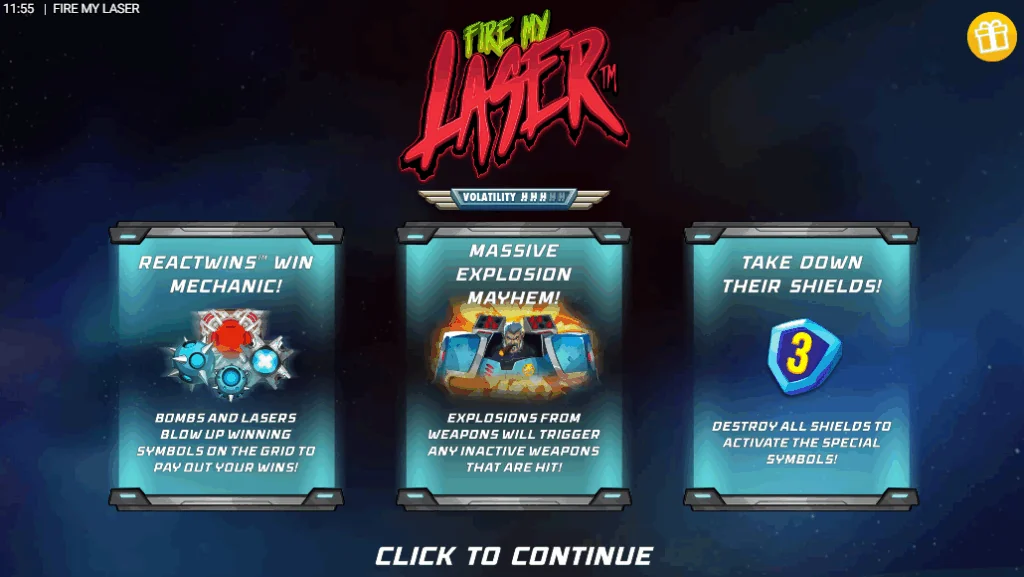
Fire My Laser is a retro-futuristic slot developed by ELK Studios, built around a 5-reel, 4-row grid with 178 fixed paylines. The mechanical foundation is straightforward, but what separates it from comparable titles is how ELK layers its proprietary betting strategies directly into the base game structure – not as an afterthought, but as a core design decision.
The RTP sits at 96%, placing it comfortably within the competitive range for modern video slots. Volatility is classified as medium-high, which means winning sessions tend to arrive in clusters rather than steadily. Players chasing consistent low-value returns will find the math model less accommodating than those willing to ride variance across longer sessions.
Maximum win potential reaches 5,000x the stake – achievable through the game’s cascading win system combined with multiplier mechanics triggered during the bonus phase. That ceiling is realistic enough to attract serious attention without making inflated promises.
Bet range spans from €0.20 to €100 per spin, giving both casual and higher-stakes players a functional entry point. The game was designed for desktop and mobile from inception, not adapted afterward.
Easy, Fast, Comfortable
Loading Fire My Laser for the first time takes under three seconds on a mid-range device. The interface wastes no screen space – the control panel occupies a compact strip beneath the reels, with bet adjustment, autoplay, and spin functions positioned without visual clutter.
ELK Studios integrates their X-iter feature directly into the betting menu. This is not a side option buried in settings; it sits front and center, allowing players to toggle between five distinct play modes before each spin. Modes include options like Bonus Hunt (which increases bonus frequency at a cost multiplier) and Super Boost (which guarantees a triggering scatter on the next spin at 10x the normal bet). These aren’t cosmetic – they meaningfully alter how sessions unfold.
The autoplay function includes a loss limit and single-win limit stop condition, both adjustable. Turbo mode compresses the spin animation without skipping outcome resolution. For players who run extended sessions, these controls reduce friction considerably.
Accessibility options are limited – there’s no formal colorblind mode, and the sound toggle only offers on/off rather than separate sliders for music and effects. That’s a minor but genuine gap.
Game Design
Theme and Graphics
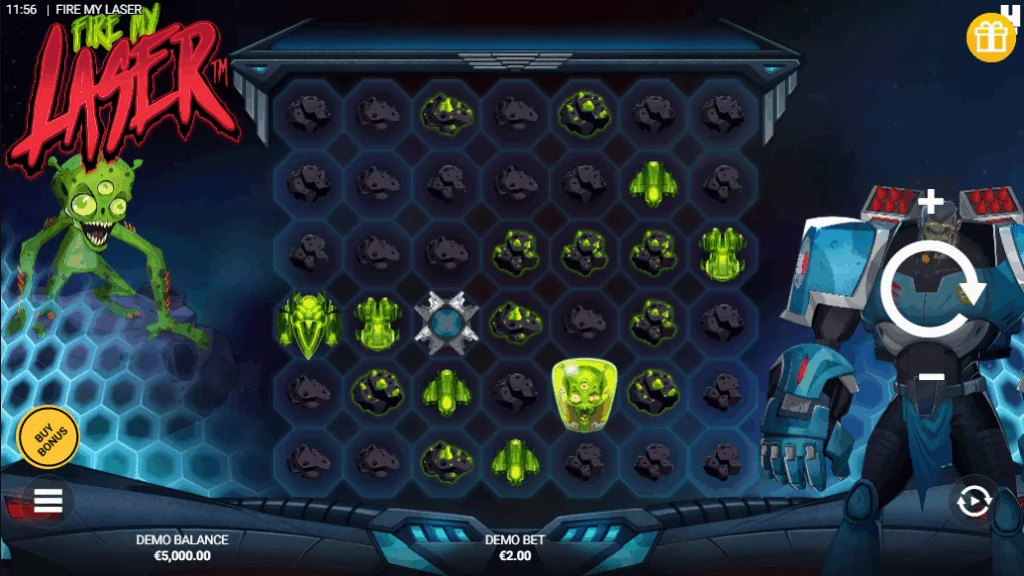
The visual language of Fire My Laser lands somewhere between 1980s arcade sci-fi and a neon-lit retro future. The reels float against a deep-space background rendered in dark purples and electric blues, punctuated by glowing grid lines that pulse during winning sequences. It’s stylized rather than realistic – ELK clearly prioritized aesthetic coherence over photorealism.
Symbol design follows the theme precisely. Lower-value symbols use geometric laser shapes with crisp pixel-influenced edges; higher-value symbols depict characters and ships rendered in bold, flat graphic style. The visual hierarchy between symbol tiers is immediately readable, which matters more than it sounds during fast-play sessions.
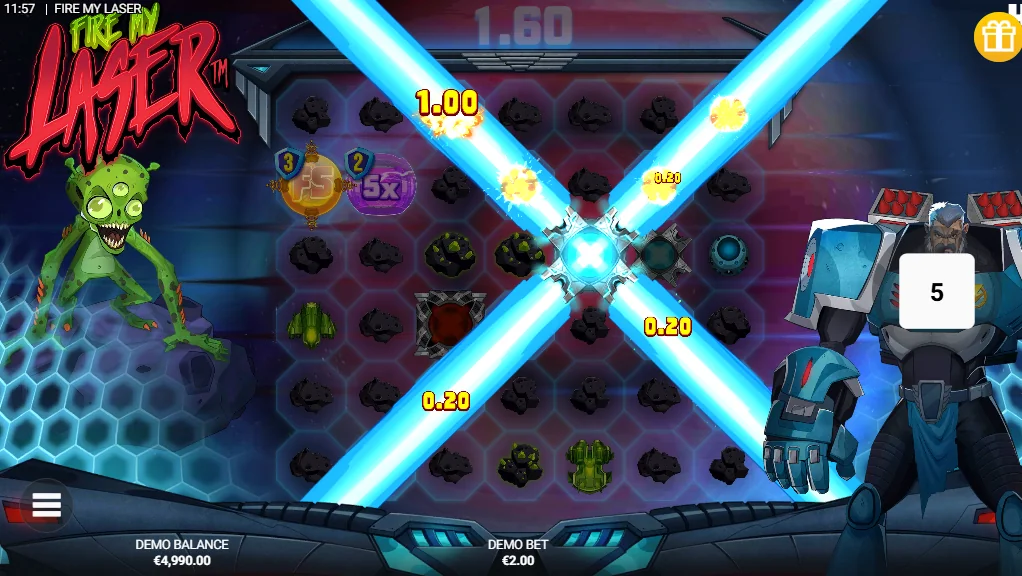
Animation quality during cascades is particularly well-executed. Exploding symbols don’t just disappear – they fragment outward with light burst effects that reinforce the laser concept without slowing resolution. The visual feedback loop between outcome and display keeps the energy consistent throughout.
Sounds and Gameplay Experience
The audio design commits fully to its retro-electronic identity. The base game soundtrack runs on a synthesized loop that sits low enough in the mix to avoid fatigue across extended sessions – a deliberate choice that many slot soundtracks fail to make. Win events layer in short, sharp electronic bursts that escalate in intensity with multiplier values, creating an audio signal players quickly learn to read.
During the bonus round, the soundtrack shifts register – tighter, more percussive, with a rising tension structure that responds to cascade depth. It’s functional sound design, not just decoration. The laser charge sound that precedes big wins has genuine impact without being jarring.
Pacing during normal gameplay feels brisk. Cascade sequences play out smoothly with no perceptible loading stutter between drops, and the transition into the free spins phase is handled with a short cinematic cut that doesn’t extend long enough to become repetitive across multiple triggers.
Bonuses and Symbols
Symbols in the Game
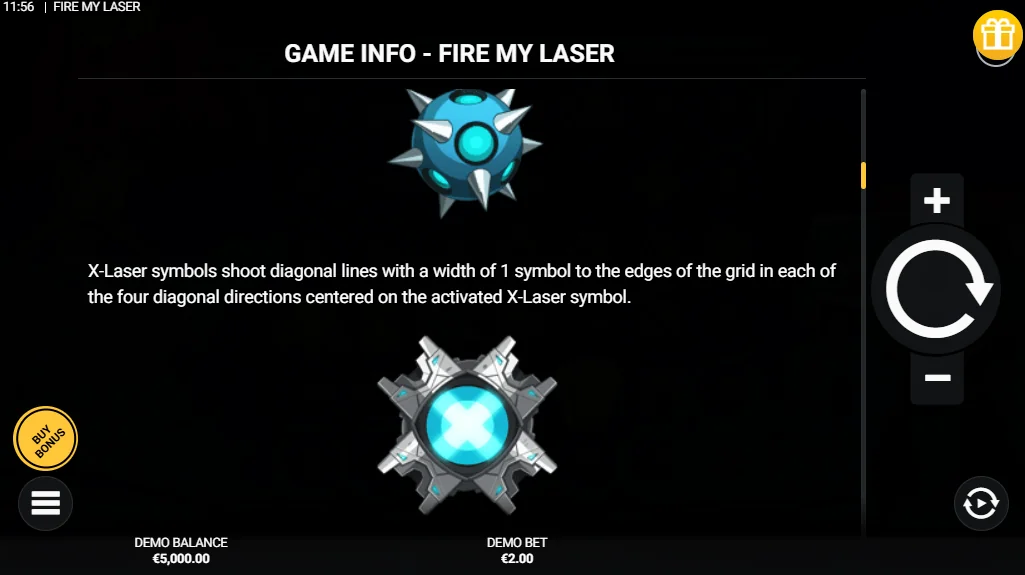
The symbol set divides into two functional categories. Low-value symbols consist of four laser-type icons that appear frequently and form the bulk of small base-game wins. High-value symbols comprise three character-based icons and a ship icon – these are the targets for meaningful payouts, particularly in combinations of four or five across a payline.
The Wild symbol substitutes for all standard symbols and appears exclusively on reels 2, 3, and 4. It doesn’t expand or stack in the base game, but its position restriction means its impact is concentrated in the center of the grid where payline density is highest.
Scatter symbols – depicted as laser crystals – appear on all reels. Three or more trigger the bonus round. Four scatters award additional free spins at entry; five scatters on a single spin is a rare event that starts the bonus phase with a significant multiplier pre-loaded.
Bonus Rounds and Free Spins
The free spins round begins with 7 spins for three scatters, 10 for four, and 14 for five. What distinguishes this mechanic from standard free spin implementations is the Laser Charge system: each cascade within the bonus adds charge to a meter displayed above the reels. When the meter fills, a random multiplier between 2x and 10x is applied to the next win in the sequence.
Cascades do not reset the charge meter between spins – it carries over. This means early cascades in a session build value that pays out later, rather than each spin being evaluated in isolation. The practical effect is that bonus rounds with four or five early cascades can generate compounding multiplier stacks that account for the majority of session variance.
Additional free spins can be triggered during the round by landing three or more scatters again, with no cap on the number of retriggerable spins. Theoretically, an extended retrigger chain combined with a deep cascade sequence is the primary path to outcomes near the maximum win.
Paytable and Winning Combinations
Five-of-a-kind on the highest-value symbol pays 25x the stake. The second and third tier high-value symbols pay 15x and 10x respectively at five of a kind. Low-value symbols max out between 1x and 2x for five-of-a-kind combinations – functional for padding small wins but not independently meaningful.
Given 178 paylines, lower-value symbol wins land frequently, which supports the medium-high volatility classification – the base game generates enough small returns to sustain balance, while significant wins depend on multiplier interaction rather than raw symbol frequency.
Wild substitutions in high-value combinations produce the most consistent mid-range wins in the base game, particularly when two wilds appear in a five-symbol line alongside three high-value characters.
Jackpot
Fire My Laser does not include a progressive jackpot. The maximum win is fixed at 5,000x, achieved through the bonus round multiplier system rather than a separate jackpot trigger. There is no standalone jackpot mechanic, no jackpot symbol, and no network-linked prize pool.
This is a deliberate design position – ELK Studios built the game’s ceiling into the core math model rather than appending an external jackpot layer. For players specifically seeking progressive prize potential, this title doesn’t serve that need.
Mobile Device Compatibility
The game runs on HTML5 across iOS and Android without a dedicated app requirement. Testing on mid-tier Android hardware (2021-2022 generation) showed no frame-rate degradation during cascade sequences, which are the most graphically intensive moments in the session.
The interface scales cleanly to portrait orientation on screens above 5.5 inches. On smaller screens, the X-iter betting menu requires more precise taps due to compressed button sizing – not dysfunctional, but noticeable. Landscape orientation on tablets renders the full desktop layout without modification.
Touch input response on the spin button and bet adjustment controls is immediate. The autoplay menu on mobile retains all the same condition options available on desktop. Battery consumption during extended sessions is moderate – typical of HTML5 casino titles with active animation layers.
Advantages and Disadvantages
Advantages
The X-iter system gives players genuine agency over session structure. The ability to pre-purchase bonus entry or adjust trigger frequency based on current bankroll is not a cosmetic feature – it changes how the math model interacts with individual sessions in a meaningful way.
The cascade mechanic with carry-over charge meter creates genuine tension across the bonus round. Unlike flat multiplier systems, the cumulative build means individual spins within the bonus are interdependent, which makes each cascade sequence feel consequential rather than random and isolated.
Visual and audio design are thematically unified without becoming fatiguing. The retro-sci-fi aesthetic is specific enough to be distinctive but restrained enough that the interface remains readable under extended play conditions.
At 96% RTP, the game sits above the industry median for non-branded video slots, providing slightly better long-run math than many comparable titles in the medium-high volatility bracket.
Limitations
The 5,000x maximum win is moderate by current market standards. Players drawn to slots with five-figure multiplier ceilings – which have become increasingly common in the high-variance segment – will find this ceiling conservative.
The Wild symbol’s restriction to reels 2, 3, and 4 limits its influence in base-game sessions where edge-reel wilds would otherwise generate additional winning combinations. This is a deliberate math model choice, but it reduces base-game frequency of strong wins.
No buy-in free spins option exists outside of the X-iter’s Bonus Hunt mode, which increases trigger frequency rather than guaranteeing entry. Players accustomed to direct bonus purchase mechanics may find the available options less precise than they prefer.
Sound customization is binary. In environments where ambient noise requires audio adjustment, the inability to separately control music and effect volumes is a usability gap.
Conclusion
Fire My Laser earns its position as a technically well-constructed medium-high volatility slot. The combination of a 96% RTP, the cascade-driven multiplier system, and the X-iter betting controls create a game that rewards deliberate engagement rather than passive spinning. It isn’t built for players chasing extreme variance or progressive jackpots – the math model is calibrated for sessions where informed decisions about risk exposure matter.
The 5,000x ceiling and the multiplier mechanics within the bonus round are well-integrated rather than bolted on. ELK’s design philosophy is visible throughout: this is a game where the systems reinforce each other rather than coexist independently. The demo version communicates this accurately – session behavior in free play reflects the mechanics players will encounter with real stakes.
For those evaluating it as a regular rotation slot rather than a one-session novelty, the balance between base-game sustainability and bonus-round variance is genuinely well-calibrated.