Forest Arrow Demo – Honest Review, RTP & Strategy
Game Overview and Basic Information
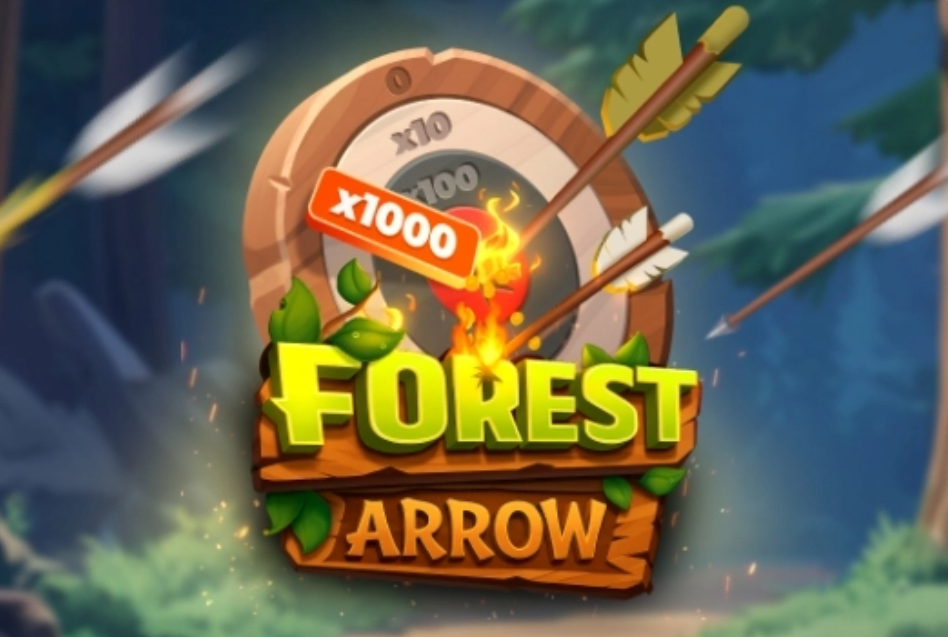
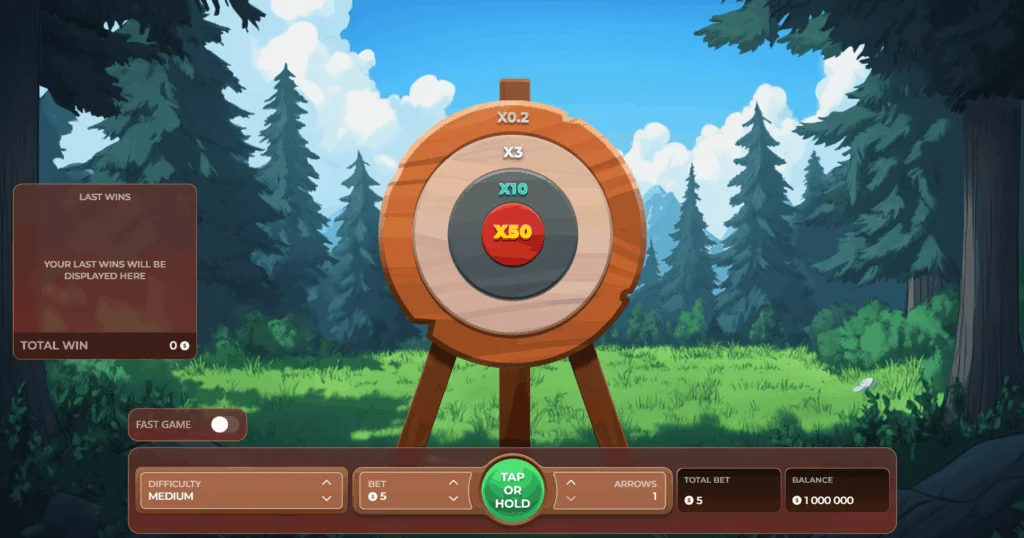
Forest Arrow swaps reels for a bow. InOut Games released it on 17 April 2025 as a crash style archery game, and instead of spinning symbols you fire arrows at a target divided into multiplier zones. Each arrow is its own bet, and you can send anything from one to a hundred of them in a single round.
The Forest Arrow RTP is not a single number. The studio publishes a range of 95% to 97% that depends on the difficulty you select, with Easy sitting near the top at around 97%, Medium around 96% and Hard around 95%. That is unusually honest labelling for this kind of product. A naira balance is converted by the operator, so the local value of each arrow depends on the rate applied at your casino rather than on the game.
Volatility is listed as medium to high, and again the mode does the heavy lifting. The maximum multiplier is x1000 per arrow, and the Forest Arrow max win is 20,000 dollars, which the studio explains as a 20 dollar arrow landing on the x1000 zone in Hard mode.
There is a documentation wrinkle worth naming immediately. The specification table lists the maximum bet as 100 dollars per arrow, but the worked example for the top payout uses a 20 dollar arrow. Those two figures cannot both be right if the cap is 20,000, so check the limits your own Forest Arrow casino actually applies.
Easy, Fast, Comfortable
The Forest Arrow rules are simple enough to describe in one breath. Choose a stake per arrow, pick a difficulty, decide how many arrows to fire, then release. Where each arrow lands on the target decides the multiplier, and the payout is settled instantly for every arrow in the volley.
Volley mode is the part that makes this different from a standard crash game. You can fire 1, 2, 5, 10, 20, 50 or 100 arrows in a round, and because every arrow is an individual bet, a ten arrow volley at one dollar each puts ten dollars on the table. The arrow count buttons sit next to the stake field, so switching volley size takes one tap between rounds.
Rounds are quick. The studio says most volleys resolve in under five seconds, which suits a metered MTN or Glo bundle far better than a slot with long animated features. You are not paying for cinematics here, you are paying for outcomes.
Most Forest Arrow play comes down to two levers. How much per arrow, and how many arrows. Get those right for your bankroll and the difficulty mode almost picks itself, since a hundred arrow volley on Hard is a very different proposition from ten arrows on Easy.
Game Design
Theme and Graphics
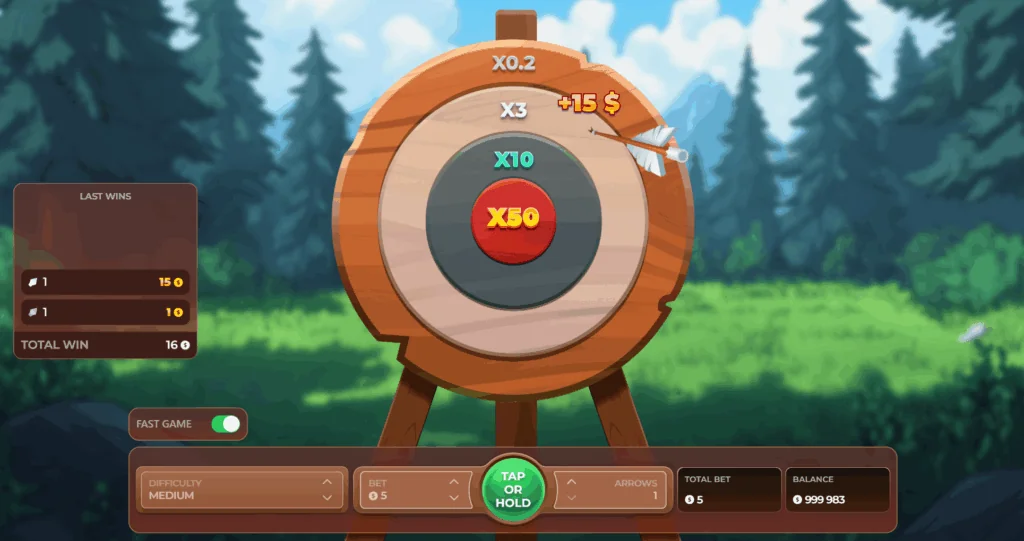
The theme is woodland archery and it stays light. A target, a bow, a forest backdrop and clearly marked multiplier zones. There is no story and no character progression. The Forest Arrow game art exists to make the zones readable, which is exactly the right priority for a title like this.
Zone labelling is the design feature that matters. Each segment of the target shows its multiplier in plain type, so you can see at a glance that Hard mode is mostly empty space. On a mid range Tecno or Infinix screen in daylight, that clarity is worth more than detailed artwork.
Anyone expecting a Forest Arrow slot machine layout with reels and symbols will need to reset their expectations. There are no paylines, no wilds and no scatters. The target is the paytable, and the zones printed on it are the only pay values in the game.
Sounds and Gameplay Experience
Audio is sparse. A bowstring, a thud on impact, and a brighter tone when an arrow finds a paying zone. Nothing important is signalled by sound alone, so muting it on a bus or in an office costs you nothing beyond a little atmosphere. The volume control lives in the settings menu and stays where you left it between sessions.
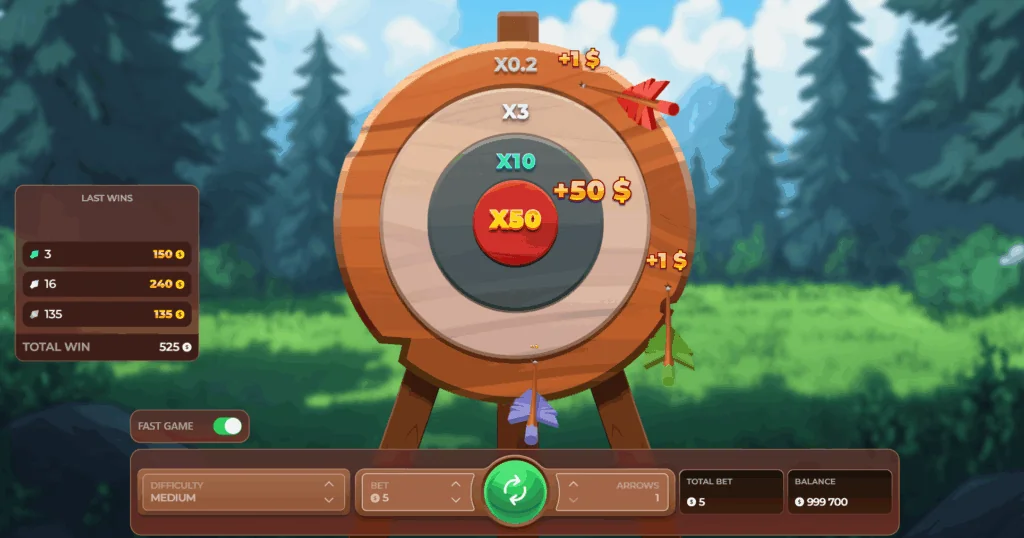
Firing a hundred arrows at once is where the game gets its character. The results arrive as a burst rather than one at a time, and watching a volley resolve on Hard mode is either exhilarating or bleak depending on how many zeroes come back.
There is a history log, and it changes how the game feels. The last hundred arrow results are stored and can be checked, which means you can actually see how often anything lands rather than relying on memory. Very few instant games hand you that data.
Bonuses and Symbols

Symbols in the Game
In place of symbols there are multiplier zones, and they change completely with the difficulty. Easy shows x0.5, x2, x5 and x10. Medium shows x0.2, x3, x10 and x50. Hard shows a miss zone at x0, then x10, x100 and x1000.
The x0.5 and x0.2 zones are worth understanding properly. They return part of your arrow cost rather than nothing, which is why Easy mode feels forgiving. A half return is still a loss, it just bleeds a bankroll slowly instead of quickly. Easy mode keeps most arrows on some kind of paying zone, which is why it suits a small starting balance.
Hard mode has no soft landing. Most of the target is the x0 miss zone, so the majority of arrows return nothing at all. The studio says as much on its own page, and it is the single most important thing to know before you switch modes.
Bonus Rounds and Free Spins
There is no Forest Arrow bonus round. No pick screens, no wheels and no second stage. Every payout comes from where an arrow lands, which keeps the maths clean but does mean the game has no built in change of pace.
Forest Arrow free spins do not exist either, because there are no spins. What can exist is a free arrow promotion, since the studio says operators can connect the game to custom offers. It gives the example of new players receiving 50 free arrows in Easy mode after a qualifying deposit.
There is also no Forest Arrow bonus buy. Nothing is gated, so there is nothing to purchase. If you want higher multipliers you switch to Hard, and the price you pay is a target that is mostly empty rather than a fee taken from your balance. Switching difficulty is free and can be done at any point, so the only cost of experimenting is the arrows you spend.
Paytable and Winning Combinations
The paytable is the target itself, and that makes the maths transparent. Stake per arrow multiplied by the zone you hit, settled per arrow. Fire ten arrows and you get ten independent results rather than one combined outcome, which is a meaningfully different risk profile.
Worked examples help here. A five dollar arrow landing on x50 in Medium returns 250 dollars. A twenty dollar arrow on the x1000 Hard zone returns the full 20,000 dollar ceiling. Those are illustrations published by the studio rather than typical outcomes.
What is missing is any statement of hit frequency per zone. The studio tells you the multipliers but not how often each one lands, so the demo history log is the only practical way to estimate it. Firing a hundred demo arrows on each mode and counting is a reasonable substitute.
Jackpot
There is no jackpot in Forest Arrow, fixed or progressive. The 20,000 dollar figure is a payout ceiling rather than a prize pool, and no slice of the return is being held back to fund one. Everything the game can pay sits in the zone values on the target. Reading the ceiling as a hard limit rather than a target is the healthier way to approach it.
That structure explains the RTP range. Because nothing is diverted to a jackpot, Easy mode can offer close to 97%, which is genuinely good. Forest Arrow money play on Easy is one of the better theoretical returns you will find in a Nigerian facing instant games lobby.
Mobile Device Compatibility
Mobile support is proper. The game is HTML5 and runs on phones, tablets and desktops from the same link, and the interface is a stake field, a difficulty selector and an arrow count. Nothing about it strains a six inch screen.
There is a Forest Arrow app in the form of an official Android package offered from the studio site, and the studio also states plainly that no installation is needed because the game is fully browser based. Both statements sit on the same page.
Given that, a Forest Arrow download is the optional route rather than the recommended one. Browser play avoids installing anything on a crowded handset and guarantees you are on the current build. If you do install, only use the official studio link and never a mirror.
Data use is light after the first load, which is what you want on Airtel or 9mobile. The bigger practical concern is connection stability during a volley, though because arrow results lock in instantly rather than being timed, a wobble hurts less here than in a cash out game. Loading the game once over wifi and then playing on mobile data is a habit worth keeping.
Advantages and Disadvantages
Advantages
Publishing an RTP range per difficulty is the standout strength. Most studios give one number and leave you guessing about how modes affect it. Being told Easy is around 97% and Hard around 95% lets you make an informed choice before you fire anything.
The history log is the second strength. Access to the last hundred results, combined with a demo balance of up to a million in virtual funds, means you can actually measure how a mode behaves instead of trusting a marketing line.
Volley mode is a genuinely clever piece of design. Being able to convert one round into a hundred small independent bets smooths variance in a way a single crash multiplier cannot, and it lets you tune session risk without changing your stake.
Access is easy and cheap. A Forest Arrow demo needs no registration and no wallet, the free mode carries the full mechanics and all three difficulties, and the real money minimum is 0.10 per arrow. There is very little reason not to test it first. Nothing about the free version is cut down, which is rarer than it should be.
Limitations
The bet limit contradiction is the most annoying flaw. One table says 100 dollars per arrow, the max win calculation uses 20 dollars, and the page hedges with the phrase on some platforms. Several Forest Arrow reviews run into the same confusion.
Hit frequencies are not published. Knowing that Hard mode contains x0, x10, x100 and x1000 tells you nothing about the odds of each, and without that the RTP figure is the only guide to how brutal the mode really is.
Hard mode is punishing in a way the marketing softens. The studio itself says most targets are empty or low value zones, and losing a hundred arrows without a meaningful hit is a normal outcome rather than bad luck. Budget for that before switching modes.
There is no content beyond the core loop. No bonus, no jackpot, no progression and no side game. Once you have tried all three difficulties, playing Forest Arrow online offers nothing new, and the studio has not pretended otherwise. A hundred arrow volley on Hard should be treated as a single large bet, not as a hundred small chances.
Conclusion
Forest Arrow is one of the more transparent instant games on the market. A published RTP range per mode, a visible zone paytable, a hundred round history log and a large demo balance add up to a title that lets you check its claims rather than just accept them.
The weaknesses are the contradictory bet limits, the absent hit frequencies and the total lack of features beyond firing arrows. If you want variety across a long evening, look elsewhere. If you want a clean risk decision with good information, this does the job.
Start on Easy in the demo, fire a few hundred arrows on each difficulty and read the history log before you spend anything. Play only at operators licensed to serve Nigerian players, check what your state regulator requires such as the Lagos State Lotteries and Gaming Authority, keep to 18 and over, and fix a loss limit before the first shot.