
Super Speed Dragon Tiger Review 2026 – RTP, Payouts and Strategy
Super Speed Dragon Tiger at a Glance
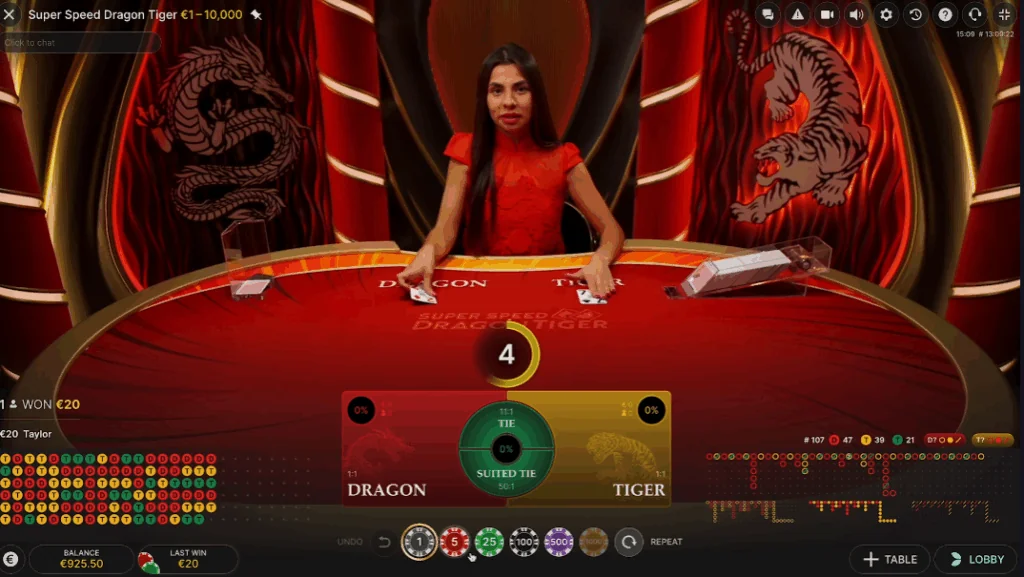
Super Speed Dragon Tiger is the quickest version of the simplest card game in the Evolution group’s live catalogue. Two cards are dealt, one to the Dragon and one to the Tiger, and the higher card wins. That is the entire game. What the Super Speed label adds is a shorter betting window and faster dealing, so the same rules cycle through more rounds in the same amount of time.
The studio describes it as the fastest variant of the classic two-card game, and the framing is accurate: nothing about the card rules has been changed. Four bet positions are available, the theoretical returns are published and, unusually for a live table, all three of them can be verified exactly by arithmetic. That is the most useful thing about this game from a review point of view, and it is covered in detail below.
| Item | Detail |
|---|---|
| Provider | Ezugi, a studio inside the Evolution group |
| Release date | 26 August 2025 |
| Game type | Live two-card game |
| Category | Live baccarat and sic bo |
| Cards dealt | One for Dragon, one for Tiger |
| Shoe | Eight decks |
| Bet positions | Dragon, Tiger, Tie, Suited Tie |
| Dragon and Tiger RTP | 96.27% |
| Tie RTP | 89.64% |
| Suited Tie RTP | 86.02% |
| Top payout | 50:1 on Suited Tie |
| Statistics | Full statistics and roads in the interface |
| Betting limits | Set by each operator, not published by the studio |
One attribution note. The official game page carries an Ezugi credit in its own title, while the largest games database lists the provider as Evolution Gaming. Both are defensible, because Ezugi is a studio inside the Evolution group, and the table above uses the studio credit from the official page.
Super Speed Dragon Tiger RTP by Bet
There is no single Super Speed Dragon Tiger RTP, because each of the four positions returns a different amount. The published figures for the Dragon Tiger family are 96.27% on Dragon or Tiger, 89.64% on the Tie bet and 86.02% on the Suited Tie. Because Super Speed changes only the pace and not the cards, those are the numbers that apply here.
| Bet | Payout | Theoretical return |
|---|---|---|
| Dragon | 1:1, half the stake lost on a tie | 96.27% |
| Tiger | 1:1, half the stake lost on a tie | 96.27% |
| Tie | 11:1 | 89.64% |
| Suited Tie | 50:1 | 86.02% |
The spread is the whole story. A player who sticks to Dragon and Tiger is facing a house edge of about 3.7%, which is reasonable for a game this simple. A player who backs Suited Tie is facing nearly 14%, almost four times as much. On a table with no decisions to make after the chips are down, choosing the right position is the only skill on offer.
Why the Dragon and Tiger Bet Returns 96.27%
The figure looks arbitrary until you work it out. With an eight-deck shoe there are 416 cards, and once the first card is dealt, 31 of the remaining 415 share its rank. That makes the probability of a tie 31 divided by 415, or about 7.47%. The remaining 92.53% splits evenly between Dragon and Tiger, giving each side roughly 46.27% to win outright.
Feed those numbers into an even-money bet and you get exactly the published return, provided one extra rule is in place. That rule is the reason the whole game works, and it deserves its own section.
The Half-Stake Tie Rule
If Dragon and Tiger simply pushed on a tie, an even-money bet on either side would return 100% and the house would have no edge at all. It does not push. When the two cards match in rank, half the stake on Dragon and half the stake on Tiger is lost, and only half comes back. That single rule is where the entire house advantage on the main bets comes from.
How the Arithmetic Confirms It
Take a one-unit bet on Dragon. It wins one unit 46.27% of the time, loses one unit 46.27% of the time, and loses half a unit 7.47% of the time. The two even outcomes cancel, leaving a loss of half of 7.47%, or 3.735%. Subtract that from one and you get 96.265%, which rounds to the published 96.27%.
The same test works on the side bets and it works to four decimal places. A Tie at 11:1 returns twelve units on a 7.47% chance, which is 89.64%. A Suited Tie requires the same rank and the same suit, so seven cards out of 415, or 1.687%, and at 50:1 that returns 86.02%. Three independent matches against three published figures is about as strong as verification gets without access to the certification report, and it also confirms the shoe is eight decks rather than six.
How to Play Super Speed Dragon Tiger
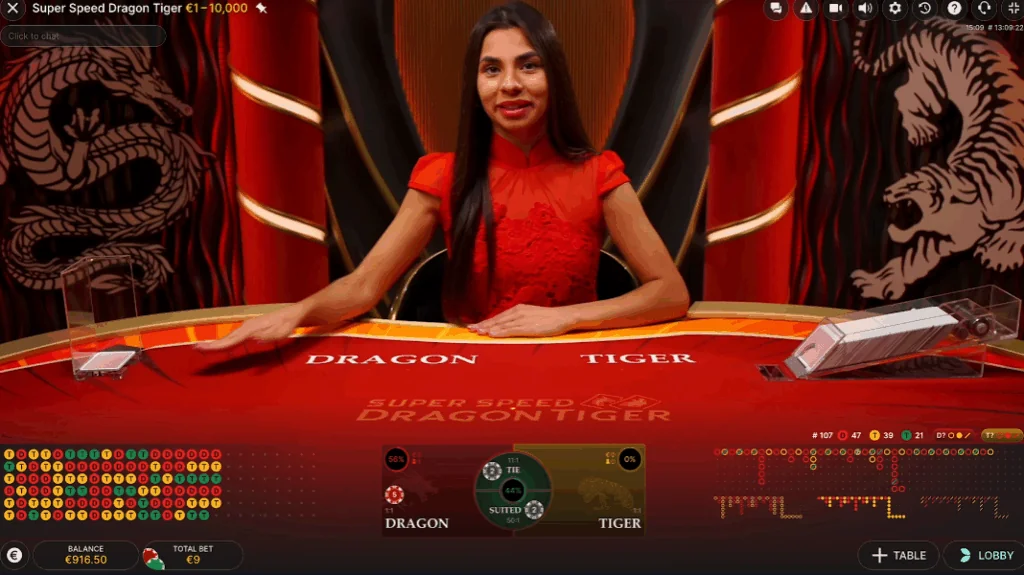
The round has three parts and none of them require input beyond the first. Place your chips during the betting window, wait for the dealer to draw one card for the Dragon and one for the Tiger, and collect if your position won. There is no drawing rule, no third card, no decision point and nothing to interpret.
The Four Betting Positions
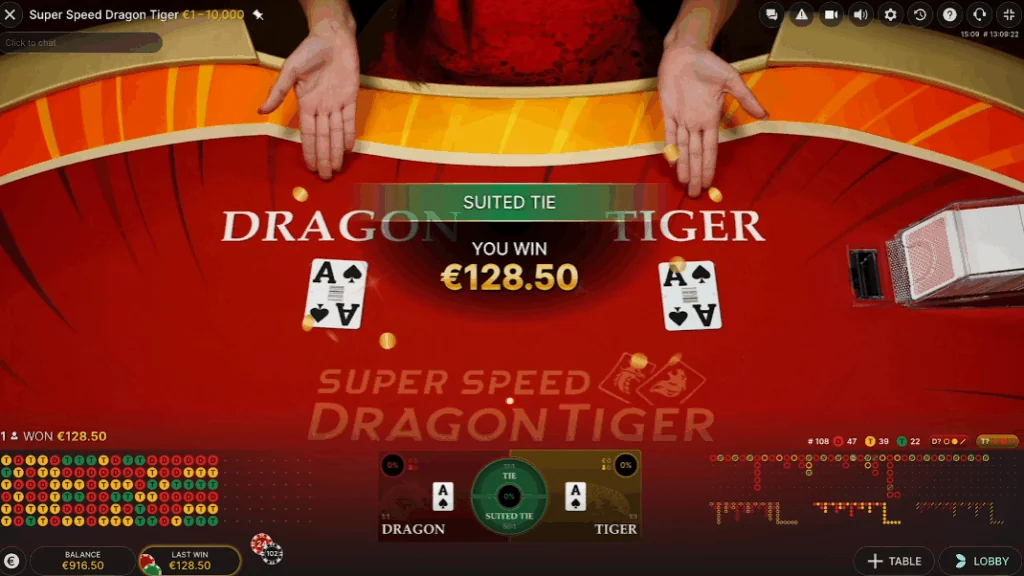
Dragon wins when the Dragon card outranks the Tiger card. Tiger wins on the reverse. The Tie bet wins when both cards share a rank irrespective of suit. The Suited Tie is the narrowest position on the table and wins only when both cards match in rank and in suit. Positions can be combined, though combining Dragon with Tiger is self-defeating because a tie takes half of both stakes.
Card ranking is by face value in the conventional order, so the comparison is a straight one between two single cards with no totals to add up and no baccarat-style modulo arithmetic. This is what the studio means when it calls the game a two-card version of baccarat: the betting shape is similar, the resolution is far simpler.
There is one practical consequence of the no-decision structure that is easy to underrate. Because nothing you do after placing a chip can change the result, there is no way to play the game badly in the way you can play blackjack badly. The flip side is that there is no way to play it well either. All of the expected value in a session is decided in the moment you choose a box, which is why the returns table further up is the most important thing on this page.
Super Speed Dragon Tiger Payouts
The payout table is short. Dragon and Tiger pay even money with the half-stake deduction on a tie. The Tie bet pays 11:1 regardless of suit, and the Suited Tie pays 50:1. Both side-bet prices are stated on the studio’s own material for the Dragon Tiger family.
Why 50:1 Is the Ceiling
50:1 on the Suited Tie is the largest payout available anywhere on the layout, and it is what a maximum win looks like here. There is no multiplier mechanic, no jackpot and no progressive element, which is a deliberate contrast with the Lightning version of the same game. If you want a four-figure multiple of your stake, this is not the table for it.
It is worth putting the 50:1 in context. The chance of a suited tie is about one in fifty-nine, and the price is fifty. That gap is the 14% house edge in a single sentence, and it is the widest on the felt.
The Eight-Deck Shoe and Card Ranking
The deck count is not stated in plain language on the game page, but it is recoverable. Only an eight-deck shoe produces tie probabilities that match all three published returns simultaneously. A six-deck shoe would give a tie chance of about 7.40%, which would push the Tie bet return to roughly 88.75% and the Suited Tie to about 82%, neither of which matches the published figures.
What the Deck Count Changes
In practical terms very little, because a single card each is drawn from a shoe of more than four hundred. Card counting has no useful application: there is no drawing rule to exploit, the removal of two cards per round barely shifts the composition, and the shoe is reshuffled long before depletion becomes meaningful. The deck count matters for verifying the maths, not for playing the game.
What Super Speed Actually Changes
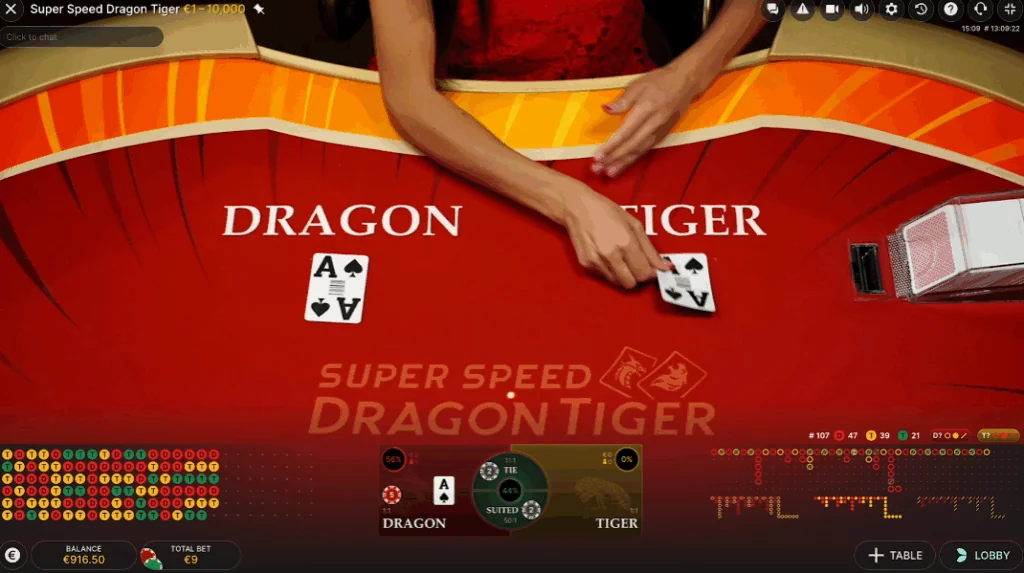
Nothing about the odds. The card rules, the payouts and the returns are identical to the standard table. What changes is the clock: a shorter betting window and swifter dealing, which the studio presents as delivering excitement in seconds. If you enjoy the rhythm of a fast table, this is a genuine improvement over the standard version.
Rounds per Hour and Expected Loss
The consequence is arithmetic rather than atmospheric. House edge is charged per round, not per hour, so doubling the number of rounds doubles the expected loss for the same stake. A player betting one unit per round at 96.27% expects to lose 3.735% of every unit staked, and a faster table simply gets through more units.
That is not an argument against the game, it is an argument for adjusting the stake. If you move from a standard table to a Super Speed one and keep your bet size the same, you have quietly increased your hourly cost. Halving the stake, or sitting out alternate rounds, restores the balance and costs nothing in expected value.
A second consequence of the fast format concerns mistakes. A shorter betting window leaves less time to reconsider a chip placed in the wrong box, and on a table where one box returns 96.27% and another returns 86.02%, a mis-click is not a trivial error. Players moving across from the standard table should expect the first few rounds to feel rushed and should place chips deliberately rather than reactively until the rhythm settles.
The Tie and Suited Tie Side Bets
Both side bets are priced well below fair value and neither should be treated as part of a main strategy. The Tie at 89.64% gives away more than ten percent, and the Suited Tie at 86.02% gives away almost fourteen. Compare that with the 96.27% on the main positions and the picture is unambiguous.
When They Are Defensible
There is one honest case for them, which is entertainment. A one-in-thirteen shot at 11:1 lands often enough to be exciting, and a one-in-fifty-nine shot at 50:1 is the only chance the game offers of a memorable single round. If that is what you are buying, budget for it separately and treat it as the cost of the experience rather than as a bet you expect to profit from.
Super Speed Dragon Tiger Compared With the Family
The Evolution group now runs several two-card variants and their published returns differ enough to matter. The table below sets the Super Speed version against its siblings and against baccarat, which is the closest conventional comparison.
| Game | Main bet return | Tie return |
|---|---|---|
| Dragon Tiger and Super Speed Dragon Tiger | 96.27% | 89.64% |
| Lightning Dragon Tiger | 96.97% | Not published separately |
| Dragon Tiger Phoenix | 96.99% | 94.51% |
| Dragon Dragon | 97.50% | Not published separately |
| Baccarat, Banker bet | 98.95% | Not comparable |
Which One Offers the Best Return
On main-bet return alone the answer is not this one. Dragon Dragon leads the group at 97.50%, Dragon Tiger Phoenix reaches 96.99% and the Lightning version 96.97%, all ahead of the 96.27% here. What Super Speed offers instead is the simplest rule set and the fastest cycle, which are preference questions rather than value questions. Anyone choosing purely on percentages should look at baccarat, where the Banker bet returns close to 99%.
Statistics and Roads
The interface carries a full set of statistics and roads, the same pattern-tracking displays baccarat players are used to. They show what has already happened: streaks of Dragon or Tiger results, tie frequency and the usual derived roads.
It is worth being clear about what they are for. Each round draws from a freshly shuffled or near-full shoe and the outcome of one round tells you nothing reliable about the next. Roads are a presentation feature that makes the session feel structured, not a predictive tool, and treating a long Dragon streak as evidence that Tiger is due is the gambler’s fallacy in its purest form.
The statistics displays do have one legitimate use, which is bankroll awareness rather than prediction. A glance at the tie counter tells you how often the half-stake deduction has been triggered in the current shoe, and that is a real cost that a player tracking only wins and losses on Dragon and Tiger can easily lose sight of. Roughly one round in thirteen ends in a tie, and each of those quietly removes half of every main-bet stake on the table.
Super Speed Dragon Tiger Strategy
The strategy here is short because the game is short. There are no decisions after the chips are placed, so everything that can be optimised is optimised before the deal.
- Stick to Dragon or Tiger. At 96.27% they are the only positions on the table worth a main stake.
- Do not hedge Dragon against Tiger. A tie takes half of both stakes, so covering both guarantees a loss on ties and a push otherwise.
- Treat the Tie bet as entertainment. At 89.64% it costs more than ten percent of everything you put on it.
- Treat the Suited Tie the same way, only more so: 86.02% is the weakest position available.
- Adjust the stake for the speed. A faster table charges the same edge more often, so a smaller bet keeps the hourly cost level.
- Ignore the roads. Every round is independent and no streak makes the opposite result more likely.
Sizing a Session
Because the studio publishes no limits, the range at your own operator is the one that counts. A workable rule on a fast table is to size the bet so that a hundred rounds of expected loss is a comfortable fraction of the session budget, which at 96.27% means roughly four units lost per hundred staked. Anything that makes a hundred rounds feel expensive means the stake is too high for the pace.
Set a loss limit and a walk-away figure before the first round and keep side-bet money in a separate mental pot. Play for entertainment rather than profit, and if the sessions stop feeling optional, every licensed operator is required to offer deposit limits, reality checks and self-exclusion tools.
Where Super Speed Dragon Tiger Sources Disagree
Three small gaps are worth recording. The first is the studio credit: the official game page names Ezugi in its own title while the largest database credits Evolution Gaming, and both point to the same corporate group. The second is the release date, which the database records as 26 August 2025 while trade coverage of the launch appeared two days later.
The third is an absence rather than a conflict. No source publishes the length of the betting window in seconds, a house edge per position beyond the returns above, a hit frequency or a betting range. Evolution does not release those figures for live tables, so any review quoting a precise number of seconds is estimating. This one does not.
Is Super Speed Dragon Tiger Worth Playing
If you want the simplest possible card game with a return under four percent from the house on its main bets, yes. The rules take one round to learn, the maths is transparent enough to verify from published figures, and the pace suits anyone who finds baccarat slow. The 50:1 Suited Tie gives the table a little upside without pretending to be a jackpot game.
If you are choosing on return alone, the same group offers better numbers elsewhere, and the two side bets here are among the weakest positions in the whole live catalogue. The honest summary is that Super Speed Dragon Tiger is a well-built, fast, no-nonsense table that rewards discipline about which box you put the chips in and punishes almost nothing else.
To place this one in its family, our Baccarat A review covers another baccarat table from the same lobby, Dynasty Speed Baccarat 1 is a second baccarat variant, Auto-Roulette VIP is another Evolution title, and Hindi Speed Baccarat A is one more baccarat table.