
Hilo Game Demo by JILI: Honest Review, RTP & Strategy


Game Overview and Basic Information
What is Hilo? It is a card-guessing crash game from Jili Games, and it belongs to the instant-win category rather than the reel category. This is a crash-style game built from a deck of cards rather than a rising curve. There are no reels and no paylines: one card is face up, and your only job is to say whether the next one will be higher or lower.
The Hilo game is built around an unbroken streak. Each correct call multiplies what is already on the table, and the ladder only pays if you cash out before a wrong call wipes it. There is no reel grid to describe, so the table below covers the card layout instead. A single card is shown, the next card is drawn against it, and the streak counter and multiplier sit alongside.
JILI lists a 10,000x max win and a publish date of 05.2023; volatility is not published, and bet limits are set by the operator. The game rules in the official JILI demo list an RTP of 97.00%; check the game info at your casino.
There are no reels and no scatter chains: the Hilo max win is 10,000x the stake, the theoretical top of the ladder. It needs an exceptionally long unbroken run of correct calls.
Easy, Fast, Comfortable
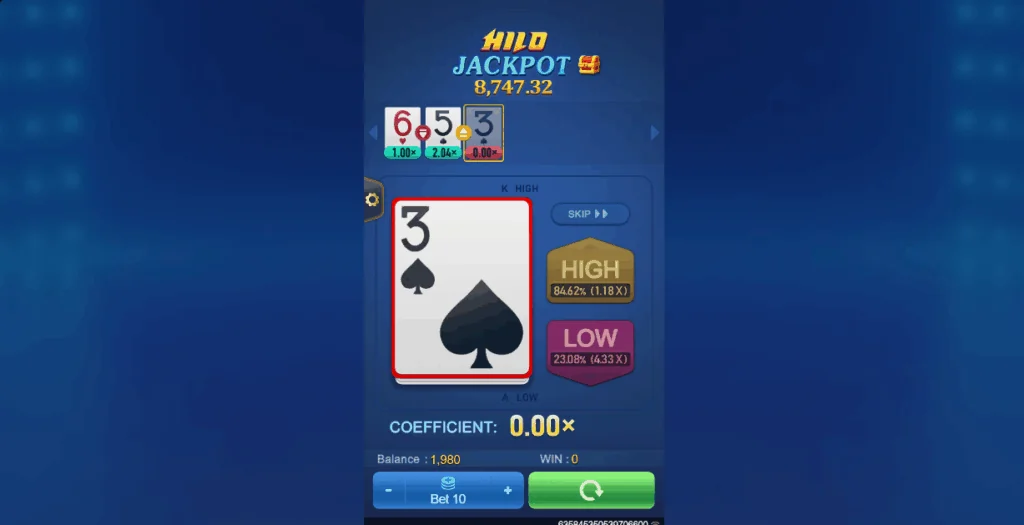
The current card sits in the centre with Higher and Lower buttons beneath it, the running multiplier above, and a cash-out button that stays live between calls. The odds for each direction are displayed before you choose.
A free Hilo demo is available. The outcome comes from a random number generator rather than physical equipment. So Hilo free play runs in the browser on practice credits with no registration and no download. It uses the same rules as the real-money build.
An auto mode repeats a set number of calls and cashes out at a target multiplier. This is useful here because it enforces the discipline the game punishes you for lacking.
Rounds are as long as your streak, so a cautious player finishes in seconds and an ambitious one can stretch a single round out considerably.
How to Play Hilo
Rules and Bet Types
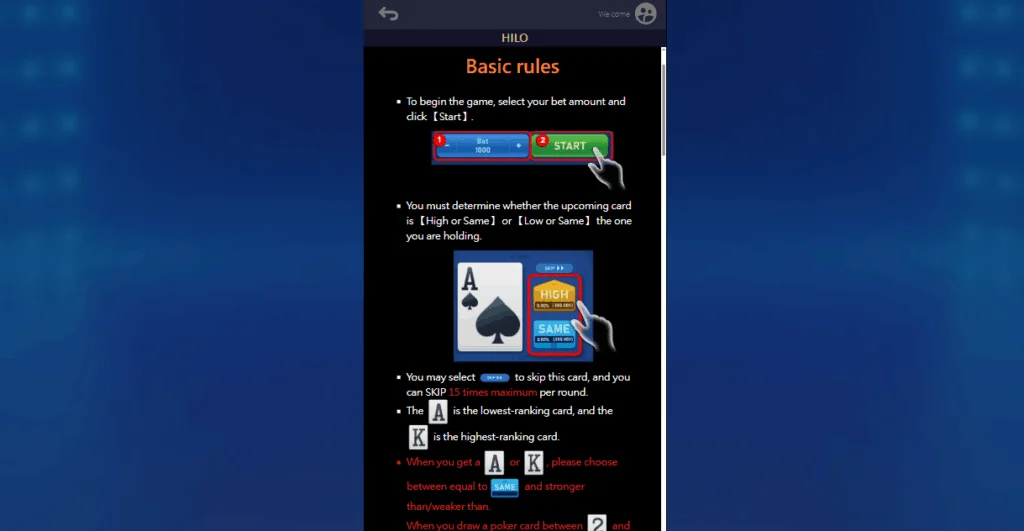
A card is dealt face up. You call whether the next card will be higher or lower, and the payout offered for each direction reflects how many cards in the deck satisfy it.
A correct call multiplies your stake and turns the new card into the next reference point. A wrong call ends the round and loses everything accumulated. You may cash out after any correct call.
Why the Odds Move on Every Card
The price on Higher and Lower is not fixed, it is calculated from the current card. With a two showing, calling higher is close to certain and pays almost nothing; with a king showing, the same call rarely wins and pays heavily.
That means the ladder is not a fixed sequence of steps. Two players with identical streak lengths can end up with very different multipliers depending on which cards they were dealt.
Cashing out is always available between calls with no timing window to miss, so there is no reflex element at all.
Game Design
Theme and Visuals
The theme is a card table stripped to essentials, with no narrative wrapper, the studio presents it simply as poker high-low.
The presentation is clean and card-focused: a large central card, clear direction buttons and a prominent multiplier. It is easy to read and offers nothing decorative.
The Hilo symbols are functional rather than decorative, the playing cards are the only symbols, and their rank relative to the card on the table is all that matters.
Sound and Gameplay Experience
Audio is limited to a card flip, a rising tone for a correct call and a flat tone for a wrong one. This is enough to follow a streak without watching.
The rising tone escalating with the streak is the one piece of deliberate pressure in the sound design.
Payouts, RTP and Volatility
Payout Structure and Multipliers
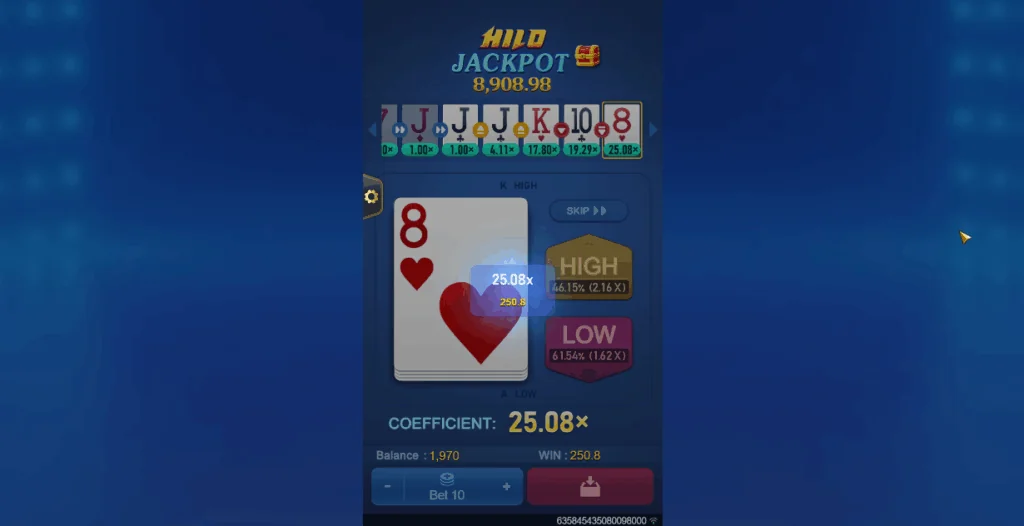
There is no fixed payout table. Each call is priced from the number of cards that would satisfy it, with the house margin applied, and the price is shown before you commit.
Multipliers compound, so the running total is the product of every price you have accepted rather than a sum. This is why the ceiling is so much higher than any single call could produce.
The Hilo feature set is deliberately narrow: directional calls with live pricing, cash-out at any point and per-round result verification.
RTP and House Edge
The game rules in the official JILI demo list an RTP of 97.00%; check the game info at your casino.
A hundred rounds can finish well above or well below it, and the undeclared volatility profile makes that spread wider rather than narrower.
Check the Hilo RTP inside the operator’s own game info panel before playing for real money. Some studios license more than one return configuration, and the version an operator deploys is the one that applies.
Max Win and Volatility
The Hilo max win is 10,000x the stake, as listed on the official JILI game page.
Hilo volatility is undeclared, and variance depends entirely on how far you push a streak, which is why no fixed rating is published for the game. The practical reading is that the bankroll needs to survive a run of losing rounds long enough for the format’s maths to show up at all.
Hilo Strategy
The only real skill is deciding a target multiplier before the round starts and cashing out there. Calls on low or high cards are near-certain but pay almost nothing. So a long streak of safe calls builds slowly while one greedy call on a middle card can end it.
The trap is that the ladder feels safer the longer it runs, when in fact the accumulated total at risk grows with every call. A streak of eight is not more likely to continue than a streak of one.
Fairness and Randomness
The studio states that the result of each round can be verified after the fact, so outcomes are checkable rather than taken purely on trust.
JILI states that the result of each round can be verified after play.
None of this changes the odds in the player’s favour; it only means each round can be checked.
Mobile Device Compatibility
A single card and two large buttons is close to the ideal mobile layout, and everything needed fits a portrait screen without scrolling or zooming.
The one thing that suffers on a small screen is the price display for each direction, which is the number you most need to read before committing.
Advantages and Disadvantages
Advantages
Official 10,000x ceiling. JILI lists the maximum clearly on its game page.
Every call is priced before you commit. You can see exactly what a call is worth before taking it.
No timing pressure on cash-out. You can cash out between any two calls.
Streaks compound rather than add. Each correct call builds on the multiplier already reached.
Limitations
The game rules in the official JILI demo list an RTP of 97.00%; check the game info at your casino.
Bet limits depend on the operator. Check the minimum stake at your casino before planning a session.
No bonus rounds or free plays. The directional call is the entire game.
One wrong call clears the whole ladder. It is also fair to note rising audio pushes toward longer streaks.
Conclusion
The 10,000x ceiling gives the round a reason to be watched, and the visible pricing on every call keeps the game simple to follow.
If you like Hilo, two more JILI games we have reviewed are Rummy and 7up7down.
The pricing of every call is visible before you commit, and there is no reflex element to fumble.
The honest summary: this is not a substitute for a feature-rich slot, and the undeclared volatility means losing runs are part of the design.
Two more JILI titles worth a look after Hilo are Money Coming and 3 Coin Wild Tiger. The reviews list the RTP, the grid and the feature set side by side with this page.