
Lightning Roulette Demo – Honest Review, RTP & Strategy

Game Overview and Basic Information
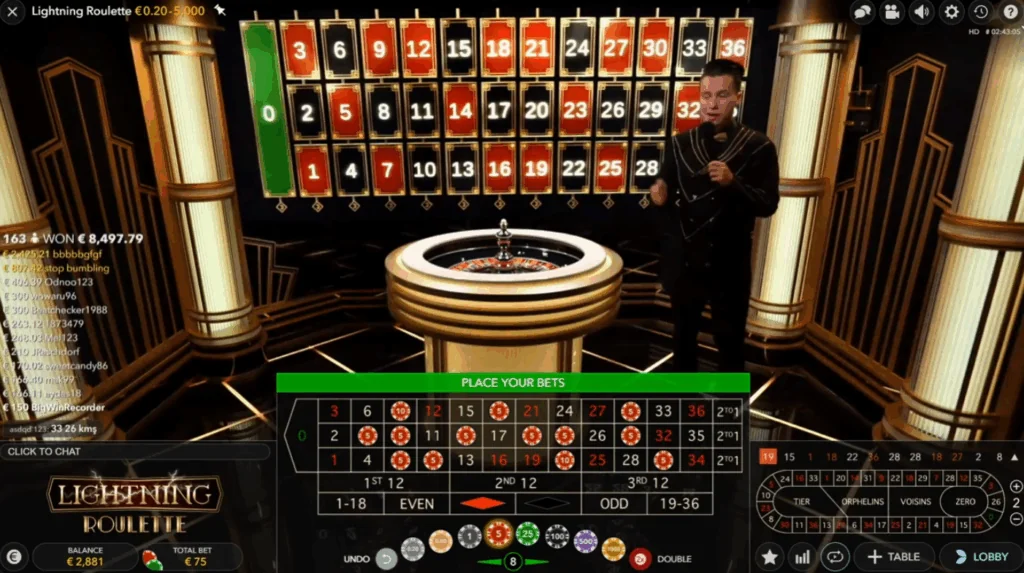
Lightning Roulette is Evolution’s electrified version of single-zero roulette, first streamed in April 2018 and still the busiest multiplier table in the live casino lobby. So what is Lightning Roulette in plain terms? It is a genuine 37-pocket European wheel, spun by a live dealer in a black-and-gold Art Deco studio, with a random multiplier layer added on top of straight-up number bets. The wheel, the ball and the dealer are real; only the multipliers are drawn electronically.
Because the title sits in the live-dealer section rather than the reels section, plenty of players first go looking for a Lightning Roulette slot and end up here instead. There are no reels and no paylines: the Lightning Roulette game is a broadcast table, so nothing digital decides where the ball stops. A certified random number generator is used once per round, after betting closes, purely to pick the Lucky Numbers and hand them their multipliers.
Evolution quotes a return of 97.30% for outside and even-money wagers, identical to standard European roulette. The Lightning Roulette RTP on straight-up numbers is 97.10%, because the base payout is cut from 35:1 to 29:1 and the multiplier hits are averaged back in. Stakes usually run from roughly €0.20 to €5,000 per round depending on the operator, and the Lightning Roulette max win is 500x a straight-up bet.
This Lightning Roulette review walks through the rules, the multiplier mechanic, the payout maths, mobile behaviour and the betting approaches that actually make sense. It also explains honestly what a Lightning Roulette demo can and cannot give you, since live tables work very differently from RNG games in that respect.
Easy, Fast, Comfortable
The table loads straight in the browser. There is nothing to install, no plugin and no client to update: you open the live casino lobby, tap the thumbnail and the stream starts within a few seconds. Round pacing is brisk, with a full cycle of betting, lightning strike, spin and payout taking well under a minute.
Free play is the one area where expectations need adjusting. A true Lightning Roulette free play mode does not exist, because every round costs the studio a real dealer and a real spin, and operators cannot hand out fake chips at a live table. What you can normally do is enter as a spectator, watch several rounds, read the statistics panel and leave without staking anything.
If you specifically want risk-free practice, the sensible route is an RNG or First Person roulette title from the same provider, where the interface, bet layout and classic payouts mirror the live table closely. Once the Lightning Roulette gameplay loop feels familiar, moving across to the live version costs you nothing in learning time.
The interface itself is built for speed. There is a favourite-bets panel, a racetrack for neighbour and section wagers, a repeat-and-double button and a history strip showing recent numbers and multipliers. Dealer chat is optional and can be hidden if you prefer a clean screen.
How to Play Lightning Roulette

Rules and Bet Types
The Lightning Roulette rules are ordinary European roulette rules with one addition. You place chips during the betting window on the standard layout: straight-up numbers, splits, streets, corners, six-lines, columns, dozens, red or black, odd or even, high or low. The wheel carries 37 pockets and a single zero with no double zero, which keeps the base house edge at 2.70% on everything except straight-ups.
Once betting closes the studio dims and between one and five Lucky Numbers are struck by lightning. Each struck number receives a multiplier of 50x, 100x, 200x, 300x, 400x or 500x. The ball is then released, and if it settles in a struck pocket where you had a straight-up chip, the multiplier replaces the standard payout for that chip.
Learning how to play Lightning Roulette therefore comes down to one trade-off. Every straight-up bet pays 29:1 instead of the usual 35:1, and that surrendered value is what funds the multipliers. Outside bets are untouched by the mechanic: they neither pay for it nor benefit from it, and they return exactly what they would at any other single-zero table.
Lightning Numbers and Multipliers
The multiplier draw is the reason this table exists and the headline among the Lightning Roulette features. Both the number of struck pockets and the size of each multiplier come from a certified random number generator that runs independently of the physical wheel, so a 500x strike is no more or less likely to be hit by the ball than a 50x one.
Strikes are not evenly distributed by value. Small multipliers appear far more often than large ones, and rounds with a single struck number are common while five-number rounds carrying a top multiplier are rare. That distribution is what keeps the long-run return inside the quoted figure while still allowing an occasional four-figure payout from a modest chip.
There is no bonus round, no free spins and no progressive pot here: everything happens inside the base round. If you want a heavier version of the same idea, Evolution’s XXXtreme variant adds chain lightning and multipliers up to 2,000x on the same kind of wheel.
Game Design
Studio, Theme and Symbols
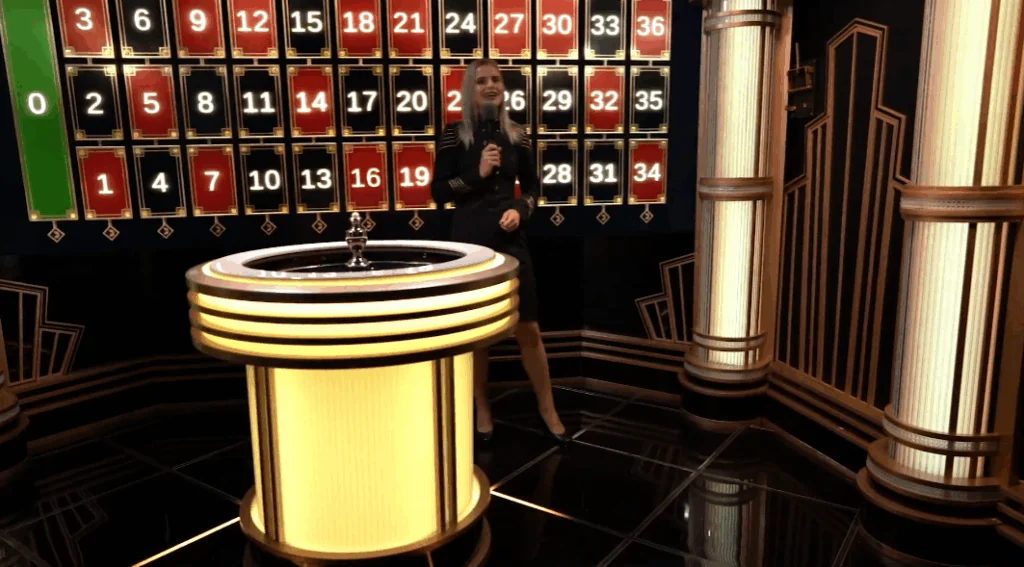
Presentation is where Evolution spends its budget and it shows. The set is a tall Art Deco hall in black, gold and deep purple, with an illuminated wheel, a raised dealer podium and a lightning cage above the table. Camera work switches between a wide studio shot, a close ball-track view and an overhead wheel angle without ever losing the spin.
The Lightning Roulette symbols are not fruit or animals but the numbered pockets, the coloured chip denominations and the electric glyphs that appear over struck numbers. When lightning hits, the affected pockets glow gold on both the betting grid and the wheel graphic, so you can see at a glance whether your chips are in play.
Text is kept small and out of the way. Bet totals, balance and the last twenty results sit along the bottom edge, while the multiplier board takes the upper right corner during the strike animation and then fades out before the ball is released.
Sound and Gameplay Experience
Audio is deliberately theatrical: a low electrical hum during betting, a thunderclap on the strike, then the familiar rattle of the ball in the track. Dealers speak English and several other languages depending on the table, and they are trained to keep patter short so rounds keep moving.
The pace suits both casual and grinding play. You can sit through a handful of rounds an hour or save a bet pattern and clear dozens, because nothing in the Lightning Roulette gameplay forces you to interact between spins beyond confirming the stake.
Latency is the one variable outside the studio’s control. On a weak connection the stream drops resolution rather than freezing, and bets already accepted still stand, but it is worth checking your signal before committing to a long session.
Payouts, RTP and Volatility
Payout Table and Odds
Outside bets pay the classic amounts: even money on red or black, odd or even and high or low, and 2:1 on dozens and columns. Splits pay 17:1, streets 11:1, corners 8:1 and six-lines 5:1, all exactly as at a regular single-zero table.
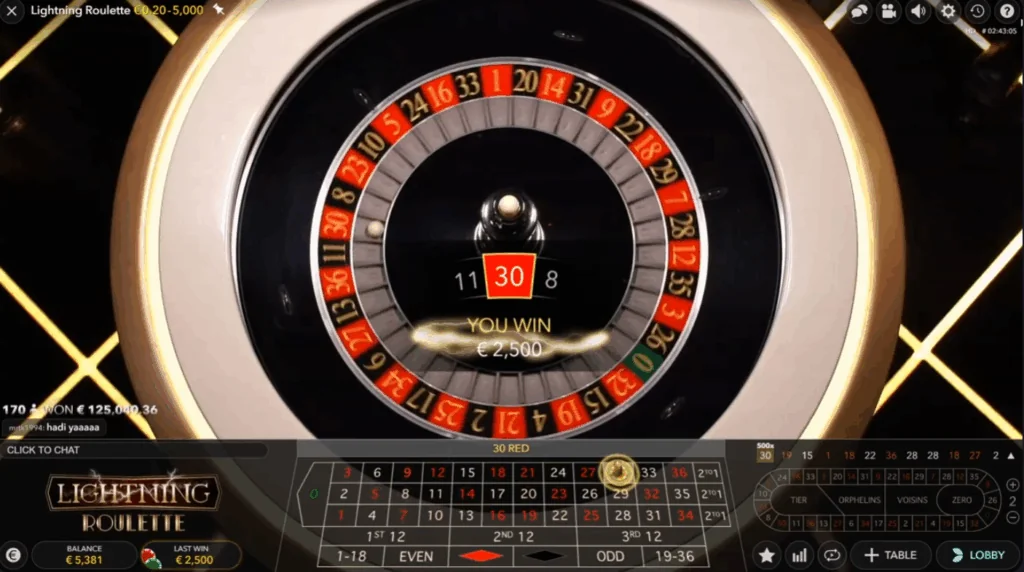
Straight-up numbers are the exception. Instead of 35:1 they pay 29:1 when the pocket is not struck, and 50x to 500x your chip when it is. A €1 chip sitting on a 500x number returns €500, which is the ceiling for a single unit.
Because only straight-up chips can catch a multiplier, the shape of your bet decides whether the mechanic matters to you at all. A player covering a dozen with one chip is, in practice, playing plain European roulette with better scenery.
RTP and House Edge
Two figures are worth remembering. The published Lightning Roulette RTP is 97.30% for every bet type except straight-ups, giving a 2.70% house edge, and 97.10% for straight-ups, giving 2.90%.
The gap exists because the reduced 29:1 payout removes slightly more value than the multipliers give back, roughly 0.20% of turnover. That is the price of admission for the 500x chance. Across a short session the difference is invisible; across tens of thousands of rounds it is measurable.
Both numbers are theoretical averages calculated over millions of rounds, and neither predicts a single session. No operator can adjust them either, since the same table is streamed to every casino carrying the game.
Max Win and Volatility
The Lightning Roulette max win is 500x per straight-up chip, so the absolute cash figure depends on the straight-up limit at your table rather than on the game itself. A €10 chip on a 500x number returns €5,000, and a table allowing €100 on a single number pushes the theoretical top return to €50,000. Multipliers do not stack across numbers, because the ball settles in only one pocket.
Lightning Roulette volatility depends almost entirely on how you bet. Covering even-money chances produces a low-variance experience with frequent small returns, while spraying chips across single numbers in search of a strike turns it into a medium-high to high variance game with long dry stretches. Treat the multiplier hunt as the high-risk mode it is and size stakes accordingly.
Lightning Roulette Strategy
No Lightning Roulette strategy changes the house edge, and any system promising otherwise is selling something. What a plan can genuinely do is control exposure, decide where your money sits and stop a session from running away from you.
The most common approach is a split bankroll: the bulk on outside bets at 97.30% for steady, low-variance play, and a small fixed portion, often five to ten straight-up chips per round, as the lottery ticket. That keeps most of your turnover on the better return while still leaving you eligible for a strike.
Neighbour and section betting through the racetrack is the other popular route. Covering five or nine adjacent pockets in a single action means any struck number inside that arc pays the multiplier if the ball lands there, and the racetrack lets you repeat the pattern without rebuilding it chip by chip.
Progressions such as Martingale deserve a warning. Doubling after losses runs into the table maximum long before it rescues a bad run, and the multiplier layer does nothing to help, because progressions are almost always applied to even-money bets that lightning never touches.
Mobile Device Compatibility
The table was rebuilt for portrait play years ago and the mobile version is not a cut-down port. The stream sits at the top, the betting grid below, and a swipe moves you between the full layout, the racetrack and your saved favourites.
It runs in Safari on iOS and Chrome on Android with no install, and inside operator apps where those exist. Video quality adapts to bandwidth automatically, and a low-data option strips the stream back to essentials if you are on mobile data.
Tablets get the best of both worlds: the desktop layout scales cleanly and the larger grid makes multi-chip straight-up patterns much easier to place accurately inside the short betting window.
Battery drain is real, as with any continuous video stream. For long sessions on a phone, dimming the screen and closing background apps makes a noticeable difference.
Advantages and Disadvantages
Advantages
The core appeal is a genuine 500x ceiling on a table game. Roulette normally caps a single-number win at 35:1, so a mechanic that can turn a €2 chip into €1,000 without altering the wheel is a meaningful addition rather than cosmetic.
The 97.30% return on outside bets is unchanged from plain European roulette, which means cautious players give up nothing by playing here instead of at a standard table. The multiplier layer is effectively optional.
Production quality and availability are hard to fault. Tables run around the clock in multiple languages, the statistics panel is detailed, and the racetrack plus favourite-bets tools save a lot of repetitive tapping.
Transparency is another plus. The wheel is physical and on camera, results are logged in the history strip, and the multiplier draw happens on screen after bets are locked, which removes most of the doubt players have about digital outcomes.
Limitations
The reduced 29:1 straight-up payout is the obvious cost, and it applies on every round including the many where your number is not struck. Anyone betting single numbers exclusively will feel that shortfall long before they feel a 500x.
Multipliers ignore outside bets entirely. If your style is red/black or dozens, the lightning is decoration: you pay nothing for it but gain nothing either, which makes the table a slower, noisier version of what you already play.
The absence of a true free-play mode is a genuine drawback for anyone who likes to test a game before staking. Spectating and RNG substitutes help, but they are not the same as practising at the actual table.
The cost of a realistic multiplier hunt adds up quickly. Covering ten numbers at the smallest chip already means ten units per round, so the practical entry cost is higher than the headline minimum suggests.
Conclusion
Years after launch, Lightning Roulette still does exactly what it set out to do: keep single-zero roulette intact while bolting on a jolt of slot-style upside. The maths is honest about the trade. You hand over six units of straight-up payout and receive a 50x-to-500x draw in return, while the 97.30% return on everything else stays untouched.
It suits two very different players. Anyone who enjoys outside bets can treat it as a better-looking European table with no penalty attached, while number hunters get a ceiling no classic wheel offers, provided they accept the higher variance and the missing 35:1.
Set a session budget before the first spin, decide in advance how much of it goes on straight-ups, and use the statistics panel rather than intuition to track what has actually happened. That, in practice, is the whole of any sensible Lightning Roulette strategy.