Jackpot Football Review 2026 – RTP, Payouts and Strategy

Jackpot Football at a Glance
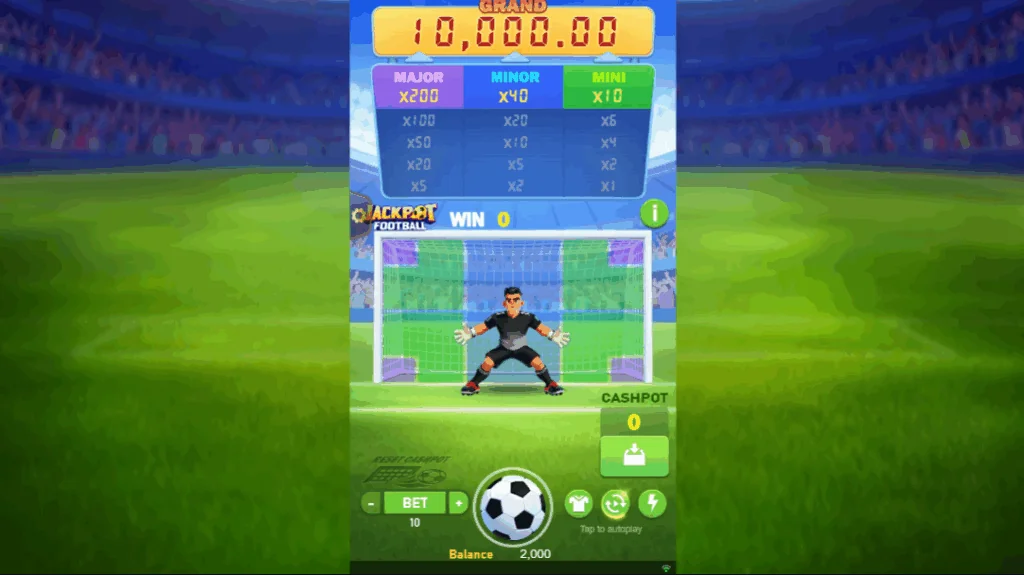
Jackpot Football is a penalty-shootout game from TaDa Gaming that went live on 26 May 2026. It is worth saying plainly at the top that this is not a reel slot, even though it usually sits in the slots section of an operator lobby: the provider files it as a crash game and lists its paylines as none. Every bet you place buys exactly one shot at goal, and everything that happens next depends on whether the ball beats the keeper.
The structure that gives the game its name is a prize board mounted above the goalmouth. It holds three columns, labelled Mini, Minor and Major, with five multiplier levels stacked inside each one, and a separate Grand Prize display sitting on top of all three. TaDa calls this arrangement the Three-Tier Board Progression, and the provider frames the central decision as choosing whether to cash out at the right moment or go all in and try to light up the entire board.
The official game sheet publishes a maximum win of 1,000x and a release month, and lists the special features as Grand Prize, Jackpot and Football. It does not publish a return-to-player figure at all. Two independent games databases carry 97.03%, and that is the source of every RTP number quoted in this review; nothing here is drawn from the provider on that point, because the provider says nothing.
| Item | Detail |
|---|---|
| Provider | TaDa Gaming |
| Release date | 26 May 2026 (provider figure) |
| Game type | Crash game (provider classification) |
| Format | Penalty shootout, one shot per bet |
| Paylines | None |
| Prize board | Three columns of five levels, plus Grand |
| Tier ceilings | Mini 10x, Minor 40x, Major 200x, Grand 1,000x |
| Cashpot ceiling | 200x (third-party review figure) |
| RTP | 97.03% (database figure, not published by TaDa) |
| Volatility | Medium, three marks of five on the in-game gauge |
| Max win | 1,000x (provider figure) |
| Min bet | 0.20 |
| Max bet | 100 |
| Jackpot type | Fixed, not progressive |
| Special features | Grand Prize, Jackpot, Football (provider wording) |
| Supported languages | 16 |
| Technology | JS, HTML5 |
| Game size | 7.6 MB |
Jackpot Football RTP and Hit Frequency
The headline figure is 97.03%, which is high for this category and roughly a point above the range most reel slots occupy. In a game with no reels, no paylines and no bonus round, that number is doing something quite specific: it describes the long-run return of a system in which one shot per bet either adds a multiplier to your running total, leaves it alone, or destroys it.
Where the 97.03% Comes From
TaDa does not print an RTP on its own promotional sheet for this title, which is consistent with how the studio treats the rest of its catalogue. The 97.03% figure appears identically on two independent games databases, both of which also match the provider on release date and on the 1,000x ceiling, so the surrounding data is internally consistent even though the return itself is unverified at source.
Neither database publishes a hit frequency for the game, and there is no theoretical basis for estimating one from the outside. What can be said is that the mechanic is designed to pay something small very often: the very first level of the Mini column is worth 1x the bet, so a single successful shot at the bottom of the board returns roughly the stake rather than a genuine profit.
Treat the 97.03% as an operator-lobby number rather than a certified one. If your casino runs a configurable build, the help panel inside the game is the only figure that applies to the money you are actually staking, and it takes a few seconds to open from the information button in the top-right corner of the play area.
Jackpot Football Volatility and Risk Profile
Both databases band the game as medium, and the game agrees with them. The loading screen carries a chilli gauge next to the logo, and three of the five marks are lit. That is the middle reading, and for once it feels honest rather than promotional, because the risk in this game is unusually easy to describe.
Three Marks Out of Five
Most of your losses are small and predictable: a shot that the keeper palms away costs you the stake and nothing else. The rare large loss is different in kind, because a shot that misses the target entirely clears the board and empties the cashpot, taking away everything you had built up but not yet collected. That single outcome is where almost all the variance lives.
The result is a risk curve that feels gentle for as long as you keep collecting early and turns sharp the moment you start holding out for the Major column. A player who banks 2x or 3x and resets will see a very different distribution from one who lets the board run towards the Grand, and both are playing the same 97.03% game.
The Three-Tier Prize Board
The board is the whole game, so it is worth reading carefully before your first shot. Three columns sit side by side above the goal: Mini in green on the right, Minor in blue in the middle, Major in purple on the left. Each column has five rungs, and the value printed in the coloured header at the top of a column is that column top prize.
Reading the Board
The Mini column runs 1x, 2x, 4x, 6x and tops out at 10x. The Minor column runs 2x, 5x, 10x, 20x and tops out at 40x. The Major column runs 5x, 20x, 50x, 100x and tops out at 200x. Above all three sits the Grand Prize, which is worth 1,000x the bet and is displayed as a cash amount rather than a multiplier.
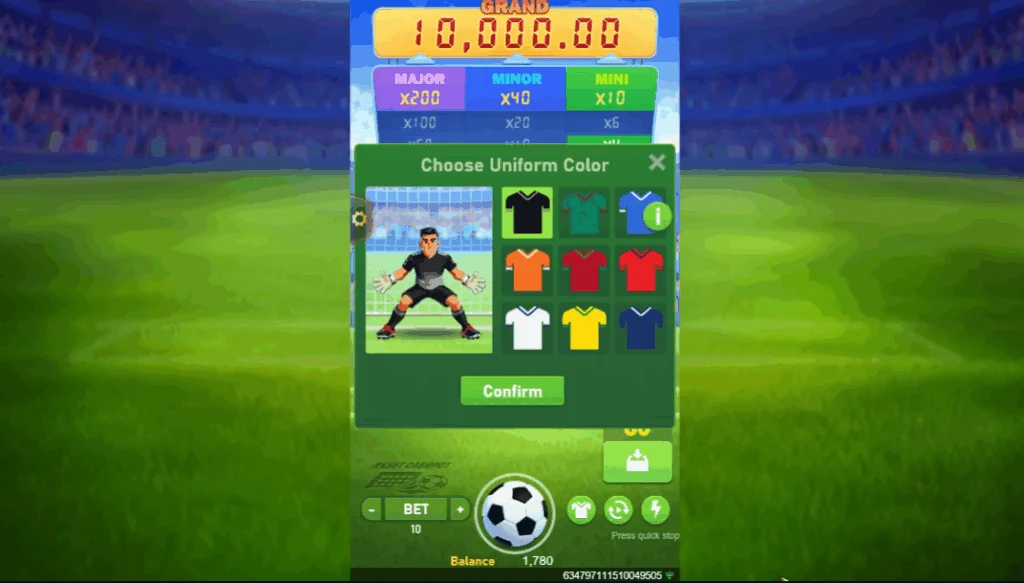
That cash display is the source of a lot of confusion in operator lobbies. On a build set to a bet of 100 the Grand panel reads 100,000.00; on a build set to a bet of 10 the same panel reads 10,000.00. Both are the same 1,000x. If the number on your screen looks enormous, check the bet field before you get excited, because the panel scales with your stake.
A fresh round starts with the bottom cell of the Mini column lit and nothing else. That is level one of fifteen, and the distance between it and the Grand is the entire arc of the game.
| Board level | Mini | Minor | Major |
|---|---|---|---|
| Tier prize (top) | 10x | 40x | 200x |
| Level four | 6x | 20x | 100x |
| Level three | 4x | 10x | 50x |
| Level two | 2x | 5x | 20x |
| Level one (start) | 1x | 2x | 5x |
How to Play Jackpot Football
There is no spin button and no autoplay-and-forget rhythm here in the way a slot player would expect. You set a stake, you take a shot, you watch the keeper, and then you decide whether to bank what has accumulated or take another shot. The loop is short enough that a session can move very fast if you let it.
Setting Up a Shot
The bet field sits at the bottom-left of the screen with minus and plus arrows either side of it. Databases list the range as 0.20 at the bottom and 100 at the top, though the exact figures your account sees are set by the operator and the currency. Once the stake is where you want it, the large circular button in the centre of the panel takes the shot.
The Control Panel
To the right of the shoot button there are three round controls: a shirt icon that changes your kit, a looping arrow that runs shots automatically, and a lightning bolt that speeds the animation up. A caption underneath reads that you hold a button for its settings, which is how the autoplay count is configured rather than through a separate menu.
On the right-hand side of the panel is the cashpot meter with a collect button directly beneath it, and on the left there is a control labelled reset cashpot, next to a small goal-and-ball icon. The win counter and the game logo sit just above the goalmouth, and the information button in the top-right corner opens the help pages and the paytable.
Scoring, Saves and Misses
Three things can happen to a shot, and they have very different consequences. The keeper stands in the middle of a goalmouth divided into coloured panels, and the outcome of each attempt is what drives the board upward, holds it still, or resets it to nothing.
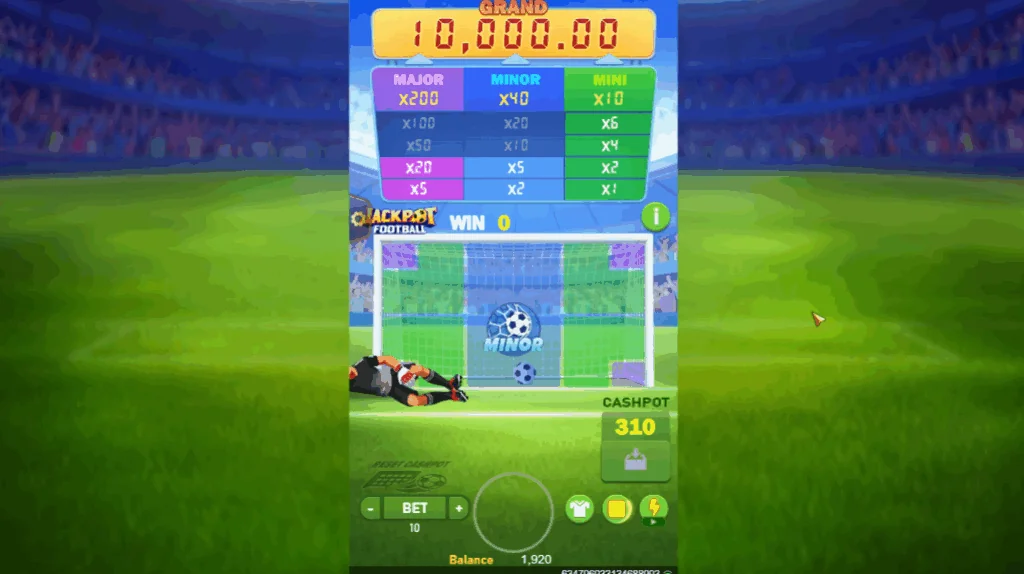
When you score, one of the three columns is selected and its lit level moves up by one rung. The multiplier belonging to that new level is added to your cashpot. The intro screen states the principle in a single line: score a goal to trigger the prize. Because the column is chosen for you rather than by you, a run of goals does not climb one ladder neatly, it spreads across all three.
What a Save Costs You
If the keeper gets a hand to it, you lose the stake for that attempt and nothing more. The board keeps every level it has lit and the cashpot keeps every multiplier already banked into it. This is the single most player-friendly detail in the game, and it is what makes long strings of attempts survivable rather than ruinous.
What a Miss Costs You
A shot that misses the target completely is the punishing outcome. It wipes the cashpot and takes the board back to its starting position, so every multiplier you had accumulated but not collected disappears. Published reviews describe this as an uncommon event rather than a frequent one, with one reviewer reporting only a handful of misses across a hundred attempts, but a single one is enough to end a good run.
The asymmetry between a save and a miss is the reason this game rewards discipline more than most instant-win titles. You are not being punished for losing individual shots, you are being punished for holding a large uncollected balance for too long.
The Cashpot and When to Collect
The cashpot is the running total of every multiplier the board has awarded since your last collection or reset. It is displayed as a cash figure in the panel on the right, and the collect button underneath it moves the whole amount into your balance immediately. Third-party reviews put the practical ceiling of the cashpot at around 200x the bet.
Collecting does not end the game, it simply banks what you have and starts the accumulation again. That makes the decision genuinely interesting rather than cosmetic, because the only real cost of a miss is the size of the uncollected cashpot at the moment it happens. A player who collects at 2x is almost impossible to hurt; a player sitting on 80x is one bad shot away from losing all of it.
Reviewers who have logged extended sessions tend to describe cashing out somewhere between 2x and 10x as the comfortable band, and to admit that the temptation to push past it is the hardest part of the game to manage. That is a behavioural observation rather than a mathematical one, and it does not change the underlying return.
The Golden Ball
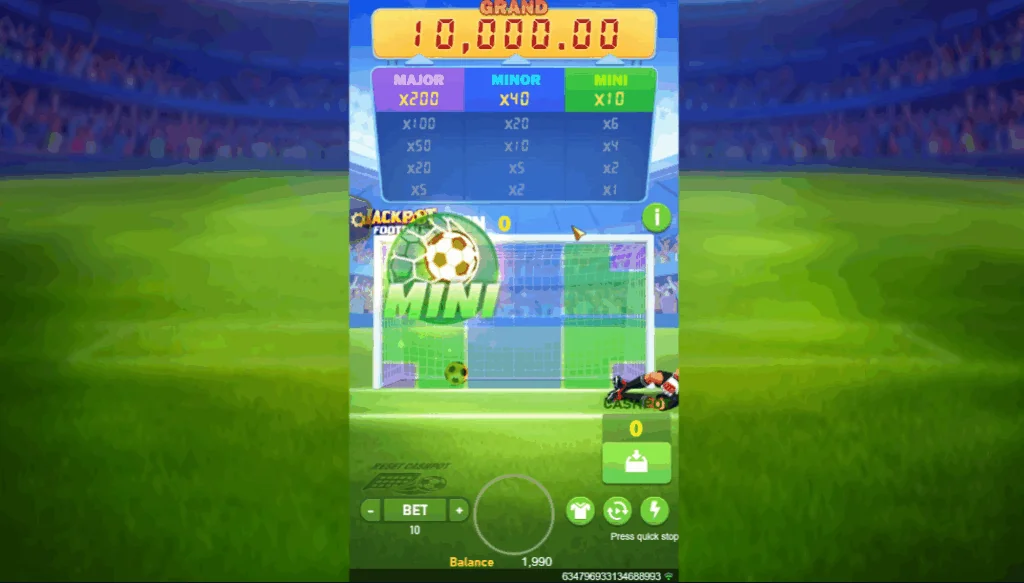
The one genuine feature layered on top of the shooting loop is a golden ball. It appears in place of the standard ball, and the promotional screens for the game show it carrying a tier label such as Mini, with the caption stating that hitting gold gets you upgraded.
Two or Three Rewards at Once
Published reviews of the game describe the effect concretely: scoring with the golden ball awards two or three rewards from the same prize column instead of the usual single step. On the Major ladder that is the difference between adding 5x and adding a meaningful chunk of the column in one attempt, which is why it is the fastest route towards the upper rungs.
TaDa does not publish a trigger rate for the golden ball, and no database carries one either. Reviewers report seeing it a handful of times across a long session rather than regularly, so it is best treated as an occasional accelerant rather than a mechanic you can plan a session around.
Jackpot Football Max Win Potential
The provider states 1,000x, and unusually for this kind of game the claim can be checked directly. TaDa publishes a win screen showing the Grand Prize being paid, and the figures on it line up exactly: a bet of 100 produces a payout of 100,000.00, which is 1,000x to the last decimal place. A second screen showing the Major Prize pays 20,000.00 on the same bet of 100, matching the 200x printed in that column header.
| Screen | Bet shown | Amount shown | Multiple of bet |
|---|---|---|---|
| Grand Prize win | 100 | 100,000.00 | 1,000x |
| Major Prize win | 100 | 20,000.00 | 200x |
| Grand panel, demo build | 10 | 10,000.00 | 1,000x |
| Major header, intro screen | 10 | 2,000 | 200x |
| Minor header, intro screen | 10 | 400 | 40x |
| Mini header, intro screen | 10 | 100 | 10x |
Why 1,000x and 1,400x Both Appear
Search for this game and you will find a maximum payout of 1,400x quoted in at least one detailed review, which sits awkwardly next to the provider figure of 1,000x. The two are reconcilable rather than contradictory. The Grand Prize itself is worth 1,000x, but the cashpot you accumulated on the way up is a separate pot that is paid alongside it, and the win screen for the Grand shows a cashpot of 15,000 still sitting in the panel at the moment the Grand is awarded.
In other words, 1,000x is the ceiling of the single largest prize the game can hand out, while the higher figure is an attempt to describe the best possible total from one complete board run. Both databases that carry the game list 1,000x, and that is the number used throughout this review because it is the one the provider stands behind.
Betting Range and Stakes
Databases list a minimum of 0.20 and a maximum of 100 per shot, with the usual caveat that operators configure their own limits and currencies. The screens published by the provider run at a bet of 100, and the freely available demo build runs at 10, which gives you a reasonable sense of the spread the game is designed to handle.
Because a shot is a single event rather than a spin with dozens of paylines, the stake maps onto the board very directly. Every multiplier printed on the board is a multiple of the current bet, so raising your stake mid-round changes what the remaining rungs are worth without changing your position on the board. That is worth remembering if you find yourself nudging the bet upwards while a run is in progress.
Strategy Tips for Jackpot Football
No strategy alters the 97.03% return, and nothing you do changes where the keeper dives. What strategy can do here is shape the distribution of your results, because you control one genuinely consequential variable: how large a cashpot you are willing to leave exposed to a miss.
Sizing a Session
Decide a collection threshold before you start and hold to it. A low threshold turns the game into a grind with very few large swings; a high one converts it into something closer to a lottery on the Major column. Neither is wrong, but switching between them mid-session is how bankrolls disappear, because the temptation to raise the threshold always arrives when the board looks promising.
Bear in mind that the board climbs a random column, not the one you would choose. You cannot steer progress towards Major, so a plan built on reaching that column top rung is a plan built on a sequence of coincidences. Sizing the stake so that a hundred shots is affordable is a more useful discipline than any threshold rule.
How Jackpot Football Compares With Other Instant-Win Titles
Against a conventional reel slot the comparison is mostly about transparency. A 97.03% return is above the band most slots occupy, and the paytable here is fifteen numbers you can read at a glance rather than a symbol grid with weighted reel strips behind it. What you give up is depth: there are no free spins, no scatters and no bonus buy, and one of the databases that carries the game confirms explicitly that free spins are not available.
Against other TaDa releases it is a more generous publisher of information than usual. The studio bingo title iRich Bingo, for example, publishes a 1,500x ceiling and a feature list but no RTP and no volatility band at all, whereas Jackpot Football at least carries a volatility gauge inside the game and consistent third-party data around it. That is a low bar, but this game clears it.
Against the crash games it is officially grouped with, Jackpot Football is slower and less punishing. There is no rising curve to bail out of and no single moment of forced commitment; you take a shot, see the result, and decide again. The trade-off is that the ceiling is fixed at 1,000x rather than open-ended, so the extreme outcomes that draw players to multiplier crash titles are simply not on the table.
Where Jackpot Football Sources Disagree
Three conflicts are worth flagging so you can judge the numbers you see elsewhere. The first is the maximum win: the provider and both databases say 1,000x, while one detailed review says 1,400x. As set out above, the difference is almost certainly the cashpot being counted on top of the Grand Prize rather than an error about the jackpot itself.
The second is the genre label. TaDa classifies the game as a crash game; one database files it under other types with an instant-win tag and a penalty-games category; and a great many affiliate pages simply call it a slot because that is the word their templates use. It has no reels and no paylines, so none of the slot vocabulary applies to it literally.
The third is the return itself. There is no RTP anywhere on the provider material, and the 97.03% that circulates everywhere is a database figure. It is repeated consistently and it sits alongside release and max-win data that the provider does confirm, which is mildly reassuring, but it is not the same thing as a published or certified number.
If you are shortlisting rather than committing, our 3 Fortune Souls review covers another game built on a fixed jackpot ladder, 100 Blazing Clover is another TaDa Gaming title, and Fortune Dice is a second fixed-jackpot game.