Tiger Jackpots Slot Review 2026 – RTP, Jackpots and Max Win

Tiger Jackpots at a Glance

Tiger Jackpots is a five payline classic slot on a three by three grid, released by Onlyplay on 18 June 2026, and everything interesting about it happens outside the paylines. The reels themselves are deliberately old fashioned. The studio has bolted on a coin collection system instead. Golden Coin symbols carry cash values and a Gong symbol on the middle reel sweeps them up. A meter beside the grid fills as those symbols pass by, then fires a Hold and Win round of its own accord.
The published numbers are a mixed bag. The return to player is 95.66%, which is not competitive. Volatility is medium, the hit frequency is 13.31%, and the ceiling is 5,216 times your stake. That combination describes a game that pays small amounts fairly often and asks you to wait a long time for the round that actually matters. Four fixed jackpots sit on top, worth 25x, 50x, 150x and 1,000x, and they are only reachable inside the bonus.
Onlyplay is open about the lineage. Databases describe the game as a reskin of Red Dragon of Luck, and the mechanic set is one the studio has shipped repeatedly across its jackpot titles. That is not automatically a criticism, because the maths model behind it is well tested, but it does mean you should not expect anything you have not seen before.
Tiger Jackpots Key Facts and Specifications
The table below draws on the studio page for Tiger Jackpots and on the two largest independent slot databases. Where they disagree, this review gives both figures rather than one tidied number.
| Item | Detail |
|---|---|
| Provider | Onlyplay |
| Release date | 18 June 2026 |
| Game type | Video slot, classic three reel layout |
| Grid | 3 reels, 3 rows |
| Paylines | 5, fixed, left to right |
| RTP | 95.66% |
| Volatility | Medium, as published by the studio |
| Hit frequency | 13.31% |
| Max win | 5,216x the bet |
| Min bet | 0.50 |
| Max bet | 40.00 |
| Top line win | 30x for three Maneki Neko, verified by two sources |
| Jackpots | Four fixed: Mini 25x, Minor 50x, Major 150x, Grand 1,000x |
| Free spins | None |
| Bonus buy | None |
| Bonus round | Yes, Hold and Win respins |
| Orientation | Landscape and portrait, 19.5:9 and 9:19.5 |
| File size | 21.5 MB per the studio, 13.5 MB per one database |
| Technology | HTML5 and JavaScript |
| Currencies | All fiat currencies and crypto |
Two entries there deserve a flag. The studio and the database that catalogued the game six days after launch give different file sizes. That usually means one of them measured a different build. And the volatility rating appears as medium in the studio specification and in one database summary, while the same database that says medium also carries a comparison row where the field reads undisclosed. The studio figure is the one to trust.
What Onlyplay Publishes About Tiger Jackpots
The studio description is worth reading closely because it is the only first party account of how the features connect. Onlyplay says that Golden Coin symbols help fill the Tiger Jackpots meter, building anticipation with every spin. It then states that the real action begins when two Special Symbols and a Special Collect Symbol trigger the Bonus Coin Game. Unlike many traditional slot bonuses, the studio says, this feature can continue through multiple rounds. The Sticky Collect Symbol stays active throughout the bonus and gathers values from Coin symbols.
Three things follow from that wording. First, the trigger is a three symbol combination, not a scatter count: two value carrying symbols plus one collector. Second, the bonus is a respin round with a reset condition, which is what continuing through multiple rounds means in practice. Third, the collector is sticky for the whole bonus rather than for a single respin, so once it is in place every coin that lands afterwards is collectable.
The Meter Is a Second Route In
The studio also says the meter builds toward exciting rewards and that rare Special Symbols can reveal valuable prizes, and it names the four jackpots as Mini, Minor, Major and Grand. Independent testing confirms what that implies: the meter is a genuine alternative entrance to the bonus, and at least one reviewer entered the feature through the meter rather than by landing the trigger. That matters more than it sounds, because the natural trigger turns out to be the hardest thing in the game to hit.
The 3×3 Grid and Exactly Five Paylines
The layout is three reels by three rows, and the five paylines are not an arbitrary choice. On a three by three grid there are exactly three horizontal lines and exactly two diagonals, which is five. Every payline is therefore in play on every spin, nothing is adjustable, and there is no configuration decision to make. Three identical symbols along one of those five lines form a win, reading left to right.
That structure caps what line wins can do. With nine cells and five lines, a single symbol can sit on at most three paylines at once, and the verified paytable tops out at 30x. That is why the coin mechanic carries the game: the paylines are there to keep the reels feeling like a slot, and the collection system is where the volatility and the ceiling actually live.
Controls Are Deliberately Minimal
You get a bet selector, a spin button, autoplay and a turbo mode. There is no gamble ladder, no bonus buy, no ante bet and no way to influence the feature. For a classic format that is consistent, but it does remove every lever a player might otherwise pull.
Tiger Jackpots Symbols and Paytable

The paytable has seven regular symbols plus a wild, and because three of a kind is the only winning length, each symbol has a single value. The figures below give multiples of the total bet. They cross check cleanly against a second source carrying the same paytable at a one unit stake: thirty, twenty, ten, ten, two, two and two. Two independent renderings of the same numbers is about as good as paytable verification gets without opening the game.
| Symbol | Three of a kind | Notes |
|---|---|---|
| Wild | No published value | Appears as a plaque marked WILD and substitutes for regular symbols. One database credits it with 50x, another lists it with no value at all |
| Maneki Neko | 30x | Top regular symbol |
| Lucky Coins | 20x | Regular symbol, distinct from the value carrying Coin |
| Golden Comb | 10x | Mid tier |
| Fan | 10x | Mid tier |
| Shrimp Sushi | 2x | Low tier |
| Lotus Flower | 2x | Low tier |
| Bamboo Sticks | 2x | Low tier |
The Wild Is the One Contested Symbol
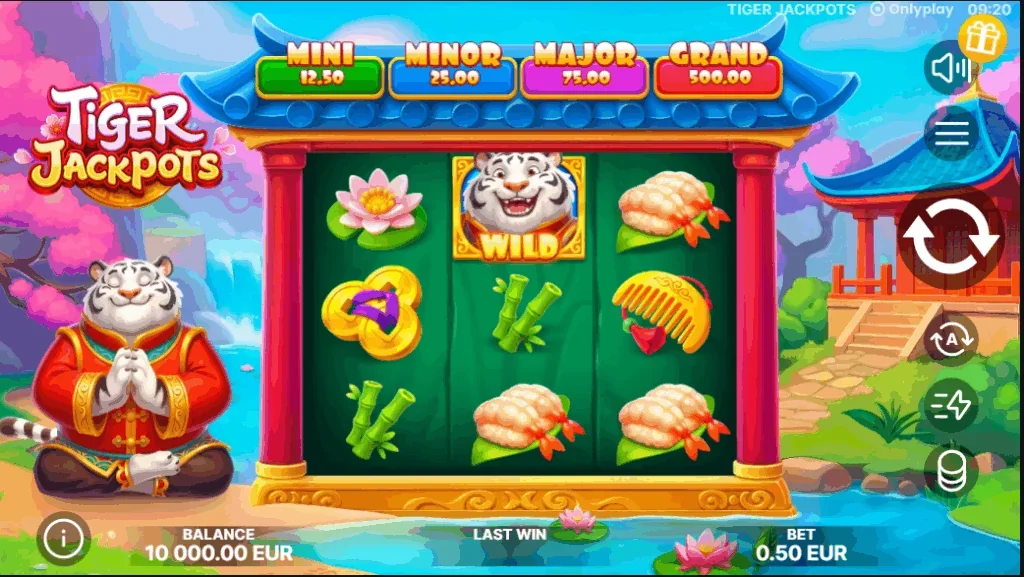
The wild is the one place where the sources fall out, and a game screenshot settles it in favour of caution. One database describes the White Tiger as the wild and credits it with a 50x line win. A published reel capture shows something different: the White Tiger sits beside the grid as the game’s mascot, while the wild on the reels is a green plaque marked WILD. The second database lists that wild in its paytable with no payout value at all. Treat the wild as a substitute symbol until the in game paytable tells you otherwise, and treat 30x for three Maneki Neko as the verified top line win.
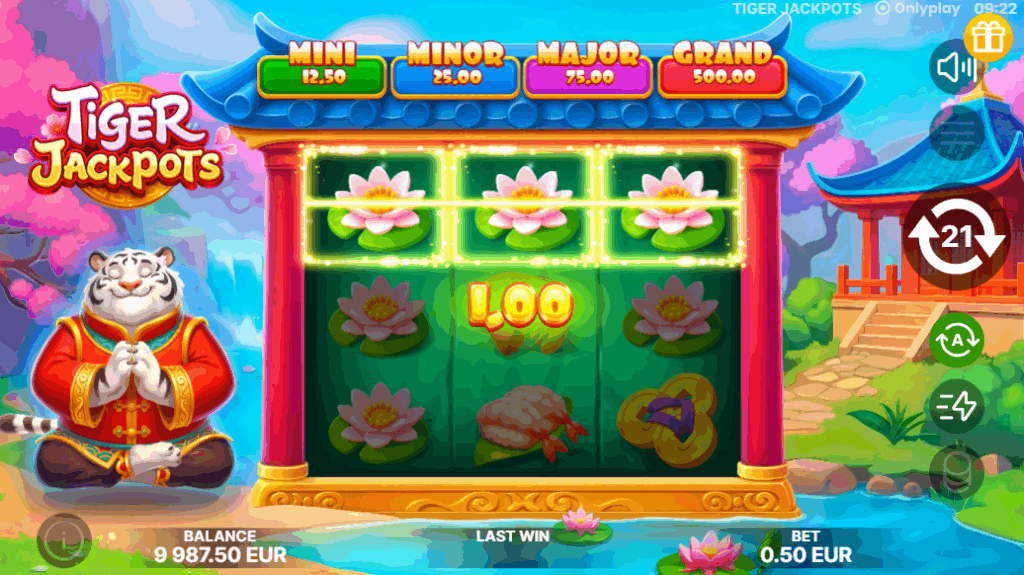
A second capture supports the scale of those numbers. It shows a Big Win banner paying 10.00 on a 0.50 stake, which is 20x the bet, and 20x is exactly what the paytable gives for three Lucky Coins. A game labelling 20x as a big win also tells you something about the distribution you should expect.
Why the Low Symbols Are Not as Weak as They Look
Three low symbols all paying 2x of the total bet reads as stingy, but on a five line game the arithmetic is different from a 25 line one. A 2x return is double your stake, not a fraction of it. Combined with a 13.31% hit frequency, that produces a useful floor: if every single winning spin paid only the minimum, the base game would still be returning around 26.6% of turnover on its own. The remaining sixty nine or so percentage points have to come from the higher line wins and from the coin features, which tells you how much of the model is loaded into the bonus.
The Coin Symbol Is Not on the Paytable
Worth stating plainly: the golden Coin that carries a cash value is a bonus symbol, not a paying symbol. It never forms a line win. Only a Gong turns it into money. Neither of the databases publishes the full range of coin denominations, so if you want to know what values are in the pool you will have to read the in game information screen.
Coin Collect and the Gong Collector
This is the base game feature and it has strict positional rules. Coin symbols can only appear on reels one and three. The Gong, which acts as the collector, can only appear on reel two. When a Gong lands with at least one Coin in view, it collects the cash value of every Coin on screen and pays the total.
Because the grid is three rows deep, that gives Coins six possible cells, three on reel one and three on reel three. Reel two has three cells for Gongs, and up to three Gongs can be present at the same time. Each one collects independently, so a full column of Gongs with Coins either side pays the collected total three times over. That is the single biggest base game outcome available and it is the reason the middle reel is the one to watch.
The Positional Rule Cuts Both Ways
Restricting Coins to the outer reels and Gongs to the middle one makes the feature legible, but it also makes it rare. You need a specific symbol on a specific reel at the same time as another specific symbol on a different reel. A tester at one review site kept landing a Coin on reel one and a Gong on reel two while the Coin on reel three never arrived. He finished the session without ever seeing the round. That is the practical cost of the design.
The Tiger Jackpots Accumulator Meter
The Accumulator is the mechanic that stops the positional rule from being fatal. Every Coin and every Gong that appears on the reels is also banked into a meter beside the grid, whether or not it produced a collection. Once the meter fills, the bonus round can start at random on any base game spin, with no trigger combination needed.
Databases classify this under symbol collection, sometimes labelled an energy meter, and it is the same progress device Onlyplay uses across its jackpot range. Functionally it is a pity timer: the longer you go without a natural trigger, the closer the meter gets. One published two hundred spin test reached the bonus exactly once, and it was the Accumulator rather than the trigger that opened the door.
What the Meter Does Not Do
It is not a jackpot meter. The four jackpot values in Tiger Jackpots are fixed multiples of your bet and do not grow with play, yours or anyone else’s. The Accumulator only governs access to the bonus round. There is no progressive pool anywhere in this game, which the databases confirm.
The Bonus Coin Game and Hold and Win Respins
The bonus is a Hold and Win round and its structure is conventional. It starts with three respins. Every time a new symbol lands, the counter resets to three. Gongs already in place are sticky and stay put for the entire round, and they continue to collect. Once the respins run out, the round ends and pays the accumulated total.
The important change from the base game is what enters the reel set. During the bonus, a new class of Coin appears carrying the values of the four jackpot prizes rather than ordinary cash amounts. The sticky Gongs collect those jackpot Coins exactly as they collect any other Coin. That is the only route to the Grand in this game. There is no separate jackpot wheel and no side bet.
Why Sticky Collectors Change the Maths
In the base game a Gong is a one spin event: it collects what is on screen at that moment and disappears. In the bonus it stays. That means the first Gong to arrive collects on every subsequent respin, the second one added collects everything again, and a third multiplies the effect once more. A round that starts slowly and then adds a second and third collector before the counter runs down is where the large outcomes come from.
No Free Spins, No Buy
There are no free spins in this game and there is no bonus buy. Both databases confirm it. The only ways into the feature are the natural trigger and the Accumulator, which means the cost of reaching the bonus is whatever the base game charges you while you wait.
The Four Fixed Jackpots in Tiger Jackpots
The four jackpots are fixed multiples of the bet in play, awarded as Coin values inside the bonus round. Because they scale with your stake rather than sitting in a shared pool, the same jackpot is worth eighty times more at the maximum bet than at the minimum.
| Jackpot | Multiple of bet | Value at 0.50 stake | Value at 40.00 stake |
|---|---|---|---|
| Grand | 1,000x | 500.00 | 40,000.00 |
| Major | 150x | 75.00 | 6,000.00 |
| Minor | 50x | 25.00 | 2,000.00 |
| Mini | 25x | 12.50 | 1,000.00 |
Those four multiples are not taken on trust. A published capture of the game running at the 0.50 minimum stake shows the jackpot ladder above the reels reading 12.50, 25.00, 75.00 and 500.00 from Mini to Grand. Divide each by 0.50 and you get 25x, 50x, 150x and 1,000x exactly. That is a rare thing in slot reviewing: the published multiples confirmed against the game’s own display rather than against another review.
The four together add up to 1,225x. That is a useful figure to hold on to, because it shows that collecting one of each in a single round would still leave you well short of the published 5,216x ceiling. Reaching the top of this game is not a matter of hitting the Grand once.
Fixed Beats Progressive Here
A fixed jackpot has one genuine advantage over a progressive: nothing is being skimmed off your return to fund a pool you will probably never win. The 95.66% you are quoted is the whole story, and the 1,000x Grand is available on your first spin at the same odds as your thousandth. The trade off is that there is no headline number to chase and no chance of an outsized payout.
Tiger Jackpots RTP, Hit Frequency and Volatility
The return to player is 95.66%, and this is one of the rare cases where every source agrees: the studio, both databases and the operator listings all carry the same figure. Neither database flags the game as having an RTP range, so there is no evidence of reduced certified builds circulating. That is genuinely good news and it is not always the case.
What is less good is the number itself. The market average sits around 96.2%, so 95.66% leaves you paying a house edge of 4.34% instead of roughly 3.8%. Over a thousand spins at a one unit stake that difference is about four and a half units of extra expected cost. It is not catastrophic, but it is a real handicap and there is no feature in the game that compensates for it.
A 13.31% Hit Rate in Practice
A 13.31% hit frequency means roughly one paid spin in every seven and a half. For a five line classic that is respectable, and it is what produces the medium volatility rating. In practice you should expect long stretches of nothing punctuated by 2x returns that barely register, which matches what testers reported: lots of 2x, occasional 4x and 6x, and rare 10x and 20x hits.
Medium Volatility Is the Honest Label
The studio calls it medium and the databases agree. Given a 5,216x ceiling that might look understated, but the distribution supports it. You get frequent small line wins and a base game coin feature that pays modestly, often enough to matter. Then there is one high variance bonus that most sessions will never reach. The volatility is medium because the base game carries so much of the weight.
Where the 5,216x Maximum Win Comes From
The studio publishes the ceiling as a max exposure of 5,216, and one database independently lists the total maximum winnings as 208,640 in currency. Those two reconcile exactly: 208,640 divided by the 40.00 maximum stake is 5,216. Two sources arriving at the same cap by different routes is a strong confirmation that the figure is the certified one rather than an estimate.
What the figure is not is a grid maximum. Consider the theoretical extreme: six Coin cells on reels one and three, every one of them carrying the 1,000x Grand, collected by three sticky Gongs. That would be 18,000x, more than three times the published cap. The 5,216x is therefore a simulated or certified ceiling drawn from the actual reel weightings and jackpot Coin frequencies, not something you can derive from the layout. Any review that claims to explain the number from the paytable is guessing.
What 5,216x Costs at Each Stake
At the 0.50 minimum the cap comes to 2,608. A 1.00 stake turns it into 5,216. Bet the 40.00 maximum and it reaches 208,640. If the cap is what you are playing for, the stake you choose is doing all of the work, because the multiplier does not change.
Betting Range and Bankroll Maths for Tiger Jackpots
The betting range runs from 0.50 to 40.00 per spin, an eighty fold spread, and both databases publish the same limits. The floor of 0.50 is higher than many modern slots offer, which is a consequence of the five line structure: the game needs a minimum of 0.10 per line to make the paytable work.
For bankroll planning the useful numbers are the house edge and the trigger rate. At 4.34% expected cost, a hundred spins at 1.00 has an expected loss of 4.34 and a realistic swing of many multiples of that either way. One published two hundred spin test reached the bonus once and finished 4% down. That is close to textbook, since the session tracked the theoretical return almost exactly. Do not treat it as typical, because such precision over so few spins is unusual.
Sizing for the Bonus, Not the Base Game
Because the jackpots and the ceiling are bet multiples, the temptation is to raise your stake. The counter argument is that the bonus arrives rarely and the Accumulator does not care what you are betting, so a larger stake buys you fewer spins and therefore fewer chances at the meter. If reaching the feature is the goal, more spins at a smaller stake is the coherent approach.
A Note on Currency and Crypto
The studio states the game runs in all fiat currencies and in crypto. If you play in a crypto denomination, check that the bet steps map to the 0.50 to 40.00 range in a sane way, because conversion at the operator end is where odd minimum stakes usually appear.
What Testers Reported and Where Sources Disagree
Two published test sessions exist and they landed in different places, which is instructive. One reviewer never triggered the bonus at all, finished around 100x of the bet down, and rated the game three out of five while still recommending it on presentation. The other reached the round once through the Accumulator, collected 69x with three active collectors, and closed a two hundred spin session 4% down. Player ratings sit at 3.5 out of 5 from a small sample at one site and 8.0 out of 10 from a single vote at the other, so neither is statistically meaningful.
The consistent thread is that the natural trigger is the problem. Both accounts describe the positional requirement as the bottleneck, and one lists it explicitly as the game’s main weakness alongside the five payline count. If you play this game expecting to see the bonus regularly, you will be disappointed.
Disagreements Worth Knowing About
The sources conflict on three points. The studio lists the download size as 21.5 MB while a database lists 13.5 MB. One database credits the White Tiger with a 50x wild payout, while the other lists the wild with no value and puts the top paying symbol at 30x; a published reel capture shows the tiger beside the grid rather than on it, and shows the wild as a plaque, which favours the second reading. And the same database that publishes medium volatility carries a comparison table where the volatility field reads undisclosed and a multiplier field reads 3x that appears nowhere else, so treat that 3x as unverified.
Availability Is Still Thin
At the time the databases were last updated, one of them had scanned twenty leading operators and found the game at none of them, and could not confirm availability at the single casino it linked. For a June 2026 release that is not unusual. It does mean you may have to hunt for the game, and it is another reason to read the RTP in the game itself once you find it.
Tiger Jackpots Verdict: Who This Slot Suits
Tiger Jackpots is a competent, well presented game on a maths model its studio has used before. Two things hold it back: a below average return, and a bonus trigger that testers say almost never fires naturally. The Accumulator is a sensible answer to the second problem, and the four fixed jackpots are a cleaner proposition than a progressive pool, but neither fixes the 95.66%.
It suits a player who likes short, low commitment sessions on a simple grid. Taking 2x and 4x returns while a meter fills has to feel like enough, and a defined 1,000x target has to beat an unbounded chase. It does not suit anyone hunting a high ceiling efficiently, anyone who wants to buy into features, or anyone chasing the best available return on their turnover. Plenty of 96%+ alternatives carry comparable jackpot mechanics.
Try the Demo First, Specifically for the Trigger
The one thing worth testing in free play is how often you see a Coin, Gong, Coin arrangement across the three reels. That single observation will tell you more about whether you will enjoy this game than any published statistic, because it is the mechanic every review names as the weak point. If the demo frustrates you, real money will frustrate you more.
If you want a direct comparison, our 100 Blazing Clover review covers another low-line classic build, 20 Blazing Clover is a second classic-style grid, and 10 Sparkling Crown is one more short-grid release.