MONOPOLY Roll ’em Review 2026 – RTP, Payouts and Building Phase


MONOPOLY Roll ’em at a Glance
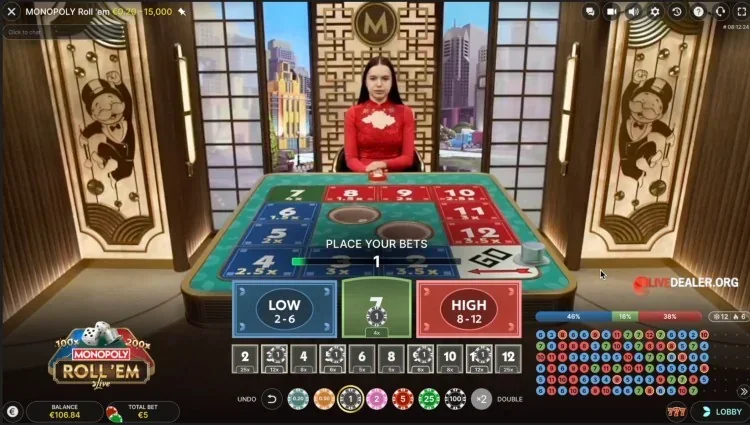
MONOPOLY Roll ’em is Evolution’s live dice game built on the Hasbro licence, and it is the studio’s simplest MONOPOLY title by a wide margin. There is no wheel, no bonus board and no interactive round. Two dice are shaken, their total is added up, and the MONOPOLY top hat moves around a twelve-square board to the winning number. You bet on where it will stop. Evolution launched the game on 15 July 2026 and publishes an optimal return of 96.97% with multipliers reaching 300x.
What lifts it above a plain two-dice betting game is the Building Phase. After betting closes but before the dice roll, MONOPOLY houses appear on randomly selected squares and add multipliers, and more houses on the same square stack them higher. The consequence is that the value of every square changes from round to round, and it changes after you have already committed your stake. That is the whole design in one sentence, and it is worth understanding before reading anything else.
| Item | Detail |
|---|---|
| Provider | Evolution |
| Licence | MONOPOLY, Hasbro, under an exclusive Evolution partnership |
| Launch date | 15 July 2026 |
| Game type | Live dice game |
| Category | Live craps and dice |
| Equipment | Two dice shakers, a 12-square board and the MONOPOLY top hat |
| Bet types | Low (2 to 6), Seven, High (8 to 12), specific number |
| Optimal RTP | 96.97% |
| Main feature | Building Phase |
| Maximum multiplier | 300x |
| Top payout | 299:1 |
| Volatility | Not published |
| Betting limits | Not published by the studio, set by each operator |
One thing the studio does not publish is a betting range. Live tables have limits set by each operator rather than by Evolution, so the figure in your own lobby is the only one that matters. The same applies to the return: the 96.97% is described as the optimal figure, and the section below explains what that word is doing.
MONOPOLY Roll ’em RTP and What Optimal Means
The published MONOPOLY Roll ’em RTP is 96.97%, and the number appears consistently across the studio’s own material, the games databases and several operators’ published returns pages. For a live entertainment format that is a competitive figure, comfortably ahead of most game shows and behind only the pure table games.
The word to notice is optimal. On Evolution tables that phrase normally means the best return available across the betting positions rather than a single number that applies to every bet. Specialist coverage of this game attributes the 96.97% to the Low and High positions, which are the widest bets on the layout. Narrower bets return less, and the published payout table makes it possible to show why.
Why the Base Payouts Return So Little
Take the single-number bets first and use the bottom of each published payout range, which is the unboosted price. A bet on 2 or 12 pays 24:1 at a probability of one in thirty-six, so the return before multipliers is twenty-five thirty-sixths, or about 69%. A bet on 6 or 8 pays 4:1 at five chances in thirty-six, which is twenty-five thirty-sixths again. Three and eleven, four and ten, five and nine, and the Seven position all land on twenty-four thirty-sixths, almost exactly two thirds.
That consistency is the strongest evidence the published table is accurate, and it tells you something important: on the narrow bets, roughly thirty percentage points of the advertised return has to be supplied by the Building Phase. Without houses on the board those positions would be dreadful. With them they reach the advertised figure, on average, over a very long run.
The Low and High Bets Are Not Flat
This is the detail most short descriptions miss, and it is what makes the game more interesting than a straight Sic Bo derivative. Low covers totals two to six and High covers eight to twelve, but they do not pay a flat price. The payout depends on which total inside the range actually lands, and it rises the further that total sits from seven.
A Low bet settled on a total of six pays 0.5:1 at its base price, while the same Low bet settled on a total of two pays 2.5:1. High is a mirror image: eight pays 0.5:1 and twelve pays 2.5:1. The design compensates you for the fact that the totals nearest seven are the ones most likely to appear, which means a range bet is really five bets of different value bundled into one position.
What That Does to the Return
The arithmetic on the base prices is worth doing. Weighting each total inside the Low range by its true probability and its unboosted payout gives a return of thirty-two and a half thirty-sixths, or a little over 90%. High is exactly symmetrical and returns the same. So the range bets start from around 90% before any multiplier lands, against about 67% for the narrow bets.
That gap is the entire reason Low and High are described as the best positions on the table. The Building Phase only has to add around seven percentage points to bring them to the advertised 96.97%, whereas it has to add thirty to do the same job for a single number. On a game where the multipliers are random and land after you have bet, the position that depends on them least is the safer one.
The Twelve-Square Board and the Top Hat
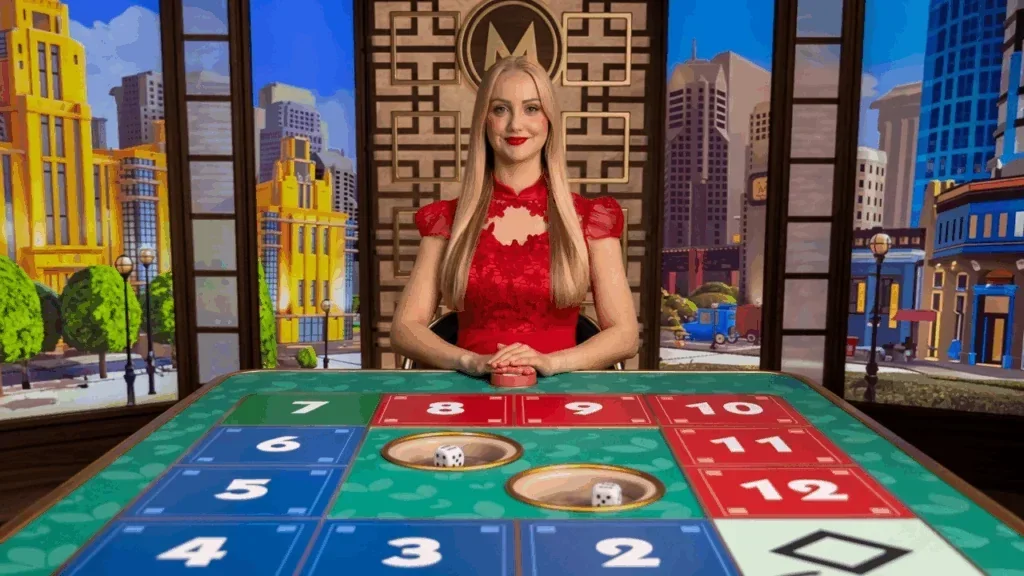
The physical setup is unusually easy to describe. There is a board of twelve numbered squares, two mechanical dice shakers and the MONOPOLY top hat as the marker. When the dice settle, their values are added and the hat travels around the board to the square matching that total, which is where the drama lives: the hat is moving while you watch, and you can see whether it is going to stop on your number.
Why Twelve Squares for Eleven Outcomes
Two dice can produce eleven different totals, from two through twelve, yet the board carries twelve squares. Evolution does not spell out the arrangement in its published material, so the honest answer is that the studio describes a twelve-square board and eleven possible totals without reconciling the two, and the layout is best confirmed by watching a round in the live lobby. What is documented is that the winning square always corresponds to the combined total of the two dice.
Presentation is otherwise standard Evolution: a licensed set built around the board, a host running the round, and on-screen statistics. The Hasbro credit on the studio page confirms the board design, the corner squares, the Mr. Monopoly character and the playing pieces are all used under licence rather than approximated.
How to Play MONOPOLY Roll ’em
A round breaks into five stages and the whole cycle is short, which is the point of the format. There is nothing to configure beyond choosing which positions to back and how much to put on each.
The Five Stages of a Round
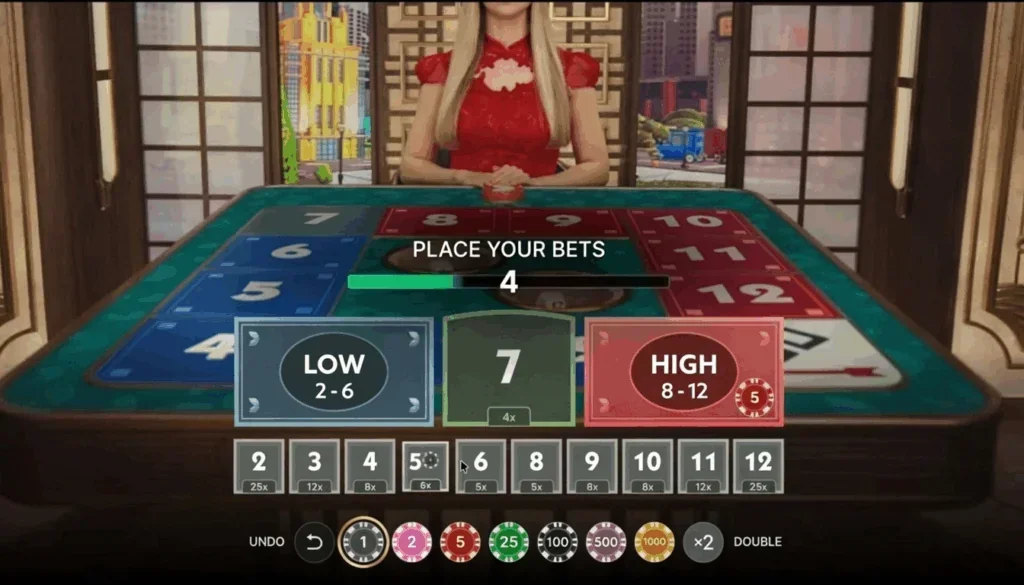
First comes the betting window, during which you can place chips on Low, Seven, High or any individual total, and you can combine selections freely. Second, betting closes and no further chips can be added. Third, the Building Phase runs and houses appear on random squares, adding and stacking multipliers. Fourth, the two dice shakers are rolled simultaneously and the values are added together. Fifth, the top hat advances around the board to the square matching the total, and every qualifying bet is settled at the relevant payout and multiplier.
Note the ordering carefully, because it is the one rule that genuinely affects strategy. The houses land in stage three, after your stake is locked in stage two. You never get to buy a boosted number. You can only hope the boost lands somewhere you already are.
Betting Options on the MONOPOLY Roll ’em Layout
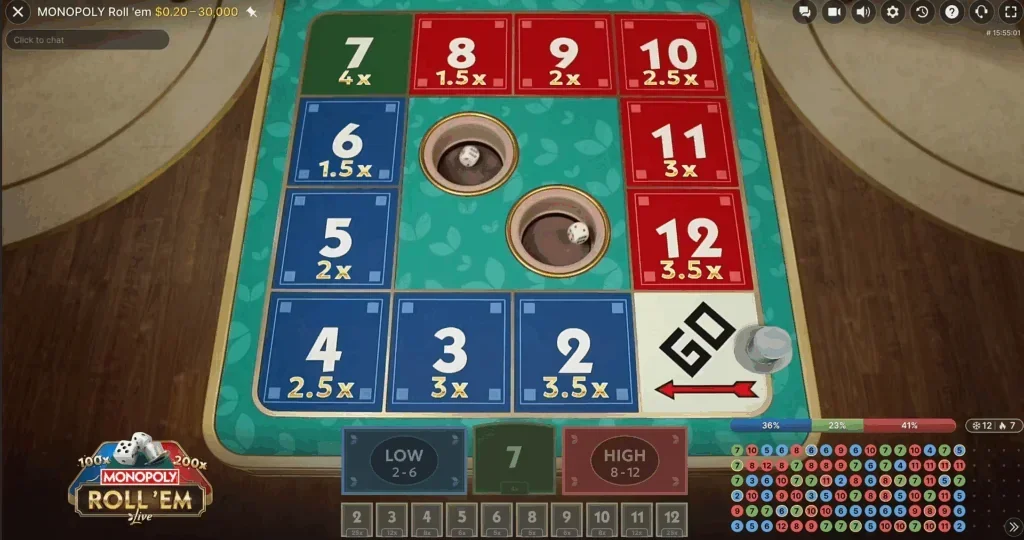
Four bet types exist and Evolution’s own launch material lists them in this order: Low covering totals two to six, Seven on its own, High covering eight to twelve, and specific-number bets on any individual total. Seven sits in its own position rather than inside either range, which is why Low and High each cover five totals rather than five and six.
Combining Selections
The studio is explicit that selections can be combined, so nothing stops you covering Low and a single high number in the same round, or spreading chips across several individual totals. That flexibility is the main lever a player has, and it is worth thinking of it as a dial between coverage and payout size rather than as a set of alternative strategies.
Combining does have a cost that is easy to overlook. Covering Low and High together leaves only Seven uncovered, which sounds attractive until you notice that the base payouts near the middle of each range are 0.5:1. A round that lands on six or eight will return less than the total staked across both positions. Wide coverage on a graduated paytable is not the same thing as a hedge.
The Building Phase Explained
Evolution describes the mechanic plainly: MONOPOLY houses appear on random squares, adding multipliers and increasing possible payouts, and more houses on a square stack the multipliers. The studio states the ceiling as 300x. There is no published distribution, no guaranteed minimum number of houses and no stated frequency, which is standard for this class of feature.
The important thing to be clear about is what a multiplier does not do. A boosted square is not more likely to be rolled. Two dice do not know where the houses are, and a 200x marker on the number four does not change the fact that four appears three times in thirty-six. The Building Phase changes the size of a potential payout, never its probability. Anyone treating a big multiplier as a signal to chase that number has misunderstood the game.
MONOPOLY Roll ’em Payouts in Full
Every position has a published range rather than a single price. The bottom of each range is the unboosted payout and the top is what the position can reach once the Building Phase has finished stacking houses on it.
| Bet and winning result | Payout range |
|---|---|
| Low, total 2 | 2.5:1 to 9:1 |
| Low, total 3 | 2:1 to 5:1 |
| Low, total 4 | 1.5:1 to 4:1 |
| Low, total 5 | 1:1 to 3:1 |
| Low, total 6 | 0.5:1 to 2:1 |
| Seven | 3:1 to 49:1 |
| High, total 8 | 0.5:1 to 2:1 |
| High, total 9 | 1:1 to 3:1 |
| High, total 10 | 1.5:1 to 4:1 |
| High, total 11 | 2:1 to 5:1 |
| High, total 12 | 2.5:1 to 9:1 |
| Specific 2 or 12 | 24:1 to 299:1 |
| Specific 3 or 11 | 11:1 to 199:1 |
| Specific 4 or 10 | 7:1 to 149:1 |
| Specific 5 or 9 | 5:1 to 99:1 |
| Specific 6 or 8 | 4:1 to 49:1 |
Read the top of the single-number rows and the marketing claim resolves itself neatly. A specific bet on two or twelve tops out at 299:1, which returns 300 units in total for a one-unit stake once the stake itself comes back. That is where the 300x figure comes from, and it is a payout ceiling rather than a separate jackpot.
The Odds Behind the Board
Unlike a wheel game, this one runs on arithmetic that is completely knowable. Two six-sided dice produce thirty-six equally likely combinations, and the totals are distributed in a triangle with seven at the peak.
| Dice total | Combinations | Probability |
|---|---|---|
| 2 | 1 | 2.78% |
| 3 | 2 | 5.56% |
| 4 | 3 | 8.33% |
| 5 | 4 | 11.11% |
| 6 | 5 | 13.89% |
| 7 | 6 | 16.67% |
| 8 | 5 | 13.89% |
| 9 | 4 | 11.11% |
| 10 | 3 | 8.33% |
| 11 | 2 | 5.56% |
| 12 | 1 | 2.78% |
Low and High each cover fifteen of the thirty-six combinations, so both sit at 41.67%. Seven covers six, or 16.67%. The two remaining combinations, the extremes of two and twelve, are the rarest at one chance in thirty-six each, which is exactly why they carry the largest payouts and the largest multiplier ceiling.
Why Seven Is Not a Bargain
Seven being the most likely total is the first thing anyone notices, and it tempts people into treating the Seven position as the smart bet. It is not. The base price of 3:1 is set precisely against the six-in-thirty-six probability, and the resulting base return of two thirds is identical to every other narrow bet on the layout. Being more likely to win does not make a bet better value when the price has already been adjusted for it.
MONOPOLY Roll ’em Compared With MONOPOLY Live
The two games share a licence and almost nothing else. MONOPOLY Live is a wheel game with an augmented-reality bonus round in which a host walks a virtual board collecting rent, and rounds are long. MONOPOLY Roll ’em is a dice game with no bonus round at all, and rounds are short. If you came looking for the game-show experience, this is not it.
Which One Suits Which Player
The comparison cuts both ways. Roll ’em is far easier to follow, the maths is transparent rather than buried in a bonus round, and the round cycle suits players who want to bet often. What it gives up is spectacle and the sense of a feature to chase. Evolution now has four distinct MONOPOLY products in its live catalogue, and this is deliberately the entry-level one.
MONOPOLY Roll ’em Maximum Win Potential
The largest published payout on the table is 299:1, available on a specific-number bet on two or twelve when the Building Phase has stacked that square to its ceiling. Add the returned stake and the total is 300 units for one, which is exactly the 300x figure the studio uses in its marketing.
Which Route Reaches 300x
Only one route gets there and it needs two independent things to happen. The Building Phase has to stack houses on the two or the twelve until that square reaches its maximum, and then the dice have to produce that exact total, which happens once in thirty-six rolls. Neither event is influenced by the other and neither is influenced by you. Every other position on the layout caps lower: Seven tops out at 49:1, three and eleven at 199:1, and the range bets at 9:1.
It is worth setting expectations honestly here. Multipliers of a few times the base price are the normal texture of the game, and the 300x headline describes the far edge of the distribution rather than a result any session should be planned around.
MONOPOLY Roll ’em Strategy
No strategy predicts dice and none predicts where houses will land. What strategy can do here is pick the positions where the published maths is least unfavourable and control how much of your bankroll is exposed to a random multiplier you cannot see when you bet.
- Favour Low and High. Their base return is around 90% against roughly 67% for the narrow bets, which means far less of your outcome depends on the Building Phase.
- Understand that a range bet is graduated. Backing Low pays 2.5:1 on a two and 0.5:1 on a six, so most Low wins are small ones.
- Do not treat the Seven position as a value bet. Its base return matches every other single-outcome bet at about two thirds.
- Ignore where the houses landed last round. Placement is random and carries no information about the next roll.
- If you want the 299:1 ceiling, accept the price: two and twelve arrive once in thirty-six rolls each.
- Keep single-number bets to a small, separate share of the session budget rather than the core of it.
Sizing a Session
Because Evolution publishes no limits, the practical starting point is whatever the table in your own lobby shows. Rounds are short by design, which means the number of decisions per hour is high and a fixed hourly loss expectation arrives faster than it would at a slower table. Sitting out rounds costs nothing and is the simplest way to slow that down.
Set a loss limit and a walk-away figure before the first round, and keep the two kinds of bet mentally separate: the range bets are the session, the single numbers are the lottery ticket. Play for entertainment rather than profit, and if it stops feeling optional, every licensed operator is required to provide deposit limits, reality checks and self-exclusion tools.
Where MONOPOLY Roll ’em Sources Disagree
There is one date discrepancy worth flagging. Evolution’s own newsroom dates the launch to 15 July 2026 and an independent game database records the same day, but the largest slot catalogue lists the release as 15 June 2026, exactly one month earlier, and a separate industry report described the game reaching operator lobbies later in July. The studio date is the one used throughout this review; the others most likely reflect a soft launch and staggered market rollouts.
The other gap is not a disagreement so much as an absence. No source publishes a volatility rating, a hit frequency, a house edge per position or a betting range, because Evolution does not release those figures for live tables. Any review quoting them precisely is estimating, and this one does not.
For context on how this sits against its neighbours, our Monopoly Cash Is King review covers another MONOPOLY-licensed release, Super Speed Dragon Tiger is another Ezugi title, Monopoly Money Magnate is a second MONOPOLY title, and Baccarat A is another Evolution title.