Is Fireball Inferno Rigged? How the RNG Works and Why It Goes Cold
Fireball Inferno is a NetGaming slot on a 5×4 grid with 20 fixed paylines and a max win listed at 1,320x the stake. Players who hit a long losing run often wonder whether the game is rigged or has “gone cold”. Neither idea matches how licensed slots work. This guide explains how the random number generator decides each spin, why cold streaks happen in a high-volatility game, and when it makes sense to stop. For the paytable and features, see our Fireball Inferno slot review.
How the RNG decides every spin
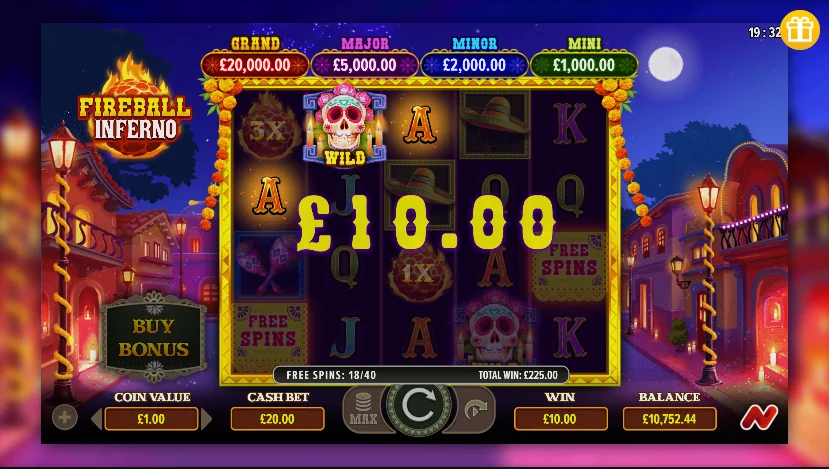
A random number generator (RNG) runs continuously inside the game server and produces numbers thousands of times per second. When you press spin, the current number is mapped to positions on each reel, and that decides the result. The outcome is fixed the moment you press the button; stopping the reels early, changing the speed or switching between auto-spin and manual play does not change it.
Games supplied to licensed casinos have their RNG and maths tested by independent labs before release. The tests check that results are random and that the long-run return matches the published RTP. The game cannot see your balance, your losses or how long you have been playing.
What RTP tells you about Fireball Inferno
RTP is the share of all money staked that a slot pays back over millions of spins. The BetFM game catalogue lists the connected version of Fireball Inferno at 94.28%, which is below the 96% many modern slots offer, so the house edge is a little higher. Check the exact figure in the game info screen at your casino. Over a short session, your own result can be far from the RTP in either direction.
Why the slot seems to go cold
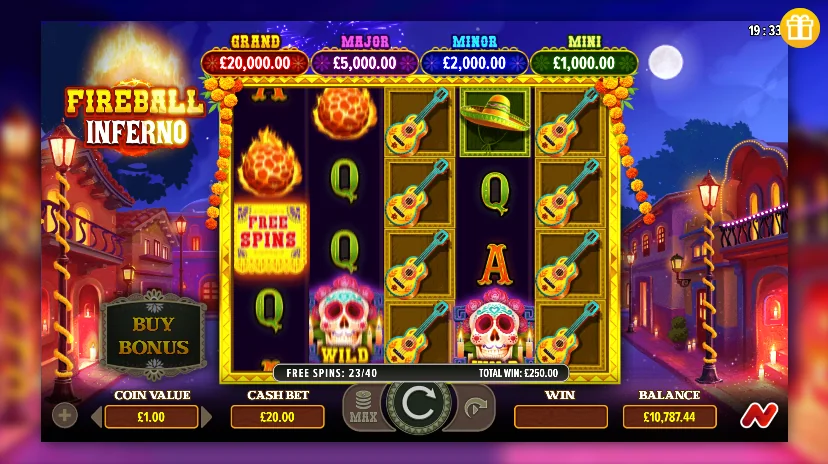
Fireball Inferno has high volatility. A large part of its return comes through the fireball features and rarer big hits, while many base spins pay little or nothing. A run of 50 or 100 spins without a feature is a normal part of that pattern, not a sign that the game has been switched to a losing mode.
- There is no “cold” or “hot” cycle; each spin is independent of the last.
- A feature is never “due” because it has not appeared for a while.
- Results seen by other players do not affect yours.
When to stop playing
Since the game cannot warm up, the right moment to stop depends on your own limits, not on the reels. A simple plan works best when it is set before the first spin.
- Set a session budget, for example ₦5,000, and stop when it is gone.
- Set a win target too; if you double your budget, end the session.
- Use a stake that gives you at least 150 spins, such as ₦25–₦30 on a ₦5,000 budget.
- Take a break after a set time, such as 30 minutes, whatever the balance.
- Never increase your stake to win back losses.
If you feel the urge to keep playing to recover money, that is the clearest signal to stop.
Frequently Asked Questions
The same question comes up for other titles, for example in our guide on whether Extra Crown Classic is rigged. Players ask the same about Grand Mustang; the answer is in our guide on whether Grand Mustang is rigged.
Is Fireball Inferno rigged?
What is the RTP of Fireball Inferno?
Why does Fireball Inferno go cold?
Can I predict when the bonus will hit?
When should I stop playing Fireball Inferno?
Play Responsibly
Gambling is for adults aged 18 and over. Real-money play carries a risk of loss, and no strategy guarantees a win. Only stake money you can afford to lose, set deposit and time limits, and stop if it stops being fun. If you need support, contact a local problem-gambling service.
How we checked this guide: game data comes from the provider, the BetFM review and the BetFM game catalogue. Figures can differ between versions and casinos.